What if your dog’s sudden refusal to obey isn’t a sign of stubbornness, but a direct reflection of a fractured communication system that requires a professional-grade overhaul? Many owners find themselves standing in a public park, shouting a name into the wind while their pet remains blissfully indifferent. It is a common, deeply frustrating experience to realize that my dog won’t listen to me anymore, especially when they previously demonstrated mastery of basic commands. This regression isn’t just an inconvenience. It is a legitimate safety risk and a source of public embarrassment that erodes the partnership you have worked to build.
You are likely exhausted by the selective hearing and the constant anxiety of never knowing if your dog will actually return when called. This article provides the professional framework needed to diagnose the root cause of this behavioral breakdown and outlines the path toward regaining total off-leash freedom. We will explore how a structured methodology, ranging from targeted Behavior Modification to intensive Board and Train programs, can restore reliability. You will discover how to transform your household into a model of elite obedience by applying high-performance standards designed for the modern landscape of 2026.
Key Takeaways
- Identify the critical distinction between a lack of comprehension and active boundary testing during the adolescent developmental phase.
- Implement a marker training system that utilizes clear “Yes” and “No” signals to eliminate ambiguity in your communication.
- Apply the “Distraction Ladder” and proofing protocols to resolve the issue when my dog won’t listen to me anymore in high-stakes environments.
- Establish structural clarity within the home through rigorous “Nothing in Life is Free” protocols and foundational place work.
- Evaluate the necessity of professional intervention, including immersive 4-Week Board and Train programs, for a complete behavioral overhaul.
Understanding Why Your Dog’s Training Has Regressed
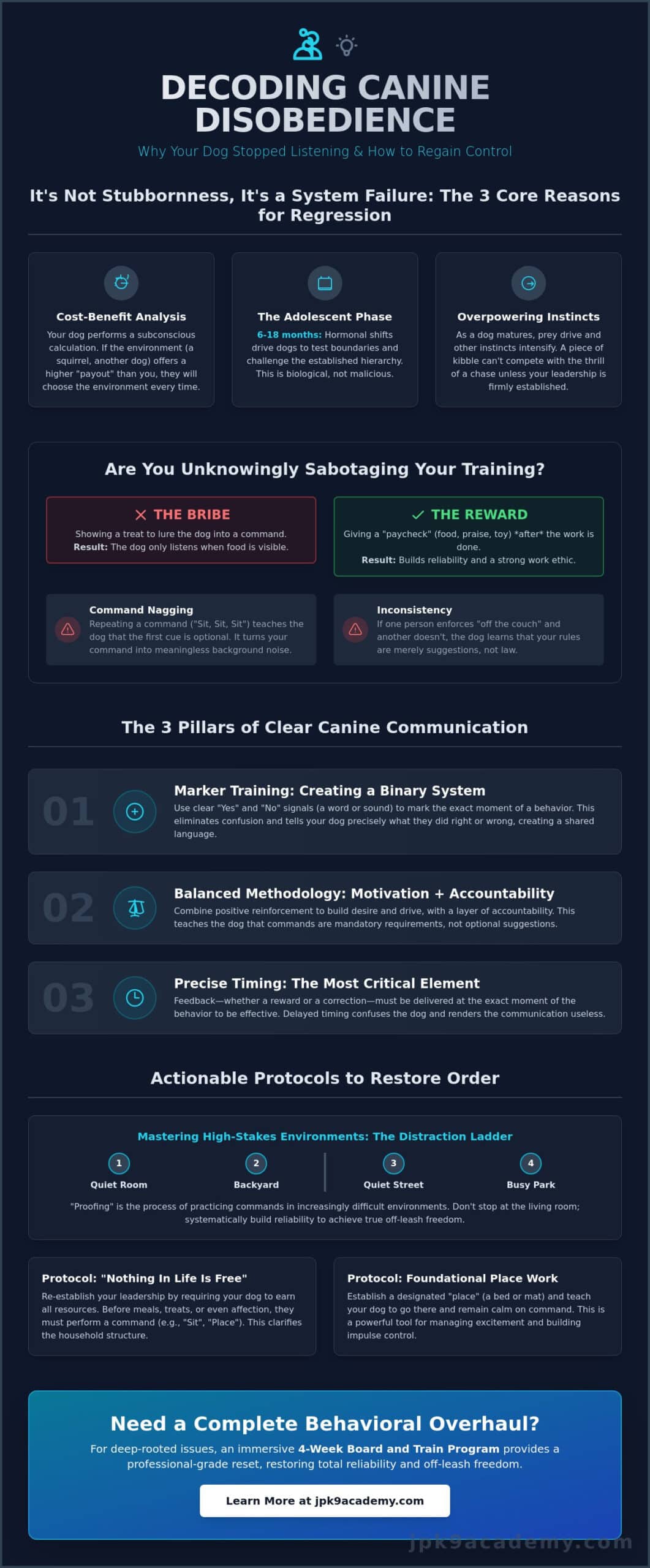
Dog training is not a destination; it’s a continuous state of maintenance. When owners realize that “my dog won’t listen to me anymore,” they often assume the animal has simply forgotten its lessons. In reality, dogs rarely forget commands they’ve truly mastered. Instead, they perform a subconscious cost-benefit analysis. If the environment offers a higher “payout” than the owner, and there’s no accountability for non-compliance, the dog will choose the environment every time. This isn’t a memory lapse. It is a calculated choice based on the current strength of your leadership and the clarity of your boundaries.
The most common period for this breakdown is the adolescent phase, occurring between 6 and 18 months. During this window, social maturity and hormonal shifts drive a dog to test the hierarchy of its pack. They aren’t being “bad”; they are biologically programmed to see if the rules established in puppyhood still apply to their emerging adult selves. Competitors often mislabel this as “fear-based” confusion, but a disciplined coach understands that this is actually a period of intense boundary testing. If you rely on bribes rather than rewards, you’ll fail this test. A bribe is a treat shown before the behavior to lure the dog; a reward is a paycheck given after the work is done. Over-reliance on the former ensures that if you don’t have a treat in your hand, you don’t have a dog that listens.
Biological Drives vs. Human Expectations
As dogs mature, their internal drives, such as prey drive or territorial instincts, become more pronounced. A squirrel or a passing cyclist becomes far more stimulating than a piece of kibble. Applying the principles of canine learning theory allows us to see that behavior is never static; it is either being reinforced or extinguished. When a dog ignores a “Come” command to chase a bird, the chase itself is the reinforcement.
- Inconsistency: If one family member enforces a “Down” but another allows jumping, the dog learns that your rules are optional suggestions.
- Misunderstood Communication: Yelling at a dog is often perceived as high-pitched barking. To the dog, you aren’t leading; you’re just joining in on the excitement.
Identifying the Breakdown in Your Routine
True reliability requires proofing, which is the process of practicing commands in increasingly difficult environments. Most owners stop training once the dog listens in the quiet of a living room. This creates a false sense of security. When the dog eventually ignores you in public, many owners fall into the “Command Nagging” cycle. This is the act of repeating a command multiple times, which teaches the dog they don’t have to listen to the first five iterations.
Command neutrality occurs when a specific verbal cue is repeated so often without enforcement that it becomes background noise, stripped of its original meaning and authority. If you find yourself saying “Sit, Sit, Sit,” you’ve already lost the battle. You aren’t training; you’re begging. Restoring reliability requires a return to a structured framework where every command is a mandatory requirement, not a polite request.
The Three Pillars of Clear Canine Communication
To resolve the frustration of feeling like my dog won’t listen to me anymore, you must replace guesswork with a binary communication system. Dogs thrive on certainty. When your feedback is vague, your dog becomes the decision-maker. Professional behavioral restoration relies on three non-negotiable pillars: marker training, balanced methodology, and precise timing. These elements combine to create a language that eliminates “selective hearing” and replaces it with reflexive obedience.
Marker training serves as the foundational “Yes” and “No” of your relationship. A marker is a specific sound or word that captures a exact moment in time, telling the dog precisely what they did right or wrong. Without this system, your dog is left to guess which part of their behavior earned a reward or a correction. Balanced training then bridges the gap between motivation and accountability. While many owners start with positive reinforcement-based solutions to build drive and desire, elite performance requires a layer of accountability. You cannot have total off-leash freedom without the dog understanding that commands are mandatory, not optional suggestions based on their current mood.
Timing is the third, and perhaps most critical, pillar. Dogs live in the immediate present. To be effective, your feedback must occur within a 1.5-second window of the behavior. If you wait five seconds to reward a “Sit,” you might actually be rewarding the dog for looking at a bird or standing back up. Consistency across this timeline builds trust. It tells the dog that the rules are the same every time, everywhere, regardless of the level of distraction.
Building a Language Your Dog Understands
Elite communication requires professional-grade equipment. Utilizing sprenger dog collars allows for clear, nuanced physical cues that a standard flat collar cannot provide. In a professional setting, we distinguish between correction and punishment. A correction is a piece of information intended to guide the dog back to the correct behavior; punishment is an emotional reaction that serves no educational purpose. By transitioning from luring with food to demanding reliability through tactile feedback, you move from a “bribe” system to a “partnership” system.
The Power of Structural Clarity
Structure is the highest form of care you can provide. For a dog that has regressed, a lack of rules creates a vacuum of leadership that they feel compelled to fill. Establishing a “working” mindset means your dog understands that when the leash is on or a command is given, they have a job to do. This mental shift is what separates a pet that occasionally listens from one that is truly reliable. Securing expert dog training in Sacramento ensures you aren’t just teaching tricks, but building a lifestyle of total autonomy. If you find your current routine is failing, our Private Lessons can help you recalibrate your communication for immediate results.
Overcoming Selective Hearing in High-Distraction Environments
The moment you step outside, your dog’s environment changes from a controlled vacuum to a sensory overload. If you find yourself frustrated because “my dog won’t listen to me anymore” specifically when you’re at a park or on a busy street, you’re dealing with a proofing deficit. Proofing is the rigorous process of ensuring a command is mandatory regardless of external stimuli. It is the transition from a dog “knowing” a command to “owning” it under high-stakes pressure. Selective hearing is not a personality trait; it is a symptom of a training plan that hasn’t accounted for the real world.
To achieve total reliability, we utilize the Distraction Ladder. This is a progressive framework where we gradually increase the difficulty of the environment without allowing the dog to fail. We start in a quiet hallway, move to a backyard, then a driveway, and finally a high-traffic area. If the dog fails at a certain level, we don’t nag or repeat ourselves. We move back one step on the ladder, reinforce the standard, and try again. This systematic approach eliminates the ambiguity that leads to selective obedience. You are building a history of success that the dog cannot ignore.
Engagement drills are the key to becoming the most relevant thing in your dog’s world. You must actively compete with squirrels, bikes, and other dogs. By using a “Long Line” technique, you provide your dog with the illusion of freedom while maintaining a physical safety net. This allows you to enforce commands at a distance, ensuring that “Come” means “Come” every single time. It provides the necessary accountability while keeping the dog safe during the learning phase.
Training for the Real World
A dog that listens in the kitchen is merely a dog that knows how to perform for treats in a low-stakes environment. True reliability requires Generalization. This means practicing in locations like Elk Grove park, where the presence of other dogs, cyclists, and diverse scents tests the dog’s commitment to the handler. If a behavior isn’t generalized across multiple different locations, it isn’t truly learned. We push the dog to perform in the same places where they usually ignore you, reclaiming those environments through disciplined structure.
Managing Reactivity and Over-Arousal
High-arousal environments often trigger “tuning out,” where the dog’s brain becomes flooded with adrenaline. This is frequently seen in dogs requiring dog aggression training, where triggers like other dogs cause a total breakdown in communication. We teach the dog to look to the handler for guidance rather than reacting to the trigger. Utilizing the “Place” command serves as a vital mental reset. It forces the dog to regulate their own emotions and remain calm while the world moves around them. This level of emotional control is the final step toward total off-leash freedom and a harmonious public life.
How to Re-Establish Structural Clarity at Home
Reliability is not a switch you flip only when you step outside. It is a baseline expectation that begins the moment your dog wakes up. If you’ve reached the point where my dog won’t listen to me anymore, the breakdown likely started with subtle boundary erosions in your own living room. We must implement a “Nothing in Life is Free” (NILIF) protocol. This framework requires the dog to perform a command, even a simple “Sit” or “Look,” before receiving any resource, including food, toys, or access to the backyard. This isn’t about being restrictive. It is about establishing you as the source of all good things through a structured exchange.
Sometimes, the relationship needs a total reboot. A “Reset” week involves stripping back all unearned privileges. This means no free-roaming, no couch access, and no constant, unearned attention. It sounds firm to the uninitiated, but for a rebellious dog, it provides the psychological safety of knowing exactly where they stand. By removing the burden of choice, you allow the dog to relax into a subordinate role where they can focus on your guidance rather than their own impulses.
Household Boundaries and Rules
Access to high-value resources like furniture and toys must be controlled by the handler. If your dog believes they own the sofa, they will eventually believe they own the decision to ignore your recall. During a behavioral overhaul, affection must be earned. Projecting calm, unwavering authority means you decide when the interaction starts and ends. You are the leader, not a vending machine for treats and scratches. This shift in dynamic is essential for long-term success.
The walk is often where the first signs of defiance appear. If your dog pulls on the leash, they are literally and figuratively leading you. This physical dominance translates directly to the “selective hearing” you experience later. Mastering the walk requires the dog to remain in a focused heel, looking to you for direction rather than scanning the horizon for distractions.
Foundation Skills for Adult Dogs
We must re-teach the basics with a 100% success rate goal. This involves a clear distinction between “Stay,” which means do not move until released, and “Wait,” which is a temporary pause. These nuances are the hallmark of professional dog obedience training. Using a leash indoors is a highly effective tool for maintaining focus and preventing the dog from making unwanted choices when you are not directly engaging with them.
If these household adjustments feel overwhelming, our Private Lessons provide the personalized coaching necessary to audit your home environment and restore respect. We help you identify the small leaks in your structure that lead to major floods in behavior.
Professional Behavioral Overhaul: The JPK9 Academy Approach
Sometimes, the structural breakdown in communication is too severe for household adjustments alone. If you’ve applied the basics and still find that my dog won’t listen to me anymore, it’s time to recognize the need for a professional behavioral overhaul. Professional intervention isn’t a sign of failure. It is a commitment to excellence and a recognition that your dog’s potential deserves a higher level of expertise. At JPK9 Academy, we specialize in resolving complex communication failures through a rigorous, results-oriented methodology that treats training as a serious craft rather than a casual pursuit.
We reject the “one-size-fits-all” approach typical of entry-level services. Every dog possesses a unique psychological profile, and our training plans are customized to address their specific triggers, drives, and temperaments. Whether your dog is navigating the adolescent regression mentioned earlier or exhibiting deep-seated defiance, we apply the precise balance of motivation and accountability required to restore respect. This isn’t just about stopping unwanted behaviors. It’s about building a foundation of strength that allows for a completely new lifestyle.
The Power of Our Board and Train Program
Our 4-Week Board and Train program serves as the gold standard for behavioral transformation. It provides 24/7 immersion, which is essential for breaking established habits and building new neurological pathways. This total immersion is the most efficient way to achieve elite K9 training in Sacramento. We don’t just teach your dog commands; we reshape their entire worldview to prioritize your guidance. The transition process is equally critical. We provide comprehensive hand-off lessons that empower you to lead with the same unwavering authority we use, ensuring the training sticks once your dog returns home.
The JPK9 Difference in Elk Grove
As a family-owned institution, we bring a blend of disciplined coaching and deep-seated passion to every case. We possess the expertise to resolve severe behavioral challenges, including aggression and intense anxiety, that other programs often avoid. Our focus remains on balanced, results-driven outcomes that provide the ultimate gift of safety and liberty. If you’re truly committed to the process of reclaiming your partnership, we’re ready to provide the solution. Don’t settle for selective hearing when professional-grade obedience is within reach. Schedule your free evaluation at JPK9 Academy today and take the first step toward a harmonious future.
Reclaiming Authority and Off-Leash Freedom
Restoring total reliability requires you to move beyond the frustration of realizing that my dog won’t listen to me anymore. You now understand that this regression is a symptom of a structural breakdown that can be resolved through clear markers, consistent accountability, and rigorous environmental proofing. By establishing a “working” mindset and implementing firm household boundaries, you replace selective hearing with reflexive obedience. This transformation isn’t just about control. It is about providing your dog with the ultimate gift of safety and autonomy.
Achieving elite performance is a serious craft that requires a proven methodology. Justin and Priscilla have specialized in complex behavior modification since 2018, serving the Sacramento and Elk Grove communities with a focus on lasting results. We possess the expertise to bridge the gap between your current struggle and a harmonious future. Transform your dog’s behavior with JPK9 Academy’s 4-Week Board and Train. Your commitment to this process is the first step toward a lifestyle of foundational strength and total off-leash freedom.
Common Questions Regarding Behavioral Regression
Why does my dog listen to my partner but not to me?
Dogs are masters at reading social hierarchies and identifying the path of least resistance. If your partner is more consistent with markers and boundaries, the dog will naturally prioritize their commands over yours. To resolve this, you must adopt the same rigorous standards and ensure you aren’t the person who allows rules to be optional suggestions.
Can an older dog be retrained if they have stopped listening?
Age is rarely the primary factor when my dog won’t listen to me anymore. Older dogs are highly capable of learning new systems of communication and accountability if the framework is clear. Retraining focuses on identifying where the previous structure failed and introducing a more disciplined methodology that respects the dog’s maturity while demanding compliance.
How long does it take to fix selective hearing in a dog?
While initial shifts in focus occur quickly, permanent behavioral transformation typically requires three to four weeks of consistent, high-level immersion. This timeframe allows us to break old neurological patterns and replace them with reflexive obedience. For most owners, a 4-Week Board and Train offers the most reliable path to achieving total off-leash freedom.
Is it too late to start a Board and Train program for a 2-year-old dog?
Two years of age is an ideal time for professional intervention because the dog has reached social maturity. They possess the focus required for advanced obedience and the physical stamina for rigorous proofing. Starting a program now prevents adolescent bad habits from becoming lifelong behavioral deficits that are harder to resolve later.
Why does my dog only listen when I have a treat in my hand?
Your dog has learned to respond to a bribe rather than a command. When a treat is shown before the behavior, the dog is performing a transaction rather than obeying an authority figure. We transition dogs away from this dependency by using treats as a reward for work already completed, backed by a balanced system of accountability.
What should I do if my dog ignores me when they see another dog?
This reaction indicates a significant deficit in engagement and proofing. When the environment becomes more stimulating than the handler, the dog’s training has failed the real-world test. You must use a “Distraction Ladder” to gradually increase difficulty while employing professional tools to maintain mental control during high-arousal moments.
Can professional training help with a dog that has become aggressive?
Yes, Behavior Modification is specifically designed to address aggression and severe reactivity. These complex issues require a practitioner who understands the underlying triggers and can implement a safe, structured plan for rehabilitation. Professional intervention is the only responsible path for managing safety risks while restoring a harmonious household environment.
How much does a 4-week Board and Train cost in Sacramento?
JPK9 Academy does not utilize a standard rate for our programs because every dog’s needs and behavioral challenges are unique. Costs are determined through a comprehensive evaluation that assesses the dog’s current state and your ultimate performance goals. You should check with the academy directly to schedule a consultation for a customized training plan.