
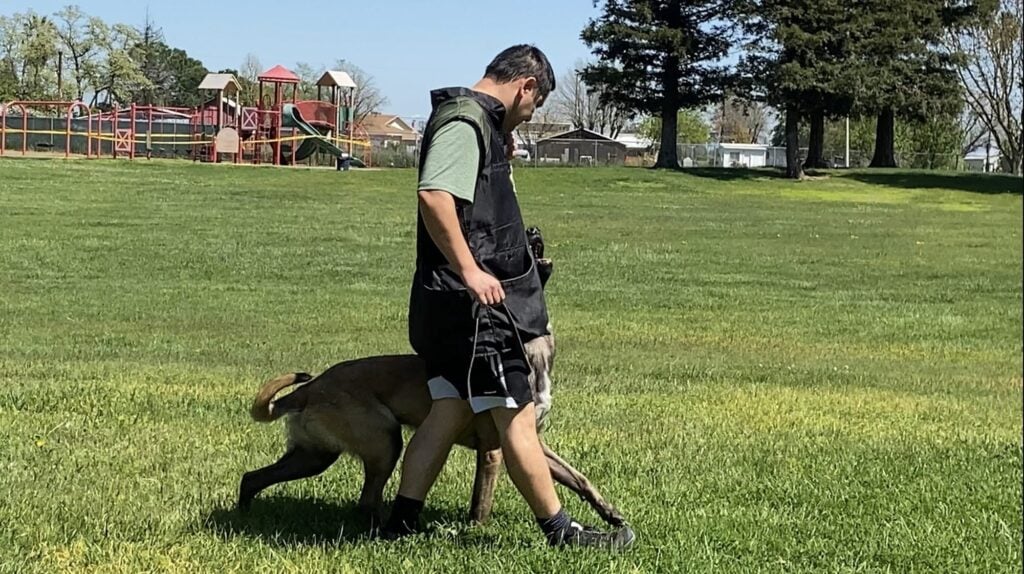
Heel means your dog walks right beside you, usually on your left, with its shoulder level with your leg, and stays there through every stop, turn and change of pace. Here’s how to teach a dog to heel, in short: reward the dog for standing in that spot, then for staying there while you take a step, then for holding it on a real walk, and only add the word “heel” once the dog is already doing it.
That’s the whole method. The hard part is patience and doing things in the right order. This guide walks through each step, what to do when a dog pulls ahead or drifts behind, and when it makes sense to bring in a trainer. It comes from JPK9 Academy in Elk Grove, CA, where trainer Juan Portillo has spent 15+ years training dogs and has worked with more than 500 of them.
What Does Heel Mean for a Dog?
In dog training, “heel” is a position plus an agreement. The position: the dog’s shoulder lines up with your leg, close enough that you could rest a hand on its head without reaching. The agreement: the dog holds that spot until you release it, whether you speed up, slow down, turn or stop.
Most trainers teach heel on the left side, and the AKC notes that the left side is traditional for obedience and rally competitions. For a pet dog, either side works. What matters is picking one side and sticking to it, because switching sides confuses a dog that’s still learning.
Heel isn’t meant for every minute of every walk. It’s the “stay right here with me” cue for the moments that need it: crossing a street, passing another dog, walking through a crowd or past a jogger. The rest of the walk can be a looser, sniffier loose-leash walk.
Heel vs Loose-Leash Walking
The two get mixed up all the time, but they’re different skills:
| Heel | Loose-leash walking | |
|---|---|---|
| Where the dog is | At your side, shoulder by your leg | Anywhere within the leash’s length, as long as it stays slack |
| Focus | On you | Free to look around and sniff |
| Turns and pace changes | The dog matches them | The dog adjusts loosely |
| When to use it | Streets, crowds, passing dogs, tight spaces | The relaxed parts of a walk |
| How long it’s held | Short stretches, then a release | Most of the walk |
If the main problem is a dog that pulls on every walk, start with loose-leash walking. JPK9’s leash training guide covers that. Heel is the next level up.
What You Need Before You Start
- A 4- to 6-foot leash and the flat collar or harness your dog already wears.
- Small, soft treats your dog actually works for, cut small enough to eat in a second.
- A marker word like “yes” (or a clicker) that tells the dog the exact moment it got it right. If your dog doesn’t know a marker yet, spend a day saying “yes” and handing over a treat right after, until the dog perks up at the word.
- A release word such as “okay” or “free” that tells the dog heel is over.
- A quiet room or yard. A dog can’t learn a brand-new position in the middle of a busy park.
Keep sessions short: five to ten minutes, once or twice a day, and stop while the dog still wants more.
How to Teach a Dog to Heel in 8 Steps
1. Pick your side and show the dog the spot
Stand still with the dog on your chosen side. Hold a treat at your hip on that side, let the dog step into position, say “yes” the moment its shoulder lines up with your leg, and give the treat right there at your leg. Where you deliver the treat matters: the dog learns that good things happen in that exact spot.
2. Reward the dog for finding the spot on its own
Move a few feet away and let the dog come back to you. Every time it lands in the right spot, mark and reward at your side. Many dogs start choosing that spot quickly, simply because it pays.
3. Take one step
With the dog in position, take a single step forward. If the dog moves with you and stays at your leg, mark and reward. Then try two steps, then three. If the dog shoots ahead, stop, reset, and go back to fewer steps.
4. Add stops
Walk a few steps and stop. Mark and reward when the dog stops with you, still at your side. Many trainers also ask for a sit at each stop, which gives the dog a clear job whenever you pause.
5. Add the word “heel”
Only once the dog is reliably walking at your side do you start saying “heel” right before you step off. Saying it earlier just teaches the dog that “heel” means “walk however I like.” Some people use “close” or “with me” instead. The word matters less than using the same one every time.
6. Add turns and changes of pace
Turn right, turn left, turn around, speed up for a few steps, slow down. Reward the dog for sticking with you through each change. Turns toward the dog’s side are harder because the dog has to slow down and tuck in, so take those slowly at first.
7. Fade the treats
Start rewarding every second or third good stretch instead of every one, then at random. Keep the praise coming. If the heel falls apart, you faded too fast. Go back a step.
8. Practice in harder places
Move from the house to the yard, then the driveway, a quiet street and finally a park. Each new place is a new lesson for the dog, so lower your expectations and reward generously again at first. Short, successful sessions in a busy place beat long, frustrating ones.
How Long Does It Take to Teach a Dog to Heel?
It depends on the dog’s age, energy and history, and on how often you practice. For many dogs, the position itself starts to click within the first week or two of short daily sessions. A heel that holds up next to other dogs, joggers, kids on bikes and squirrels takes longer, often a few months of steady practice.
Dogs that have spent years pulling on the leash usually take longer than puppies, because they’re unlearning an old habit while learning a new one. High-energy breeds can learn the position fast but need more work to stay calm in it.
Common Heel Problems and How to Fix Them
The dog pulls ahead
Stop the moment the dog’s shoulder passes your leg. Wait, call the dog back to your side, reward it there, and start again. A quick turn in the opposite direction also works: the dog learns that racing ahead just means going somewhere else. Delivering treats slightly behind your leg helps stop the dog from creeping forward.
The dog lags behind
Lagging usually means the dog is unsure, tired or distracted. Use a happier voice, shorter stretches and better treats, and walk a little faster. A dog that suddenly starts lagging when it didn’t before may be sore, so a vet check is worth it.
The dog goes wide or cuts in front of you
Practice along a wall or fence so there’s less room to drift. Reward close to your leg, never out in front of you.
The dog sniffs or loses focus
Go back to an easier place, keep sessions shorter, and use a release (“okay, go sniff”) as the reward for a good stretch of heel. Sniffing becomes something the dog earns.
The dog is too excited at the start of the walk
Don’t start heel the second the door opens. Wait for a calm sit at the door, start with a short stretch of heel, then release the dog into the rest of the walk.
Mistakes Owners Make
- Saying “heel” before the dog knows the position. The word should name something the dog already does.
- Holding the leash tight. A tight leash teaches the dog to lean into it. The leash should hang in a loose J between you.
- Rewarding out in front of you. It pulls the dog forward, out of position.
- Long sessions. Ten focused minutes beat thirty minutes of nagging.
- Expecting heel for the whole walk. Use short stretches, then release the dog.
- Moving to busy places too soon. Build the skill where the dog can win first.
- Changing the side, the word or the release. Consistency is what makes heel stick.
Teaching Heel to a Puppy vs an Adult Dog
Puppies can start learning the heel position early, as a game: a few steps, a treat, lots of praise, then play. Their attention span is short, so a few one-minute sessions spread through the day work better than one long one. JPK9’s puppy training builds these foundations from the start.
Adult dogs, especially ones with a long pulling habit, usually need more structure: more repetitions in quiet places, very clear rewards, and patience while the old habit fades. They can absolutely learn it. It just takes them longer to trust that walking at your side is worth more than pulling ahead.
Training Tools: Treats, Leash and E-Collars
Most dogs learn heel with treats, a marker word and a regular leash. Rewards are what teach the dog where to be. JPK9’s guide to the four quadrants of dog training explains how rewards and consequences shape a dog’s behavior.
Some dogs need more than food to hold heel around big distractions. In JPK9’s programs, Juan Portillo uses both rewards and Dogtra e-collars. An e-collar is a communication tool that takes skill to use fairly, so it’s something to learn with a trainer, not from a blog post.
Avoid yanking the leash. Sharp jerks without a clear plan can make some dogs more anxious or more reactive, not more focused.
When to Get Help From a Trainer
Teaching heel at home works for a lot of dogs. It’s time to bring in a trainer if:
- The dog pulls hard enough to hurt you or knock you off balance.
- Heel falls apart every time another dog, person or bike shows up.
- The dog lunges, barks or growls on the leash. That’s reactivity, and it needs its own plan; JPK9’s behavior modification program is built for it.
- You’ve practiced for weeks and progress has stalled.
JPK9 Academy in Elk Grove works with dog owners across Sacramento, Elk Grove, Roseville, Folsom and nearby cities:
- Private lessons: one-on-one coaching for you and your dog, from $1,300 for four lessons ($1,700 for six, $3,000 for eight).
- Group obedience classes: practice heel around other dogs and people.
- Board and train: the dog lives and trains with Juan for three to five weeks, with three to four training sessions a day, starting at $3,200.
Every program starts with a free phone consultation. For a full breakdown, see how much dog training costs.
Frequently Asked Questions
Which side should a dog heel on?
Traditionally the left, and that’s what formal obedience uses. For a pet dog either side is fine. Just use the same side every time.
What does heel mean for a dog?
It means walking at your side with the dog’s shoulder by your leg, matching your pace, turns and stops until you release it.
Can you teach an older dog to heel?
Yes. Older dogs with a pulling habit usually take longer, but they learn heel the same way: small steps, clear rewards and short sessions.
Should my dog heel for the whole walk?
No. Use heel for the parts of a walk that need control, then release the dog to a looser walk with time to sniff.
What’s the difference between heel and loose-leash walking?
Heel is a precise position at your side with the dog’s focus on you. Loose-leash walking only asks the dog not to pull.
Can I use a different word than “heel”?
Yes. “Close” or “with me” work just as well. Pick one word and always use the same one.