A dog trainer for excessive barking finds out why your dog barks, removes what keeps the habit going, and teaches a calmer response the dog can do instead. In Sacramento and Elk Grove, Juan Portillo of JPK9 Academy works with barking dogs through private lessons starting at $1,300 or a board and train program starting at $4,200. Every case starts with a free phone call.
Barking is normal. Dogs bark to warn, to ask for something, and to let off steam. It becomes a problem when it does not stop, when it happens at every sound, or when a neighbor starts keeping track. This guide explains what counts as excessive barking, why it happens, what a trainer actually does about it, what it costs in the Sacramento area, and what the local barking rules say.
What Counts as Excessive Barking?
Barking is excessive when it is frequent, hard to interrupt, and out of proportion to what set it off. A dog that barks twice at the mail carrier and settles is normal. A dog that barks for minutes at every passing car, or for most of the time it is alone, has a barking problem.
Common signs that barking has become a habit rather than communication:
- The dog cannot be called away from barking, even with treats.
- Small triggers set it off: a leaf, a door closing down the street, the TV.
- The barking keeps getting longer or louder over the months.
- Neighbors mention it, or it happens mostly when no one is home.
Elk Grove even puts a number on it. Its municipal code treats barking as a nuisance when it lasts ten minutes or more within a thirty-minute period and disturbs another person. More on the local rules further down.
Why Does My Dog Bark So Much?
Most excessive barking comes from one of six causes: alerting, demanding, boredom, reactivity, fear, or being left alone. The cause decides the fix. That is why the first thing a good trainer does is identify the type of barking, not reach for a quick trick.
Type of barking | What it looks like | Where to start |
|---|---|---|
Alert / territorial | Barking at the window, the fence, the doorbell or people passing | Block the view, teach a “go to bed” response to the door |
Demand | Barking at you for food, play, attention or to go out | Stop rewarding the bark, reward calm instead |
Boredom / frustration | Barking in the yard or crate with no clear trigger | More exercise, structure and mental work |
Reactive | Barking and lunging at dogs or people on walks | Distance from triggers and focused training. See reactive dog training in Sacramento |
Fear | Barking while backing away, tail low, at new people or noises | Slow, confidence-building work. Never force the dog closer |
Separation-related | Barking, howling or pacing soon after you leave | Gradual alone-time training. See separation anxiety training |
High-energy breeds bark more when they do not get enough to do. If that sounds like your dog, the guide to training high-energy dogs covers how to channel that energy.
Rule Out Pain or Medical Causes First
If the barking started suddenly, comes with other changes, or shows up in an older dog, see your veterinarian before starting training. Pain, hearing or vision loss, and age-related confusion can all cause new barking that training alone will not fix.
Book a vet visit first if you notice any of these:
- Barking that began suddenly in a dog that used to be quiet
- Barking at night together with pacing, restlessness or confusion
- Barking when touched or picked up
- Changes in eating, sleeping or bathroom habits at the same time
Once the vet has ruled out a medical cause, training can start on the behavior itself.
How Juan Portillo Trains a Dog That Barks Too Much
Juan treats excessive barking as a behavior problem with a cause, not as noise to silence. He works in four steps: evaluate the dog, find what triggers and maintains the barking, build a plan for that dog, and practice it in real life until it holds up at home. JPK9 Academy is built on one rule: look at the dog before saying anything about it.
1. Evaluate
It starts with a free phone call, then an in-person behavior evaluation ($175). Juan goes over the barking history, the specific triggers, the home and yard, and what the family wants to change. No program is suggested before he has seen the dog.
2. Identify the pattern
Juan works out three things: what sets the barking off, what keeps it going, and what the dog is feeling underneath. Most problem barking is not stubbornness. It is an emotional response, such as alarm, frustration or excitement, that has turned into a habit.
3. Build a plan for that dog
No two dogs get the same plan. A dog that barks at the front window needs a different plan from a dog that barks and lunges at other dogs on walks. The plan usually includes management at home, so the dog stops rehearsing the habit, and a clear replacement behavior, such as going to a “place” bed when the doorbell rings.
4. Practice in real life, with owner coaching
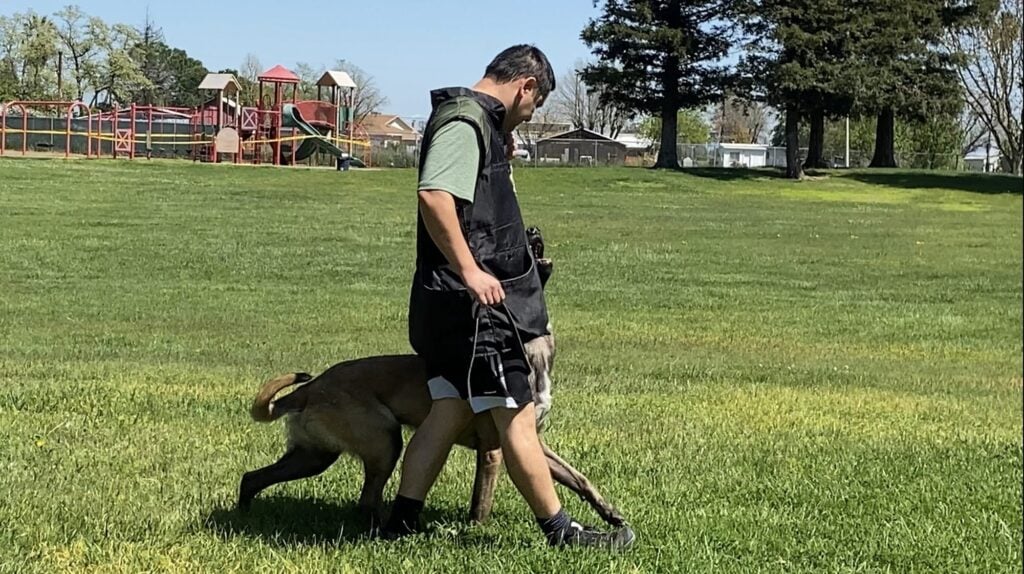
Training starts in a controlled setting, then moves to the situations that matter in the dog’s daily life in Sacramento and Elk Grove: the front door, the backyard fence, the neighborhood walk. The owner learns the same cues and timing, with written homework between sessions, so the results hold once the trainer is gone.
Does Juan Use a Remote Training Collar for Barking?
For some dogs, yes. Juan uses a Dogtra remote training collar as one part of the plan, never as the first step and never as an automatic bark collar. The dog learns the behavior first, and the collar is added later as a low-level signal that helps the dog break focus on a trigger and respond to what it already knows.
How it is used at JPK9 Academy:
- Foundation first. Engagement and the replacement behavior are taught before the collar is introduced. By the time it is used, the dog already understands the command.
- The lowest level that works. The working level is found by starting at zero and raising it until the dog shows a small sign it noticed, such as an ear flick or head tilt. The goal is a level the dog acknowledges without stress or fear.
- A tap to break focus. When a dog locks onto a trigger, a precise low-level tap helps interrupt that focus so the dog can do the trained alternative.
- Vibration as an option. For dogs that have mastered their foundations, the collar’s vibration mode can serve as a non-stim signal.
- Owner guidance. If the collar is part of the plan, Juan teaches the owner how to use it correctly. It is not something to start on your own.
A remote collar is different from an automatic bark collar. An automatic collar reacts to every bark on its own, including normal ones, without teaching the dog anything. A remote collar is controlled by a trained handler, with timing that matches a cue the dog already knows. If the collar does not fit the dog, it is simply not used.
Private Lessons or Board and Train for Barking?
JPK9 Academy offers both, and the choice depends on the dog, its history and what the owner needs. Private lessons suit owners who want to be hands-on and learn the handling themselves. Board and train suits dogs that benefit from immersive, structured daily training, or families without time for daily practice. Juan recommends one after the evaluation.
Private lessons | Board and train | |
|---|---|---|
How it works | Free consultation, then hands-on sessions where Juan works with you and your dog together. You practice at home with written homework between sessions, with text or email support from Juan. | The dog stays with Juan in Elk Grove for structured daily training, including controlled exposure to its triggers. You learn the handling in owner sessions before and after pickup. |
Best for | Owners who want to become the dog’s main trainer; barking with a clear trigger | Long-standing or reactive barking, or households without time for daily practice |
Starting price | $1,300 (4 lessons) · $1,700 (6) · $3,000 (8) | From $4,200 for behavior modification board and train |
Typical length | Some owners see real progress in 3 to 4 sessions. More complex cases usually take 8 to 12 sessions. | 3–4 or 4–5 weeks, plus owner sessions and a follow-up |
Learn more | Behavior modification · Boarding and training for Sacramento dogs |
How Much Does a Dog Trainer for Barking Cost in Sacramento?
At JPK9 Academy, barking training starts at $1,300 for four private lessons, and behavior modification board and train starts at $4,200. The $175 behavior evaluation is separate from the program price, and the exact price is confirmed on the free phone call.
For a full comparison of private lessons, group classes and board and train prices in the area, see how much dog training costs in Sacramento.
How Long Does It Take to Stop Excessive Barking?
In private lessons, some owners see real progress within 3 to 4 sessions, while more complex barking usually takes 8 to 12 sessions. Board and train runs 3 to 5 weeks. There is no fixed timeline, because a dog that has barked at the window for three years will take longer than a young dog with a new habit.
Three things decide how fast it goes:
- The cause. Demand barking often improves quickly. Fear and separation-related barking take longer.
- How long the habit has been rehearsed. Every day of practice makes it stronger.
- Consistency at home. Everyone in the house needs to respond the same way.
What You Can Do at Home Right Now
While you arrange training, the fastest wins are to block what the dog sees, stop rewarding barking, and give the dog more to do. These steps do not replace training, but they stop the habit from getting worse.
- Block the view. Use window film or close blinds where the dog watches the street.
- Do not yell. To many dogs, yelling sounds like you are barking too.
- Reward quiet. Calmly reward the dog in the moments it is quiet near a trigger.
- Do not reward demand barking. Wait for a second of quiet before you give food, play or attention.
- Add structure. A daily walk, a short training session and a food puzzle use up energy that would otherwise go into barking.
- Limit long yard time alone. A dog left outside for hours often barks at everything it hears.
Barking Complaints in Sacramento and Elk Grove: What Owners Should Know
Both Sacramento County and Elk Grove can act on chronic barking, and it can end in a citation. Starting training early, before a formal complaint, is the simplest way to avoid that.
Elk Grove
- Barking counts as a nuisance when it lasts 10 minutes or more within a 30-minute period and disturbs someone, day or night.
- After a first complaint, Animal Services mails the owner a letter with tips and gives seven days to fix the problem.
- If it continues, neighbors can start a formal case with a petition and bark logs, which can lead to an investigation and a citation.
Sacramento County
- Barking complaints go to Animal Care Services through 311.
- Chronic barking can lead to a citation from an Animal Control Officer
How to Choose a Dog Trainer for Excessive Barking
Choose a trainer who asks why your dog barks before suggesting a fix, explains the method in plain words, gives clear prices, and coaches you, not just the dog. Be careful with anyone who promises a silent dog overnight.
Questions worth asking on the first call:
- What type of barking do you think this is, and why?
- What will my dog learn to do instead of barking?
- Which tools do you use, and how?
- How will you teach me to keep the results going?
- What does it cost, and what is included?
Real reviews from local owners tell you more than any ad. You can read what owners say on the JPK9 client reviews page.
Why Sacramento and Elk Grove Owners Call Juan Portillo
Juan Portillo has trained dogs for more than 15 years, has worked with over 500 dogs, and trains every dog in his programs himself. JPK9 Academy holds a 5.0 rating from more than 80 Google reviews.
JPK9 Academy is based in Elk Grove, just south of Sacramento, and works with families from across the area. Juan runs the academy with his wife, Sarah, and the person you talk to on the first call is the same person who trains your dog. Learn more about dog training in Elk Grove or dog training in Sacramento.
Frequently Asked Questions About Excessive Barking
Can a dog trainer stop excessive barking?
Yes, in most cases a dog trainer can bring excessive barking down to a normal level. A trainer finds out why the dog barks, removes the payoff, and teaches a calmer response, such as going to a bed when the doorbell rings. The goal is a dog that barks less and stops when asked, not a dog that never barks.
How long does it take to train a dog to stop barking?
It depends on the cause, how long the habit has been going on, and how consistent the household is. In private lessons with Juan, some owners see real progress within 3 to 4 sessions, and more complex cases usually take 8 to 12 sessions. Board and train runs 3 to 5 weeks, followed by owner lessons.
Does Juan use a bark collar to stop barking?
No automatic bark collars. For some dogs, Juan uses a Dogtra remote training collar at the lowest level the dog responds to, and only after the dog already knows the behavior being asked for. It is one part of a plan that starts with finding the cause of the barking.
How much does a dog trainer for barking cost in Sacramento?
At JPK9 Academy, private lessons start at $1,300 for four lessons, and behavior modification board and train starts at $4,200. The in-person behavior evaluation is $175 and is separate from the program price. Every program starts with a free phone call with Juan Portillo.
Should I ignore my dog’s barking?
Ignoring helps only with demand barking, when the dog barks to get food, play or attention. It does not work for alert, fearful or reactive barking, because the payoff in those cases is not your attention. A trainer can tell you which type you are dealing with.
Why does my dog bark at everything?
A dog that barks at everything is usually over-alert. It has learned that barking makes passing people, dogs and noises go away, so the habit keeps growing. Blocking the view, giving the dog a calm job such as going to a bed, and more daily structure usually help.
Is barking when I leave a sign of separation anxiety?
It can be. If the barking starts within minutes of you leaving and comes with pacing, howling, drooling or destruction, it may be separation-related. If the dog only barks at noises outside, it is more likely alert barking. A short phone video of the dog alone helps a trainer tell the difference.
What counts as nuisance barking in Elk Grove?
Elk Grove’s municipal code treats barking as a nuisance when it lasts ten minutes or more within a thirty-minute period, day or night, and disturbs another person. Barking caused by someone trespassing on the property or teasing the dog does not count.
What should I do if a neighbor complains about my dog barking?
Start by talking to the neighbor and asking when the barking happens. Keep your own log of barking times, block the dog’s view of the street, and limit long periods outside alone. Then start training. In Elk Grove, the first step after a complaint is usually a letter giving the owner seven days to fix the problem.
Do I need board and train, or are private lessons enough for barking?
JPK9 Academy offers both. Private lessons suit owners who want to be hands-on and can practice daily. Board and train suits dogs that need immersive, structured daily training, or families short on time. Juan recommends one after the in-person evaluation.
Talk to Juan About Your Dog's Barking
Every barking case is different, and the first step costs nothing. Call Juan Portillo at (916) 571-0157 for a free phone consultation, tell him when and where your dog barks, and he will tell you honestly whether private lessons, board and train, or a vet visit makes the most sense.