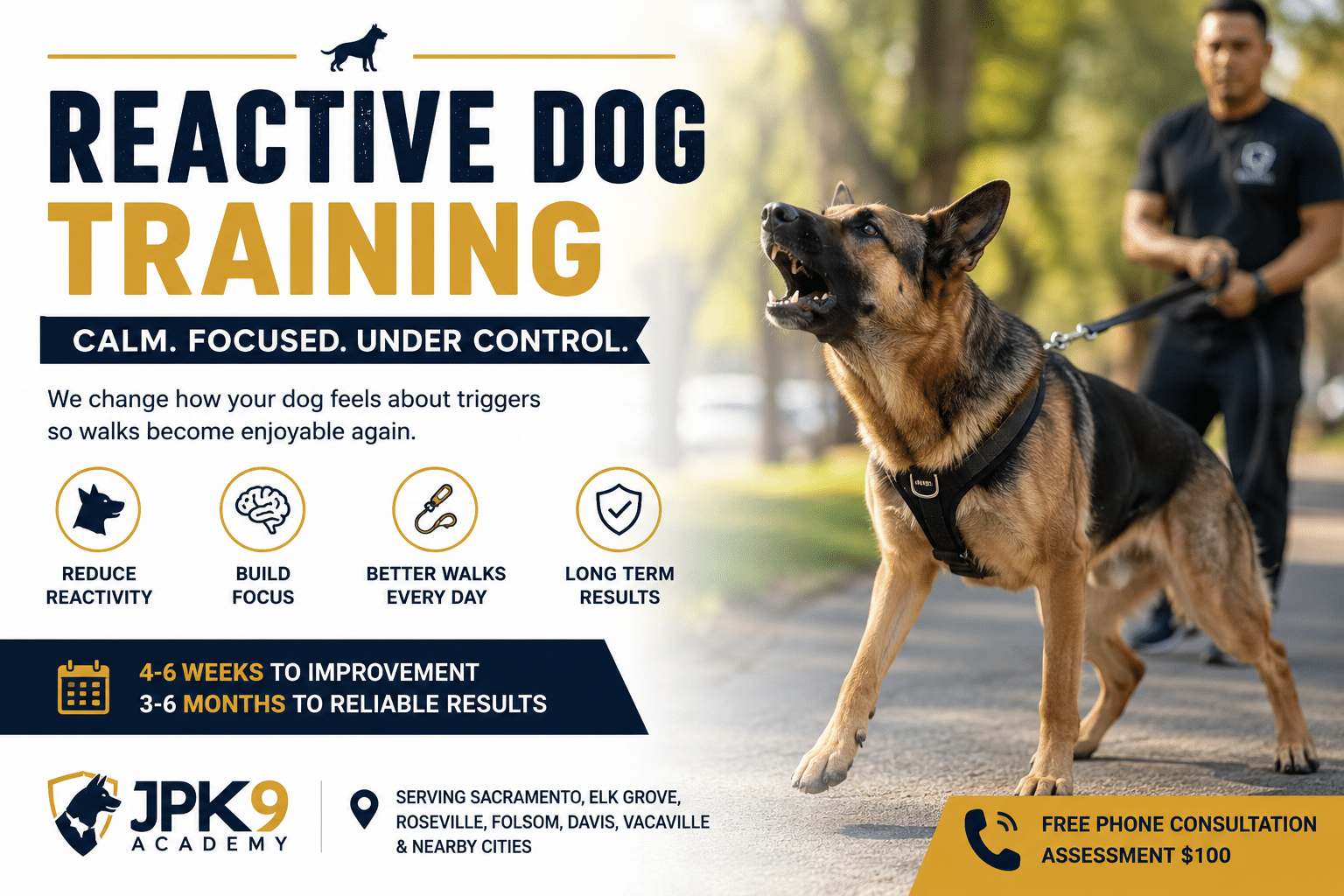
Quick Answer: Reactive dog training changes a dog’s emotional response to triggers through threshold based exposure and counterconditioning, and the large majority of reactive dogs improve to the point where lunging and barking stop under normal conditions. Training runs 4 to 6 weeks to measurable improvement and 3 to 6 months to solid public reliability. At JPK9 Academy in Elk Grove, reactive dog training costs $3,500 for the 8 lesson aggression training package or $6,000 for the 6 to 8 week residential program, serving Sacramento, Elk Grove, Roseville, Folsom, Davis, Vacaville and nearby cities.
Walks have turned into route planning. Which streets have the fewest dogs, which hours the fewest joggers, which direction to spin when a trigger appears anyway. Every reactive dog owner in Sacramento knows the routine, and most have already tried a class, a video method or an obedience course that treated the barking instead of the reason for it. Reactivity is not a manners problem, which is exactly why manners training keeps failing it. Here is what actually works, what it costs, how long it takes, and where the process goes wrong.
What Is Reactive Dog Training?
Reactive dog training is a behavior modification process that changes the dog’s emotional response to triggers, rather than suppressing the barking and lunging those emotions produce. Reactivity is an overreaction to normal things: dogs, strangers, bikes, skateboards, delivery trucks. The dog is not dominant and usually not aggressive; the dog is over threshold, flooded past the point where thinking is possible. Reactivity differs from aggression in intent: a reactive dog wants the trigger to go away or wants to reach it out of frustration, while an aggressive dog intends to make contact. The two overlap at the edges, which is why serious cases get assessed rather than guessed at.
Can Reactivity Be Trained Out of a Dog?
Reactivity responds to training in the large majority of cases, with most dogs improving to the point where triggers no longer produce explosions under normal conditions. The precise framing matters: training does not delete the underlying sensitivity, it changes what the dog feels and does when the trigger appears, and maintains that change through practice. A realistic success picture after committed training: walks on normal streets at normal hours, passing dogs across the street without eruption, and recovery within seconds on the occasional hard day. Owners chasing a dog that never notices anything are chasing a different dog; owners wanting their neighborhood back get exactly that.
What Are the Signs of a Reactive Dog?
A reactive dog shows 6 signs: barking and lunging at specific triggers, freezing and hard staring before the explosion, inability to take treats near triggers, pulling toward or away from dogs at distance, over the top greetings, and fast escalation with slow recovery. The earliest and most useful sign is the freeze: the moment of stillness and fixation before the eruption. Owners who learn to spot the freeze gain the 2 seconds that make redirection possible, and every protocol below is built on acting inside that window.
What Breeds Are Prone to Reactivity?
Herding and guardian breeds dominate reactivity cases: German Shepherds, Belgian Malinois, Cattle Dogs, Border Collies, Australian Shepherds and terrier mixes, because motion sensitivity and vigilance were bred into those lines on purpose. Breed sets the tendency, never the destiny: early socialization decides whether the tendency activates, which is why the same genetics produce both service dogs and street reactive rescues. Sacramento dog homes lean heavily into exactly these breeds, and high drive working breeds fill a matching share of the JPK9 Academy caseload.
How to Train a Reactive Dog: The 5 Step Protocol
To train a reactive dog, work through 5 steps built on threshold distance and counterconditioning. The 5 steps are outlined below.
-
- Find the threshold: Identify the exact distance where the dog notices the trigger and can still eat. All learning happens at or beyond this line, and a dog refusing food is a dog too close to learn.
-
- Countercondition at threshold: Trigger appears, high value food flows, trigger leaves, food stops. Hundreds of clean repetitions rewire the emotional equation from threat to predictor of good things.
-
- Teach an incompatible behavior: Install a pattern like look at the trigger then look at the handler, or a U turn cue. The dog needs something to do instead, not just something to stop.
-
- Shrink the distance in stages: Close the gap only while the body stays loose and the food keeps working. One calm session at 30 feet outranks a screaming session at 10 feet, every time.
-
- Proof across environments: Quiet streets, then busier ones, then the hard places. A dog calm on one route owns one route; generalization is trained, never assumed.
The protocol reads simple and fails in execution for one reason: timing. Reading thresholds, marking the right half second and managing distance in a moving environment is a skill, and the fastest progress happens when a professional installs the system and the owner maintains it.
Dog Leash Reactivity Training: Why the Leash Makes Everything Worse
Leash reactivity training addresses the most common reactivity pattern of all: dogs that explode on leash and stay calm off leash, because the leash removes the ability to create distance. A loose dog meeting a trigger can retreat, arc away or approach on a curve. A leashed dog loses all three options, and the trapped feeling converts into barking and lunging, while a tight leash telegraphs the handler tension straight down the line. Dog training for leash reactivity adds 3 leash specific layers to the standard protocol: keeping the leash loose at threshold distance so the dog never feels trapped, passing triggers on wide arcs instead of head on lines, and installing a cheerful U turn cue that turns retreat into a trained skill instead of a panic. Dog reactivity training on leash also proofs the handler: hands quiet, breathing normal, pace steady, because the dog reads the human end of the leash all walk long.
What Are the Biggest Mistakes in Reactive Dog Training?
The biggest mistakes in reactive dog training are 6 errors that make reactivity worse while feeling like training. Each mistake is listed below with the correction.
-
- Punishing the reaction: Corrections for barking teach the dog that triggers predict punishment, deepening the negative association. The bark is the smoke; training targets the fire.
-
- Flooding: Forcing the dog to face triggers up close to get used to it rehearses panic. Habituation only happens under threshold, never over it.
-
- Dog park exposure: Sending a dog reactive dog to the dog park for socialization is pouring gasoline on the fire. Controlled distance work first, contact last.
-
- Retreating from the world: Walking at 5 AM forever manages the problem and trains nothing. Management buys time; only exposure at the right distance changes the dog.
-
- Inconsistent handlers: One family member doing threshold work while another lets the dog lunge at the fence splits the dog between two rulebooks.
-
- Starting in a group class: A reactive dog in a room of dogs sits over threshold for the entire hour, rehearsing the exact behavior everyone came to fix. Group settings belong at the end of the journey, never the start.
How Long Does It Take to Train a Reactive Dog?
Training a reactive dog takes 4 to 6 weeks for measurable improvement and 3 to 6 months for solid public reliability, with severe cases running longer. The table below shows the typical timeline by case level.
| Case Level | Typical Timeline | Realistic Outcome |
| Mild (staring, occasional barking) | 4 to 8 weeks | Passes triggers calmly on normal walks with maintenance |
| Moderate (regular lunging, barking) | 2 to 4 months | Reliable neighborhood walks, recovery within seconds on hard days |
| Severe (bite history, redirection, years of rehearsal) | 4 to 8 months, residential aggression program recommended | Managed public reliability with structured routines and ongoing maintenance |
The variable that moves the timeline most is rehearsal history: a dog practicing reactivity for 3 years has 3 years of repetitions to outweigh. Starting this month is the only way the number ever shrinks.
What Is the 3-3-3 Rule and What Does It Have to Do With Reactivity?
The 3-3-3 rule maps a rescue dog’s adjustment: 3 days of decompression, 3 weeks of learning the routine, 3 months of full settling. The rule matters in reactive dog training because many adopted dogs get labeled reactive inside the adjustment window, when the behavior is transition stress rather than established reactivity. A rescue barking at everything in week 2 deserves patience and structure first; the same behavior unchanged at month 4 deserves a training plan. Sacramento area adopters from the SPCA, Front Street and Bradshaw shelters see this pattern constantly.
When to Hire a Dog Trainer for Reactivity
Hiring a dog trainer for reactivity makes sense at 4 clear signals: the dog lunges within 30 feet of triggers, home practice has stalled for a month, the dog has snapped or made contact, or walks have shrunk to trigger free hours. A dog trainer for reactive dogs does 3 things an owner working alone cannot: reads threshold distances in real time, controls setups with steady decoy dogs at exact distances, and catches the half second timing that decides whether a repetition helps or hurts. The vetting question that sorts trainers fastest: ask how the trainer works a dog that refuses food near triggers. Answers about pushing through describe flooding; answers about adding distance describe someone who understands thresholds. At JPK9 Academy, head trainer Juan Portillo handles every reactivity case personally, and reactive and aggressive dogs form the core of the caseload rather than the referral pile.
Reactive Dog Training Options and Costs in Sacramento
Reactive dog training in Sacramento at JPK9 Academy runs through the aggression training tier in two formats: a lesson based track at $3,500 and a residential program at $6,000. The table below compares the options for a reactive dog.
| Format | Price | Structure | Best For |
| Aggression training lessons | $3,500 | 8 private sessions covering obedience foundation, leash work, place command and owner coaching, with unlimited group class access | Mild to moderate reactivity with an owner able to practice daily |
| Aggression training board and train | $6,000 | 6 to 8 weeks at the Elk Grove facility, plus 3 transitional private lessons, 1 home follow up visit, unlimited group class and weekly progress videos | Moderate to severe reactivity, bite history, busy households, stalled progress |
| In person assessment | $100 | Trigger mapping and threshold read with Juan Portillo, applied toward program selection | Every reactive dog, before any program |
| Phone consultation | Free | Case discussion and honest direction | The starting point for every owner |
The lesson track is the behavior modification program in private session form, and the residential track runs it as an immersive board and train program . The included unlimited group class access serves the final proofing stage described below. One honest scheduling note: reactive dog cases fill a large share of the JPK9 caseload, and severe cases book the residential program 2 to 4 weeks ahead.
Do Group Classes Work for Reactive Dogs?
Group classes work for reactive dogs at the end of training, never at the beginning. Reactive dog training classes are the most marketed local format, and the format has a structural problem as a starting point: a reactive dog surrounded by dogs sits over threshold for the entire session, rehearsing the behavior instead of replacing it. The sequence that works runs individual threshold work first, controlled one on one dog exposures second, and structured group settings last, as the graduation exam. The JPK9 Academy group obedience classes, capped at 8 dogs with every dog on leash, serve exactly that final proofing role, and both aggression tier programs include unlimited group class access for graduates.
Can a Reactive Dog Be Boarded or Sent to Board and Train?
Reactive dogs board successfully at facilities built around individual housing with no forced dog contact, and the reactive dog board and train format goes one step further: the dog boards and trains in the same stay. Standard kennels with group play fail reactive dogs the same way group classes do. JPK9 Academy runs both options from the Elk Grove facility: dog boarding in Sacramento with individual quiet housing covers reactive dogs needing safe overnight care, and the residential aggression program turns a boarding need into a training outcome. Every option starts with the $100 assessment.
Reactive Dog Training Near Sacramento, Elk Grove and the Region
Reactive dog cases across the Sacramento region share the same geography: the American River Parkway and the area’s bike trail network put bikes, joggers and dogs in constant close passes, which is where most local leash reactivity gets rehearsed daily. JPK9 Academy works reactive dogs at the Elk Grove facility and in owners’ homes across Sacramento, Elk Grove, Roseville, Rocklin, Folsom, Fair Oaks, El Dorado Hills, Davis, Vacaville, Fairfield and Napa, with proofing runs built around each dog’s real trigger environments, from Midtown sidewalks to Folsom trail crossings. Head trainer Juan Portillo handles every reactive case personally, and reactivity alongside aggression cases makes up the core of the JPK9 caseload: the dogs other programs refer out are the dogs this program was built for.
Reactive Dog Training: Frequently Asked Questions
Can reactivity be trained out of a dog?
Reactivity responds to training in the large majority of cases, with most dogs reaching the point where triggers no longer produce lunging or barking under normal conditions. The honest framing: reactivity gets managed to near invisibility through changed emotional responses, and maintenance keeps it there for life.
How long does it take to train a dog out of reactivity?
Most reactive dogs show measurable improvement in 4 to 6 weeks of consistent threshold work, with solid public reliability arriving between 3 and 6 months. Severe cases with bite histories or years of rehearsal run longer, and residential programs compress the early phase into 4 to 5 weeks.
How much does reactive dog training cost in Sacramento?
Reactive dog training in Sacramento costs $3,500 for the 8 lesson aggression training package at JPK9 Academy, and $6,000 for the 6 to 8 week residential aggression board and train. The phone consultation is free, and the in person assessment costs $100.
What is the 3-3-3 rule for dog training?
The 3-3-3 rule describes rescue dog adjustment: 3 days of decompression, 3 weeks of routine learning, 3 months of full settling. The rule matters for reactivity because many rescue dogs get labeled reactive during the adjustment window, when the behavior is stress, not established reactivity.
What breeds are prone to reactivity?
Herding and guardian breeds top reactivity statistics: German Shepherds, Belgian Malinois, Cattle Dogs, Border Collies and terrier mixes, because vigilance and motion sensitivity were bred in on purpose. Breed sets the tendency, not the destiny: socialization and early training decide whether the tendency activates.
Does PetSmart train reactive dogs?
Big box store classes including PetSmart focus on basic obedience in open retail environments and generally decline or refer out genuinely reactive dogs, since a reactive dog in a busy store sits far over threshold. Reactivity needs controlled environments and individual protocols that retail group classes cannot provide.
Can a reactive dog go to group training classes?
Group classes come last in reactive dog training, never first: a reactive dog dropped into a room of dogs sits over threshold and rehearses the exact behavior training exists to stop. Individual work builds the foundation, and structured group settings then proof the neutrality at the end.
Can reactive dog training be done at home?
Home based reactive dog training works for mild cases through daily threshold walks and counterconditioning, and works best with professional guidance setting the protocol. In home private lessons put the trainer where problems happen, while severe reactivity with lunging or bite history needs the residential format first.
What equipment helps with leash reactivity?
A 6 foot fixed leash with a front clip harness or flat collar gives predictable control, and retractable leashes fail reactive dogs by making distance random. Equipment follows the assessment: tools that add pressure to a fearful dog deepen the problem, which is why the trigger profile comes first.
Is there free or affordable reactive dog training near Sacramento?
Free reactive dog training does not realistically exist beyond online videos, which cannot read a specific dog’s thresholds. Affordable paths that work: the free JPK9 phone consultation for a direction check, the $100 assessment for a real plan, and shelter behavior helplines for adopted dogs.
Can a reactive dog be boarded?
Reactive dogs board successfully at facilities built for individual housing rather than group play, and the reactive dog board and train format goes further: the dog boards and trains simultaneously. JPK9 Academy accepts reactive dogs for both, with a required $100 assessment before any stay.