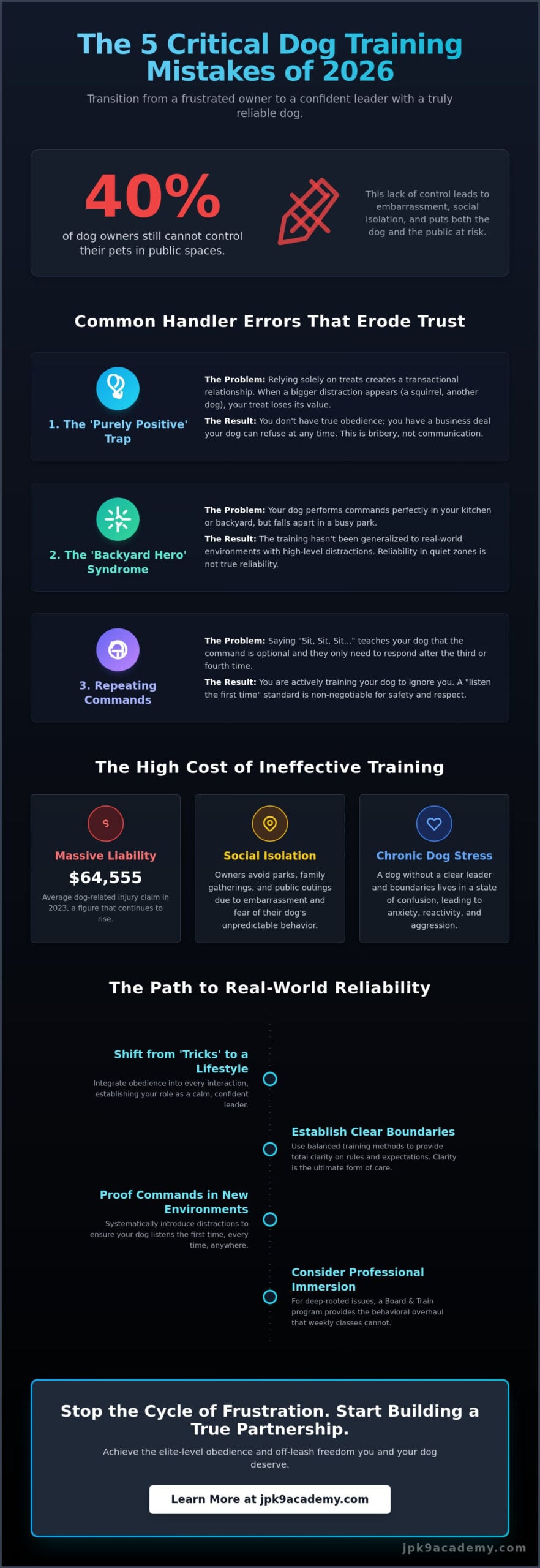
What if the treats in your pocket are the very thing preventing your dog from actually listening to you? It’s a hard truth to accept, but nearly 40% of dog owners in 2026 report they still cannot control their pets in public spaces. You likely feel the weight of this reality every time your dog lunges on a leash or ignores a command. Identifying the specific dog training mistakes to avoid 2026 is the first step toward reclaiming your household and your sanity. You’re likely exhausted by the noise of conflicting advice from “purely positive” ideologies and “old school” tactics that leave you feeling more confused than when you started.
I recognize the frustration of being unable to enjoy a simple walk without embarrassment. This guide provides the professional framework needed to correct the critical errors preventing your dog from achieving true off-leash freedom and elite-level obedience. You’ll learn how to transition from bribery to a clear communication system that grants your dog the ultimate gift of safety and liberty. We’ll examine the shift toward rigorous standards and the exact methodology required to ensure your dog listens the first time, every time, whether you’re at home or in a busy Sacramento park.
Key Takeaways
- Identify the “Backyard Hero” syndrome and learn how to proof commands so your dog performs reliably in public spaces, not just in your kitchen.
- Stop the cycle of repeating commands; learn why “Sit, Sit, Sit” actually trains your dog to ignore you and how to establish a “listen the first time” standard.
- Correct the critical dog training mistakes to avoid 2026 by replacing treat-based bribery with a clear, respect-driven communication framework.
- Discover why immersive conditioning in a professional Board and Train program provides the behavioral overhaul that once-a-week classes cannot achieve.
- Learn to avoid “poisoning the cue” and other common handler errors that create confusion and break down the partnership between you and your dog.
The Evolution of Frustration: Why Traditional Training Fails in 2026
The world looks significantly different in 2026. Public spaces are more crowded, and environmental distractions have reached an all-time high. Many owners still rely on “hobbyist” training methods that might have worked in a quiet backyard decades ago, but these tactics fail when faced with the complexity of modern life. Understanding The Evolution of Dog Training Methods helps clarify why basic incentives often fall short in high-stakes environments. A dog that knows how to “sit” in your living room isn’t necessarily trained. Real-world reliability means your dog makes the right choice when a squirrel darts across the path or a cyclist zooms past. Failing to bridge this gap is one of the primary dog training mistakes to avoid 2026. When training fails, the emotional toll is heavy. Owners feel like prisoners in their own homes, while dogs live in a state of constant confusion and anxiety because they lack a clear leader.
The High Cost of Ineffective Training
Ineffective training isn’t just an inconvenience; it’s a massive liability. In 2023, the average dog-related injury claim reached $64,555. By 2026, these risks have only intensified as public tolerance for out-of-control pets continues to diminish. Sacramento dog owners often find themselves socially isolated, avoiding local parks because they can’t trust their dog’s reaction to triggers. This lack of structure creates chronic stress for the animal. A dog without clear boundaries is a dog that feels responsible for managing its own safety, which frequently leads to heightened reactivity and aggression. Waiting for a dog to “grow out of it” is a dangerous strategy. This passive approach allows problematic behaviors to become deeply ingrained habits that are much harder to break later.
Shifting from “Tricks” to “Behavior Modification”
Elite performance requires moving beyond 15-minute “trick” sessions. True obedience is a lifestyle that dictates every interaction between you and your dog. It’s about building a foundation where the dog understands its role within the family unit at all times. Utilizing professional dog obedience training in Elk Grove allows you to establish this framework under expert guidance. Elite reliability is the intersection of clear boundaries and high motivation. By addressing the root causes of behavior rather than just masking symptoms with treats, you ensure your dog remains a calm, confident partner in any environment. Avoiding common dog training mistakes to avoid 2026 requires this fundamental shift in perspective from viewing training as a casual hobby to treating it as a serious craft.
The ‘Purely Positive’ Trap: Why Avoiding Boundaries Is a Critical Error
Respect is not a commodity you can purchase with a bag of biscuits. Many owners fall into the “Treat-Only Trap,” believing that constant bribery equals training. This is a critical dog training mistake to avoid 2026. When a high-value distraction like a wandering cat or a loud truck appears, your treat loses its currency. If the dog only listens when they want the reward, you don’t have obedience; you have a business transaction that the dog can opt out of at any time. True reliability requires balanced training that utilizes all four quadrants of operant conditioning to provide total clarity. Setting firm boundaries isn’t cruel. It’s the only way to ensure your dog understands the rules of the world they live in. Clarity is the highest form of care you can provide.
The Myth of the “Untrainable” Aggressive Dog
Aggressive or reactive behavior often stems from a lack of clear consequences. Many people believe certain breeds or temperaments are simply “untrainable,” but this myth usually persists because the handler refuses to implement accountability. This lack of structure fuels the need for dog aggression training in Sacramento, where we see firsthand how dogs struggle without a decisive leader. Managing a reactive dog by simply avoiding triggers is a temporary fix, not a solution. Real rehabilitation requires addressing the underlying behavior through professional intervention. Owners must learn when to seek professional help to move beyond mere management and toward a permanent shift in the dog’s mindset.
Balancing Motivation and Accountability
Effective training balances high-value motivation with strict accountability. We use rewards to build new skills and create positive associations, but we use clear corrections to enforce those standards once the dog understands the command. Tools like the Herm Sprenger prong collar are essential for this process. It is a tool for precision, not punishment, allowing for subtle communication that a standard flat collar cannot provide. This level of detail ensures the dog doesn’t get confused when distractions increase. True safety comes from a dog knowing exactly what is expected of them. If you’re tired of your dog only listening when you have food in your hand, our Behavior Modification programs offer the rigorous structure necessary for a total behavioral overhaul.
Communication Breakdown: Common Handler Mistakes That Confuse Your Dog
Training is a dialogue, yet many owners inadvertently speak a language of confusion. One of the most prevalent dog training mistakes to avoid 2026 is the habit of repeating commands. When you say “Sit, Sit, Sit,” you’re teaching your dog that the first two repetitions are optional noise. This devalues your authority and creates a dog that waits for you to lose your temper before complying. Another subtle error is poisoning the cue. If you use your recall command only to end fun at the park or to lead the dog to a bath, the command becomes a warning of a negative experience. Your dog isn’t being stubborn; they’re making a logical choice based on the poor data you’ve provided.
Inconsistent body language further complicates the partnership. Your dog is a master of non-verbal communication. If your posture suggests hesitation while your voice demands a “Down,” the conflicting signals lead to freezing or non-compliance. Similarly, the “nagging” handler provides constant, low-level corrections without ever showing the dog the path to success. This creates a state of learned helplessness. True training requires you to be a clear, decisive leader who provides a definitive roadmap for every interaction. It’s about being a disciplined mentor rather than a source of white noise.
The Rule of One: Command, Action, Reward/Correction
Establish a “Rule of One” to ensure your communication remains surgical. Issue the command once. If the dog fails to respond, move immediately to a correction to enforce the standard. If they comply, provide a clear marker. This system relies on a “release” word to define the end of a task. Without a release word, the dog decides when the work is over, which erodes duration and focus. Using a marker system like a sharp “Yes” or “No” provides the instant feedback necessary for the dog to connect their behavior to the outcome.
Emotional Leakage: How Your Stress Travels Down the Leash
Your internal state is visible to your dog. During Sacramento walks, handler anxiety often travels straight down the leash, signaling to a reactive dog that there is a reason to be afraid. This emotional leakage is a primary driver of public outbursts. To achieve elite performance, you must adopt a high-performance coach mindset. Maintain a neutral, confident demeanor even when things go wrong. Your dog needs your certainty far more than they need your affection during a crisis. If you find yourself struggling to maintain this discipline, our Private Lessons or immersive Behavior Modification programs can help you refine your handling skills. Mastering your own responses is a prerequisite for mastering your dog’s behavior and is essential to sidestepping the dog training mistakes to avoid 2026.
The ‘Backyard Hero’ Syndrome: Failing to Generalize Training
A dog that responds perfectly in your kitchen but ignores you at Elk Grove Park isn’t actually trained; they’ve simply memorized a routine in a sterile environment. This failure to generalize behavior is among the most common dog training mistakes to avoid 2026. Most DIY trainers skip the “Proofing” phase, which is the rigorous process of testing a command against increasing levels of environmental distraction. If you only train when it’s easy, your dog will only listen when it’s convenient. Real reliability requires you to stop avoiding distractions and start conquering them as part of a structured developmental plan. True mastery isn’t found in the absence of conflict; it’s found in the dog’s ability to maintain focus despite it.
Training in the Real World: Sacramento Specifics
Midtown Sacramento provides the ultimate stress test for any training foundation. Moving from a quiet backyard to the high-distraction environments of local cafes and busy sidewalks introduces “social pressure” that most dogs aren’t prepared to handle. You must safely introduce these variables without overwhelming the animal. This transition requires a professional framework that balances safety with exposure. When you move training into the real world, you’re no longer just practicing commands; you’re proofing the dog’s mindset against the unpredictability of urban life. If you can’t trust your dog’s “Down-Stay” while a delivery truck rattles past, the behavior isn’t yet functional.
The Danger of the “Part-Time” Standard
Consistency is not a part-time commitment. Allowing your dog to pull on the leash during a “casual” Tuesday walk ruins the “always” standard you’re trying to build for Saturday afternoon. This lack of discipline is a primary reason why many owners struggle to see progress. Achieving total reliability requires a 24/7 lifestyle shift, especially during the critical early stages of puppy training in Elk Grove. Generalization is the process of making a behavior bulletproof across all environments, ensuring the rules remain the same whether you are in your living room or a crowded public square. If you’re ready to bridge the gap between backyard tricks and real-world freedom, our Advanced Obedience Group Class provides the high-distraction environment necessary to finalize your dog’s education.
Beyond DIY: Why Professional Board and Train Is the Ultimate Solution
Once-a-week group classes often fail to address deep-seated behavioral issues. They provide a glimpse of training but lack the intensity required for a total overhaul. Immersive conditioning is the superior choice because it offers constant reinforcement. This structure ensures that every choice the dog makes is guided by a professional hand. One of the biggest dog training mistakes to avoid 2026 is underestimating how much the home environment reinforces bad habits. By utilizing the “Reset” button of a professional facility, we break those negative associations and build a new foundation from the ground up. Bad habits don’t stand a chance when the dog is removed from the cues that trigger them.
The most critical phase of a board and train in Sacramento occurs during the hand-off lessons. This is where the owner learns the specific communication framework used during the program. Without this education, the results will inevitably degrade over time. We don’t just train dogs; we empower owners to maintain elite standards and lead with confidence. It’s about ensuring the transition back to your home is seamless and successful. Your commitment to the process is the final piece of the puzzle that ensures lasting reliability.
Why Elite Results Require Expert Hands
Behavior modification requires surgical precision. Professional trainers identify “micro-behaviors,” such as a slight shift in weight or a subtle change in eye focus, that precede major outbursts. Most owners lack the experience to catch these signals before they escalate into a crisis. A professional facility provides a safe, controlled environment where these issues are resolved without the distractions of everyday life. This level of expertise is what separates casual obedience from elite performance. It offers you the peace of mind that comes from knowing your dog is in the hands of a practitioner who has resolved a vast range of challenges.
Freedom through Obedience: The JPK9 Vision
We view training as the ultimate gift of liberty. A dog that is truly reliable can enjoy the world without the restriction of a leash or the anxiety of uncertainty. This freedom is earned through rigorous structure and mutual respect. It requires a serious commitment from the owner to uphold the standards established during our 3-Week or 4-Week Board and Train programs. When you choose a high-level institution, you aren’t just buying a service; you’re investing in a comprehensive lifestyle shift. Transform your relationship and reclaim your freedom with JPK9 Academy. Every dog has potential, but only a proven framework can unlock it.
Reclaim Your Freedom and Lead with Confidence
Elite reliability isn’t a matter of luck; it’s the result of a disciplined framework and clear leadership. By addressing the critical dog training mistakes to avoid 2026, you move from a state of frustration to a partnership built on mutual respect and surgical precision. We’ve explored why bribery fails in high-stakes environments and how immersive conditioning provides the behavioral reset necessary for lasting success. If you’re tired of conflicting advice and stagnant progress, it’s time to embrace a methodology that prioritizes results over incentives.
JPK9 Academy is family-owned and operated by expert trainers Justin and Priscilla. We specialize in the aggressive and difficult cases other trainers often turn away, serving the entire Sacramento and Northern California region with results-driven programs. Whether you need a 4-Week Board and Train or targeted Behavior Modification, we provide the professional guidance required to transform your dog’s mindset. You don’t have to navigate these challenges alone. Apply for an Elite Evaluation at JPK9 Academy Today and take the first step toward a harmonious, stress-free future. Your dog’s potential is waiting to be unlocked.
Frequently Asked Questions
What is the single biggest dog training mistake owners make?
The single biggest mistake is failing to establish a clear communication framework based on respect rather than bribery. Many owners treat training as a series of isolated sessions rather than a 24/7 lifestyle. This lack of structural consistency is one of the primary dog training mistakes to avoid 2026 if you want elite-level reliability. Without a foundation of respect, commands become optional suggestions the dog can ignore at will.
Can you fix a dog that has already learned aggressive habits?
You can absolutely rehabilitate a dog with aggressive habits through a rigorous Behavior Modification program. Aggression is often a symptom of underlying insecurity or a lack of clear leadership. By implementing a professional framework that balances accountability with motivation, we shift the dog’s mindset and restore safety. It’s a serious craft that requires identifying root causes rather than just managing the outward symptoms of reactivity.
Why does my dog listen at home but ignore me at the park?
Your dog ignores you at the park because you haven’t generalized their training to high-distraction environments. This is a common failure in the proofing phase of training. To achieve real-world reliability, you must test every command against environmental variables like social pressure and moving objects. Until a behavior is proofed in public, your dog hasn’t actually mastered the skill; they’ve only memorized a routine.
Is it a mistake to use a prong or e-collar on my dog?
It’s not a mistake to use these tools; the error lies in using them without professional instruction. These are high-precision instruments designed for clear communication, not punishment. When integrated into a balanced training system, they provide the nuance needed for off-leash freedom and total safety. They allow you to give subtle directions that a standard flat collar simply cannot convey in high-stress situations.
How long does it take to correct years of bad behavior?
Correcting years of ingrained bad behavior requires an immersive reset that typically takes three to four weeks of intensive conditioning. While minor adjustments happen quickly, a permanent behavioral overhaul requires the 24/7 structure found in a professional 4-Week Board and Train. This duration allows us to break old patterns and cement new, reliable habits that survive the transition back to your home environment.
What is the most common mistake in puppy socialization?
The most common mistake is prioritizing forced interaction over neutral exposure. Owners often mistakenly believe socialization means their puppy must meet every person and dog they encounter. This often creates over-excitement or fear-based reactivity. True socialization means teaching your puppy to remain calm and focused on you while the world happens around them, which is the core philosophy of our Puppy Preschool.
Is board and train better than private lessons for reactivity?
Board and train is significantly more effective for reactivity because it provides a controlled, immersive environment for 24/7 conditioning. Private lessons are excellent for handler education, but they can’t match the speed and depth of a professional facility. Immersive programs allow us to identify micro-behaviors in real-time and address them before they escalate, which is essential for correcting complex dog training mistakes to avoid 2026.
Why do “purely positive” methods often fail with difficult breeds?
Purely positive methods often fail with high-drive or difficult breeds because they lack a mechanism for accountability. These dogs require clear boundaries and consequences to understand their role within the partnership. Relying solely on treats is a transaction that the dog can opt out of when a distraction becomes more valuable than the bribe. True reliability requires a balanced approach that pairs motivation with firm standards.