
In California, a single moment of canine aggression isn’t just a stressful afternoon; it’s a high-stakes legal and financial liability that requires an elite-level response. With California leading the nation in dog bite insurance claims at an average cost of $86,229 per incident, there’s no room for guesswork. You’re likely feeling a mix of paralyzing guilt and a deep fear that the county will label your dog as “vicious” or “potentially dangerous.” Knowing exactly what to do when your dog bites another dog california is the only way to safeguard your dog’s life and your own assets.
We’ve developed this professional framework to move you from reactive panic to disciplined resolution. You’ll gain a clear understanding of the 2026 regulatory landscape, including the $139.00 quarantine fees in Placer County and the strict reporting protocols in Sacramento and El Dorado. Beyond the legalities, we provide a path toward total behavior modification. This article outlines the essential steps to minimize liability, navigate county investigations, and implement the rigorous structure your dog needs to regain their safety and liberty.
Key Takeaways
- Secure the environment immediately by removing your dog from the visual field of others using professional safety barriers rather than your hands.
- Execute the expert protocol for what to do when your dog bites another dog california to address property damage laws and minimize your legal exposure.
- Comply with mandatory local reporting and quarantine requirements in Northern California to prevent your dog from being designated as potentially dangerous or vicious.
- Diagnose the root cause of the incident through behavioral triage, distinguishing between isolated reactivity and systemic aggression.
- Transition from temporary management to permanent reliability by implementing a structured framework for behavior modification and elite performance.
Immediate Crisis Protocol: Safety and Information Exchange
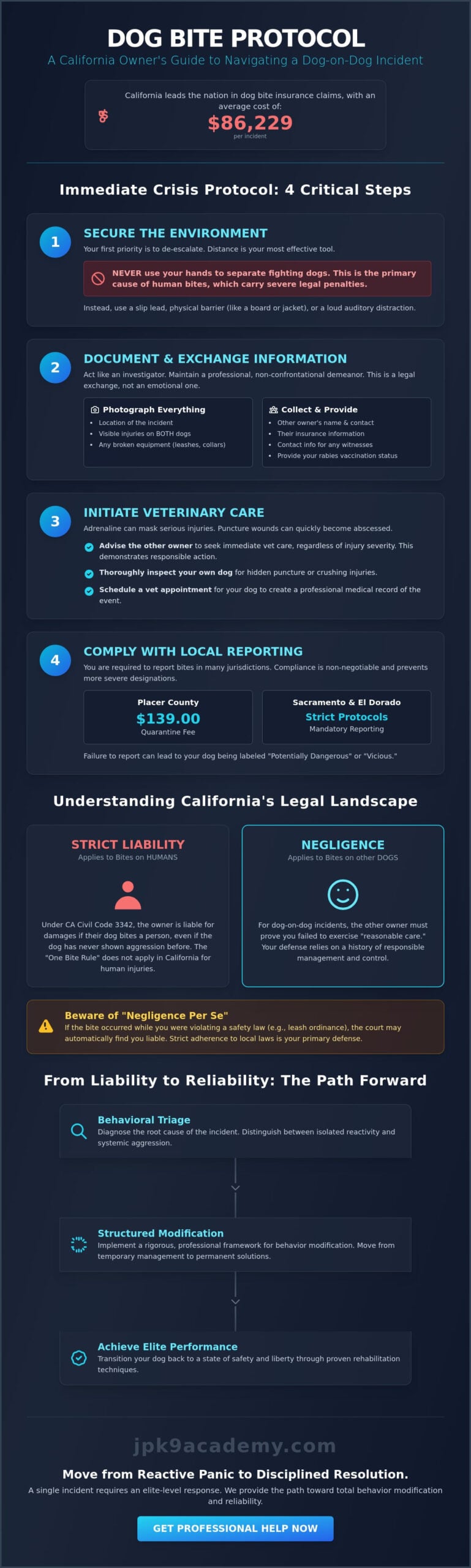
When an altercation occurs, your first responsibility is the immediate cessation of conflict. Secure the environment by physically removing your dog from the visual field of the other animal. Distance is your most effective tool for de-escalation. If the dogs are still engaged, never reach into the fray with your hands. This is how a dog bite to a human occurs, which carries significantly higher legal penalties under California Civil Code 3342. Instead, use a slip lead, a physical barrier, or a loud auditory distraction to break the engagement safely. Knowing exactly what to do when your dog bites another dog california begins with this total environmental control.
Maintain a professional, non-confrontational demeanor throughout the interaction. Even if you believe the other owner’s lack of control contributed to the event, emotional volatility only complicates the legal aftermath. Treat this as a high-stakes professional exchange rather than an emotional crisis. Document the scene immediately. Take clear photos of the location, any broken equipment like leashes or collars, and the exact position of the animals if possible. Capture images of any visible punctures or abrasions on both dogs before owners depart the scene. This evidence is crucial for your defense against future negligence claims.
The Information Exchange Checklist
You must act as the lead investigator of your own incident. Collect the other owner’s full name, contact number, and homeowners or renters insurance information. In California, dogs are classified as personal property, so this exchange mirrors a vehicle accident protocol. Provide your dog’s current rabies vaccination status and license number immediately to demonstrate compliance with local health codes. If there are bystanders, secure their contact details. Their objective statements are vital if the county later investigates your dog’s behavior. Clear communication now prevents expensive misunderstandings later.
Immediate Post-Bite Medical Steps
Adrenaline is a powerful mask for pain and can hide significant trauma. Once you’re in a secure location, perform a “hands-on” inspection of your dog. Look for “hidden” injuries like crushing trauma or small puncture wounds that can quickly become abscessed under the fur. Advise the other owner to seek veterinary care immediately, regardless of how minor the wound appears. This proactive suggestion demonstrates that you aren’t acting with negligence. Finally, schedule an appointment with your own veterinarian if your dog sustained any counter-bites. A professional medical report from the day of the incident serves as an essential record of the event’s severity.
Navigating California’s Legal Landscape for Dog-on-Dog Bites
In the eyes of California law, your dog is classified as personal property, or “chattel.” This distinction is critical because it fundamentally changes the legal standard used to evaluate an incident. While California Civil Code 3342 establishes strict liability for bites to humans, it generally does not apply to dog-on-dog altercations. Instead, these cases are decided based on the principles of negligence. To successfully hold you liable, the other owner must prove you failed to exercise reasonable care in managing your animal. Understanding what to do when your dog bites another dog california requires recognizing that your defense rests on your history of responsible management and adherence to local statutes.
Be aware of the concept of “Negligence Per Se.” If the bite occurred while you were in violation of a safety law, such as a leash ordinance or a containment requirement, the court may automatically find you liable for damages. In Sacramento County, a simple leash law violation carries a $50 fine, but the legal implications of that violation during a bite incident are far more severe. By breaking a law designed to prevent animal conflict, you forfeit many of your legal defenses. This makes strict adherence to local regulations your first line of defense against financial and legal ruin.
Strict Liability vs. Negligence in CA
California is a strict liability state for human injuries, meaning the “One Bite Rule” does not protect you. If your dog bites a person, you are liable even if the dog has never shown aggression. For dog-on-dog bites, the plaintiff must prove you were negligent. This involves demonstrating a lack of reasonable care or control. Your homeowners or renters insurance typically covers these property damage claims, which is why the average cost per claim in California reached $86,229 in 2024. Establishing a foundation of elite performance through behavior modification is the most effective way to eliminate the risk of these expensive legal entanglements before they ever manifest.
Potential Legal Consequences for the Owner
A dog-on-dog bite can trigger both civil and administrative consequences. In civil court, you may face a lawsuit for “Trespass to Chattels,” a legal filing used when personal property is damaged or interfered with. Small claims court is the frequent venue for these disputes, where owners seek reimbursement for extensive veterinary bills and associated costs. Beyond civil lawsuits, local animal control agencies can issue citations that carry significant weight. While a misdemeanor fine in El Dorado County for a “potentially dangerous” dog escaping its enclosure is $500, the administrative record of the bite is permanent. This record creates a “paper trail” that proves you had prior knowledge of your dog’s behavioral struggles, which can lead to more severe designations like “potentially dangerous” in future incidents.
Reporting Requirements in Sacramento and Northern California
In California, reporting an animal altercation is a legal mandate, not a choice. If you are determining what to do when your dog bites another dog california, you must prioritize contacting the correct local agency immediately. In Sacramento County, all incidents of animal aggression must be reported by calling 311. For those within the city limits of Elk Grove, Elk Grove Animal Services manages these investigations. These agencies do not just track bites; they evaluate the safety of the community. Failure to report a bite that breaks the skin can lead to criminal citations and complicates your legal standing if a civil lawsuit follows. Transparency with officials demonstrates that you are a responsible owner committed to a professional resolution.
During an investigation, an animal control officer will likely visit your property to verify containment. They look for secure fencing and evidence of responsible management. They also determine if your dog should be designated as “potentially dangerous” or “vicious.” In El Dorado County, a dog that attacks another domestic animal can be declared “potentially dangerous,” which triggers a first-year investigation and license fee of $700.00. A “vicious” designation is far more severe, often resulting from a dog causing death or serious injury, and can lead to a court-ordered euthanasia. Following AVMA dog bite prevention guidelines is the best way to ensure your management practices meet these high regulatory standards.
When and Where to File a Report
Sacramento County Animal Care investigates all cases of animal aggression to ensure public safety. You must file a report as soon as the environment is secure. Being honest and cooperative during this process is essential. If you attempt to hide an incident, you risk a $100 penalty for licensing violations, which Sacramento County may waive only if you comply within 14 days. Cooperation suggests that the bite was an isolated management failure rather than a pattern of negligence. This distinction is often the difference between a simple warning and a formal dangerous dog hearing.
Understanding the Quarantine Process
California law requires a mandatory 10-day rabies observation period for any dog that has bitten another animal or person. This observation is required regardless of your dog’s vaccination status. In many cases, you may be granted a “home quarantine” if your dog is current on its rabies shots and your property is secure. Effective July 1, 2026, Placer County residents must pay a $139.00 fee for this at-home quarantine. If your dog is unlicensed or behind on vaccinations, the county may require a facility-based quarantine at your expense. Completing this period without incident is a necessary step in the rehabilitation process.
Behavioral Triage: Assessing the Root Cause of the Bite
A bite is never a random event. It is the final, devastating link in a chain of communication failures that likely began months or years ago. When you are determining what to do when your dog bites another dog california, you must look past the incident itself and identify the underlying behavioral pathology. Is this true predatory aggression, or is it a reactive response triggered by fear? Understanding this distinction is the only way to build a foundation for a safer future. You cannot fix what you do not understand. Treating a dog with high prey drive the same as a dog with resource guarding issues is a recipe for a second, more severe incident.
Immediately implement a total management lockdown. This is the highest form of care you can provide right now. Muzzle training is now a non-negotiable requirement for all public outings. High-strength equipment, such as a properly fitted prong collar or a heavy-duty slip lead, must replace standard flat collars or harnesses that offer zero leverage. Your dog has demonstrated they can no longer handle the freedom they once had. Restricting that freedom is the only path toward eventually earning it back through rigorous structure. You must transition from a state of shock to a state of clinical observation to prevent future liability.
The Spectrum of Aggression
Aggression exists on a clinical scale. A warning snap that makes no contact is a clear signal of discomfort, whereas a full-pressure bite with a hold-and-shake indicates a much higher level of intent. You must also account for “Redirected Aggression.” This occurs when a dog, in a state of high arousal, bites the nearest object or person, often the owner attempting to intervene. This is not a personal betrayal; it is a neurological bypass. To understand where your dog falls on this scale, review our guide on Reactivity vs. Aggression. Identifying the specific trigger, whether it is resource guarding or leash reactivity, is the first step toward a total behavioral overhaul.
Immediate Environmental Management
Your dog’s social life is suspended indefinitely. Stop all outings to dog parks, pet stores, or busy hiking trails. These environments are high-arousal zones that your dog is currently unequipped to handle. Perform a rigorous gear audit. If your leash is frayed or your collar is loose, replace them with professional-grade tools immediately. At home, implement a “double-door” or “airlock” system. This means two physical barriers must be between your dog and the outside world at all times to prevent accidental escapes. This level of discipline is the only way to ensure the safety of the community while you seek a permanent solution through behavior modification.
From Liability to Reliability: Professional Rehabilitation
Managing a reactive dog through environmental controls and specialized equipment is a necessary first step, but it is not a permanent solution. True safety requires a transition from temporary management to active behavior modification. When you are faced with the reality of what to do when your dog bites another dog california, the ultimate goal must be the total transformation of your dog’s decision-making process. Relying solely on leashes and muzzles is a defensive posture that leaves you vulnerable to the next management failure. Professional rehabilitation replaces that vulnerability with foundational strength and clinical precision.
Residential Board and Train programs represent the gold standard for high-risk behavior cases. In these immersive environments, we remove the dog from the specific triggers of their home life and place them into a rigorous, structured framework. This allows for thousands of repetitions of correct behavior under the guidance of an expert. Balanced training is essential here. It establishes the clear boundaries and high-performance standards necessary for reliable off-leash control. By providing a consistent language of “yes” and “no,” we transform the owner-dog relationship from one of constant anxiety into a disciplined partnership built on mutual respect and clarity.
The JPK9 Approach to Aggression
Our Dog Aggression Training in Sacramento is designed to address the neurological root of the bite rather than just suppressing the symptoms. We demand high standards of performance because safety is non-negotiable. Many “positive-only” methods fail in high-stakes aggression scenarios because they lack the necessary structure to stop dangerous behaviors in high-arousal states. We provide the clear communication your dog needs to navigate the world with autonomy and liberty. This ensures they choose a neutral response even when challenged by the environment.
Selecting the Right Program for Recovery
Choosing the correct level of intervention is vital for a successful outcome. For dogs with a bite history, a 4-Week Board and Train offers the depth and duration required for a total behavioral overhaul. Private lessons can be effective for minor reactivity, but serious aggression requires the intensity of a residential program. Every journey begins with a professional behavioral evaluation at our Elk Grove facility. We analyze the incident, identify the triggers, and map out a precise path toward reliability. Schedule your professional evaluation at JPK9 Academy to stop the cycle of aggression and secure your dog’s future today.
Securing a Safe and Reliable Future
Navigating the aftermath of a bite requires more than legal compliance; it demands a total commitment to behavioral change. You now understand the mandatory reporting protocols in Northern California and the critical distinction between temporary management and permanent rehabilitation. Knowing exactly what to do when your dog bites another dog california is the first step toward reclaiming your peace of mind. True safety is found in a disciplined partnership where boundaries are clear and performance is consistent. You don’t have to navigate this transition alone.
Since 2018, JPK9 Academy has served Sacramento and Elk Grove as specialists in behavior modification and aggression. Our results-driven balanced training methodology is designed to resolve the most complex behavioral challenges by establishing foundational strength. We don’t just manage problems; we provide the framework for a total behavioral overhaul. Don’t let a single incident define your dog’s legacy or your personal safety. Take Control of Your Dog’s Future: Book a Professional Evaluation Now. Your path to a harmonious and secure future begins with a single, decisive action.
Frequently Asked Questions
Is my dog going to be put down for biting another dog in California?
Your dog is unlikely to be euthanized for a single dog-on-dog altercation unless the attack was exceptionally predatory or resulted in catastrophic injury. California law generally prioritizes containment and rehabilitation for first-time offenders. A “vicious” designation, which can lead to a court-ordered euthanasia, is typically reserved for dogs that have caused serious injury or death to humans or have a repeated, documented history of severe animal attacks.
Am I legally responsible for the vet bills if my dog bit another dog?
You are legally responsible for veterinary expenses if the court determines the bite resulted from your negligence. Since California treats dogs as personal property, you must compensate the other owner for the “damage” caused to their animal. Understanding what to do when your dog bites another dog california involves recognizing that violating a local leash law often establishes automatic liability under the principle of negligence per se.
What does a ‘Potentially Dangerous Dog’ designation mean in Sacramento?
A “potentially dangerous” designation is a formal administrative status triggered by incidents of animal aggression. In Sacramento and surrounding counties, this status requires you to adhere to strict management protocols, such as maintaining a secure enclosure and using a muzzle in public. You may also face significantly higher licensing costs, similar to the $700.00 first-year investigation and license fee required in El Dorado County for dogs with this designation.
Can I be sued if the other dog was off-leash when my dog bit them?
You can still be sued, but the other owner’s violation of leash laws may reduce your ultimate financial liability. California courts apply a “comparative negligence” standard, meaning the judge will weigh the actions of both parties to determine fault. Even if the other dog was off-leash, you must still prove you exercised reasonable care and maintained control over your own animal to avoid a full negligence judgment.
Do I have to report the bite to Animal Control if the injury was minor?
Reporting is mandatory for all bites that break the skin, regardless of the perceived severity of the wound. California health codes require this reporting to monitor potential rabies exposure and maintain community safety records. Failing to report an incident to Sacramento County Animal Care or your local agency can result in administrative fines and creates a negative record of non-compliance that can hurt you in future legal proceedings.
Will my homeowners insurance cover a dog-on-dog bite incident?
Most homeowners and renters insurance policies provide coverage for dog-on-dog bites under the property damage section of your liability coverage. With California dog bite claims averaging $86,229 in 2024, this financial protection is vital for most owners. You should review your policy’s “animal liability” exclusions immediately, as some providers refuse coverage for specific breeds or dogs with a prior history of aggression.
How can I tell if my dog is aggressive or just reactive?
Reactivity is an over-stimulation response often driven by fear or frustration, while aggression is the clinical intent to cause physical harm. Distinguishing between the two requires a sophisticated understanding of behavioral principles and body language. A professional evaluation at our Elk Grove facility is the only way to correctly diagnose the underlying pathology and develop a precise path toward behavior modification.
Can an older dog be trained to stop biting other dogs?
Age is never a barrier to a total behavioral overhaul. While older dogs may have deeply ingrained habits, they remain capable of learning new patterns through a disciplined, high-performance framework. A 3-week or 4-week Board and Train program provides the consistent, rigorous structure necessary to replace dangerous impulses with reliable obedience, ensuring your dog can navigate the world with safety and liberty.