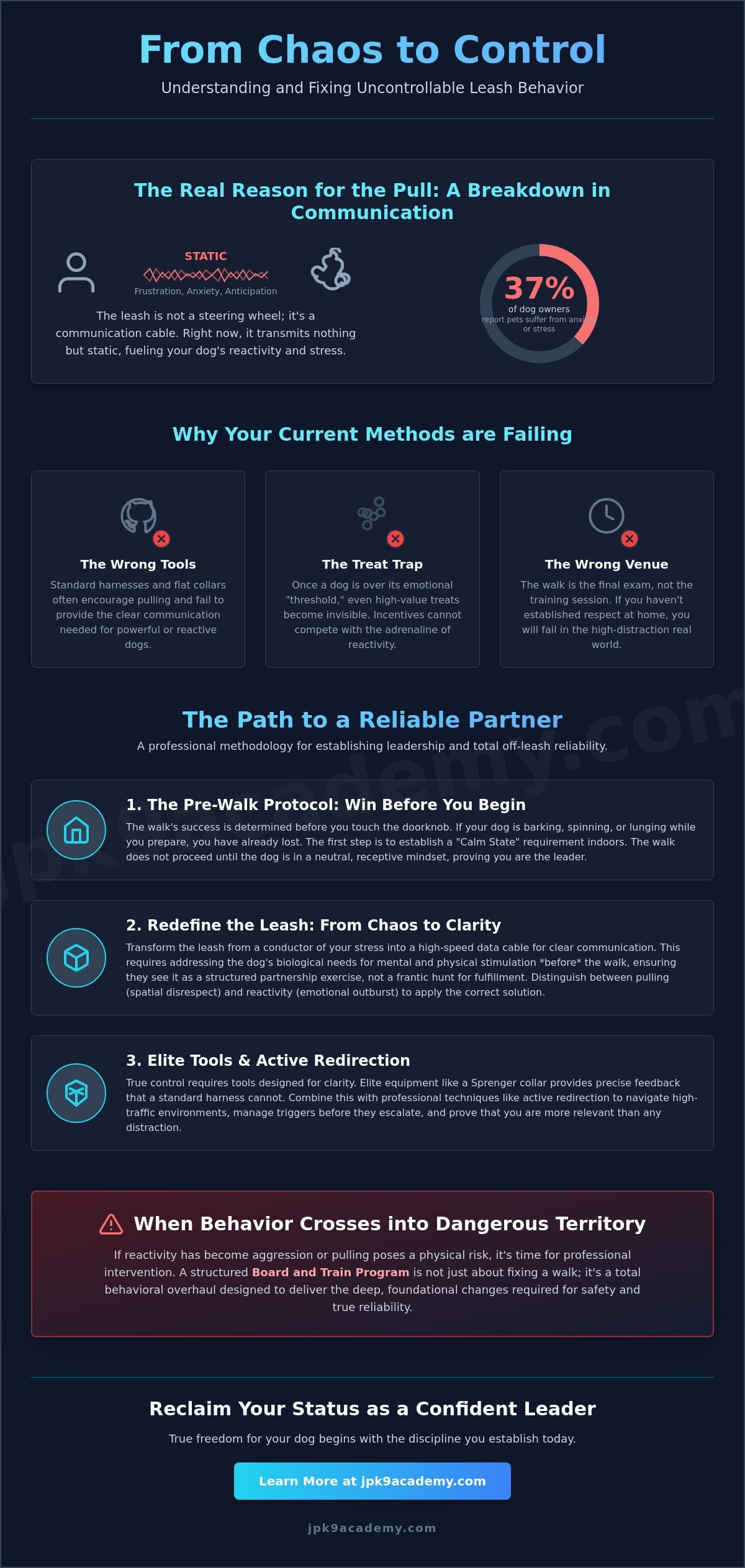
The leash is not a steering wheel; it is a communication cable that currently transmits nothing but static. If you feel like my dog is uncontrollable on walks, you aren’t just battling a physical pull; you are experiencing a breakdown in the fundamental hierarchy of your relationship. The physical strain on your shoulders and the social embarrassment of a neighborhood scene are symptoms of a deeper structural deficit. While 37 percent of dog owners report their pets suffer from anxiety or stress related behaviors, most fail to realize that the solution lies in elite structure rather than simple incentives.
You likely believe that a different harness or more treats will solve the chaos, yet the lunging persists. We promise to transform your stressful outings into a structured, harmonious experience by addressing the root causes of leash reactivity through professional behavior modification insights. This guide previews our methodology for establishing rigorous standards that lead to total off-leash reliability. You will learn how to turn every stroll into a disciplined display of partnership, ensuring you remain compliant with local leash laws while reclaiming your status as a confident leader. True freedom for your dog begins with the discipline you establish today.
Key Takeaways
- The walk begins inside the home. Master the pre-walk protocol to ensure your dog is in a calm, receptive state before you ever step onto the pavement.
- Discover the exact behavioral shifts required to regain mastery when my dog is uncontrollable on walks, moving beyond simple management toward true leadership.
- Navigate high-traffic Sacramento landmarks like William Land Park with precision using active redirection and professional techniques to manage environmental triggers.
- Identify why standard harnesses fail powerful dogs and how elite tools like the Sprenger dog collar provide the clarity necessary for high-level communication.
- Recognize when behavior has crossed into dangerous territory and explore how a structured board and train program delivers a total behavioral overhaul.
Understanding Why Your Dog is Uncontrollable on Walks
The chaos you experience at the end of the leash is rarely a mystery; it’s a direct result of a fractured foundation. When you feel that my dog is uncontrollable on walks, you aren’t just dealing with a stubborn animal. You’re witnessing a breakdown in communication where the dog has assumed the role of decision-maker. Most owners view the walk as a casual activity, yet for a dog, the outdoors is a high-stakes environment filled with competing motivators. Without a clear framework, your dog will naturally prioritize the environment over your presence.
Your leash acts as a high-speed data cable. Every ounce of your frustration, every reflexive grip-tighten, and every moment of anticipation travels directly to your dog. They don’t just see your anxiety; they feel it through the line. This “leash as a conductor” effect creates a feedback loop where your stress fuels their reactivity. Understanding the fundamental principles of dog training is essential to moving past these surface-level struggles and establishing a professional standard of conduct.
Biological fulfillment plays a massive role in leash behavior. A bored dog is a creative dog, and their creativity often manifests as lunging, sniffing, or pulling. If a dog’s needs for mental stimulation and physical outlets aren’t met before the walk, they will seek that fulfillment on the street. They treat the walk as an opportunity to hunt, explore, or defend rather than a structured exercise in partnership. You must address these biological drives if you expect a calm companion at your side.
The most common mistake is treating the walk as the training session. In reality, the walk is the final exam. If you haven’t established engagement and respect within the low-distraction environment of your home, you’ll inevitably fail in the real world. Success requires a shift in mindset: you don’t teach your dog to walk on the street; you prove that they can maintain the standards you’ve already mastered in private.
The Difference Between Pulling and Reactivity
Pulling is typically a lack of spatial awareness and respect for the handler’s pace. The dog simply wants to get somewhere faster and hasn’t been taught that the leash is a boundary. Reactivity is different; it’s an over-aroused emotional response to specific stimuli like other dogs or cars. While the symptoms look similar, the root causes vary. Both issues require a total behavioral overhaul that prioritizes engagement over environmental distractions. You aren’t just stopping a movement; you’re changing a mindset.
Why Treats Fail with Uncontrollable Dogs
Many owners find that high-value treats become invisible once they enter high-distraction environments like Elk Grove regional parks. This happens because the dog has crossed their “threshold,” the point where their emotional state overrides their interest in food. A piece of chicken cannot compete with the adrenaline of a passing squirrel or another barking dog. Relying solely on incentives ignores the need for clear boundaries. A balanced approach provides the clarity your dog needs to make the right choice when the stakes are high, ensuring safety and reliability in every situation.
The Pre-Walk Protocol: Winning the Walk Before You Leave the House
Most owners mistakenly believe the training begins once they cross the property line. In reality, the success of your outing is decided the moment you reach for the leash. If your dog is spinning, barking, or lunging at the door, you have already lost control. You cannot expect a calm walk from a dog that is in a state of hyper-arousal before the collar even touches their neck. When you struggle with the feeling that my dog is uncontrollable on walks, you must audit your pre-departure routine. This protocol establishes that you are the leader and the environment is secondary.
High-performance handling requires a “Calm State” requirement. If the dog cannot sit quietly while you prepare, the walk does not proceed. This isn’t about being harsh; it’s about setting a professional standard. Understanding the psychological reasons behind leash pulling helps you realize that excitement is just another form of stress. By demanding a neutral mindset indoors, you build the foundational strength needed for the challenges outside. You are training the brain, not just the body.
Success is found in the details of your preparation. If you allow a chaotic exit, you’re telling your dog that their adrenaline is the primary driver of the experience. We focus on creating a partnership where the dog looks to you for every cue. If you find this transition impossible to manage alone, our Private Lessons can provide the one-on-one coaching needed to refine your technique and restore order to your home.
Mastering the Front Door Threshold
The front door is the ultimate test of your authority. A threshold is the boundary between excitement and control. To master this, you must require your dog to sit and maintain eye contact while you open the door. If they break the sit, the door closes. You repeat this until they understand that permission to exit is a gift, not a right. This prevents the explosive exit that typically leads to a chaotic, pulling-filled walk. You must be the first one through the door to signal that you are leading the way into the world.
Living Room Engagement Drills
Before facing the distractions of Sacramento streets, practice engagement in your living room. Use name-call and eye-contact exercises to prove your dog can prioritize you over a quiet environment. Try the “follow me” drill: move around your home without a leash, changing directions and pace frequently. Your dog should learn to track your movement naturally. This builds a “working” mindset, turning the walk into a collaborative task rather than a frantic exploration. Establishing this focus in a low-stakes environment is the only way to ensure reliability when the environment becomes complex.
Managing Distractions and Reactivity in Sacramento Neighborhoods
Walking through high-traffic zones like William Land Park or the historic corridors of Old Sacramento demands more than basic obedience. It requires a handler who can navigate environmental chaos with clinical precision. When you feel my dog is uncontrollable on walks, the density of Midtown or the crowds at the riverfront amplify every existing flaw in your training foundation. You cannot rely on hope in these environments. You must rely on a proven system of engagement that prioritizes your cues over the surrounding noise.
Many trainers suggest the “Look at That” (LAT) game to build positive associations, but this methodology often falls short when a dog is already over their emotional threshold. We favor active redirection. This involves demanding the dog’s focus return to you the instant they acknowledge a trigger. You aren’t waiting for the dog to decide to look at you; you are directing their attention back to the partnership. This shift from passive observation to active engagement is what separates a chaotic walk from a disciplined one.
Encountering an off-leash dog in your neighborhood is a frequent reality that tests your leadership. Your dog must trust that you will manage the interaction. Stand firm and project confidence. Your calm authority prevents your dog from feeling the need to defend the space. If these encounters lead to volatile outbursts that you can’t manage, professional dog aggression training is the only responsible path forward. Serious reactivity requires a specialized approach to ensure the safety of your dog and the community.
The Bubble Concept: Managing Space
Every dog has a “critical distance.” This is the invisible boundary where they can no longer process information calmly and instead resort to reactive behavior. Your primary job is to identify this distance before a blow-up occurs. Use tactical positioning by placing your body between your dog and the distraction, acting as a physical and psychological shield. Never allow “socializing” during a structured walk. On-leash greetings are a recipe for disaster because they create artificial tension and unpredictable dynamics that undermine your control.
Correcting Lunging and Barking
Timing is the difference between a successful correction and a physical struggle. You must catch the “stare” before it becomes a “lunge.” Once the dog has committed to a bark, you’re merely managing the fallout rather than teaching a better choice. Use rhythmic leash pressure to guide the dog back to a neutral state. In the narrow corridors of Midtown Sacramento, where space is a luxury, this level of precision is a safety requirement. Consistent corrections teach the dog that reactivity is not an option, eventually leading to a state of calm indifference.
Elite Tools for Total Control: Beyond the Flat Collar
Standard equipment often fails because it is designed for dogs that already listen. If you are struggling because my dog is uncontrollable on walks, you’ve likely realized that a flat collar or a front-clip harness offers zero leverage against a determined animal. Flat collars can cause tracheal damage during a lunging episode, while harnesses actually trigger the opposition reflex, encouraging the dog to lean into the pressure like a sled dog. To achieve elite-level reliability, you must utilize tools that provide clear, sophisticated communication rather than just physical restraint.
We utilize the sprenger dog collar to bridge the gap between handler intent and dog understanding. Unlike entry-level options, this tool is designed for clarity, distributing pressure evenly to mimic the natural corrections dogs use with one another. For those seeking total off-leash reliability eventually, the Dogtra 280c e-collar allows for low-level, nuanced communication at a distance. These tools are high-performance instruments that require professional instruction to ensure they are used as a supportive mentor would, rather than as a blunt force.
Mastering these tools is a serious craft. If you are ready for a total transformation, our Behavior Modification program provides the rigorous structure necessary to master these advanced handling techniques and regain mastery of your walks.
The Science of Leash Pressure
Leash pressure is a binary language: pressure on means a change is required, and pressure off is the reward for compliance. This system teaches the dog to turn off the pressure by yielding to your lead. Directional changes are significantly more effective than pulling back, as they disrupt the dog’s forward momentum and force a mental reset. Properly balanced tools provide a power steering effect for owners, allowing for effortless control of even the most powerful breeds.
Choosing the Right Equipment for Your Breed
One size does not fit all in a behavioral overhaul. While we recommend the Herm Sprenger 2.25mm for most Sacramento clients due to its precision, sensitive dogs may require a different calibration than high-drive working breeds. Avoid the various no-pull gimmicks that use restrictive straps around the chest or muzzle. These often cause physical imbalances and fail to address the underlying lack of respect. Focus on quality gear that facilitates a partnership built on clear expectations and mutual trust.
When to Seek Professional Intervention: The JPK9 Solution
Recognizing the threshold between a nuisance and a liability is the first step toward safety. If you find that my dog is uncontrollable on walks despite trying every harness and treat-based method on the market, you’ve likely moved past the stage where casual advice is effective. Dangerous behaviors include lunging with intent, redirection onto the handler, or pulling that causes physical injury to your shoulders or back. These are not traits that will vanish with time or simple “patience.” They require a clinical environment where the dog’s existing habits are replaced by a new, disciplined operating system.
A board and train sacramento program offers the most efficient path to success for owners at their breaking point. At JPK9 Academy, we do the heavy lifting by immersing your dog in a 24/7 structured environment. This removes the dog from the triggers of their home life and allows us to install a foundation of respect and neutrality. We don’t just “fix” the dog; we rebuild their understanding of how to exist in the world. The ultimate goal is a dog that remains calm and indifferent to the world around them, regardless of the environment.
The transition back to your home is the most critical phase of the process. While we establish the behavioral foundation, you must be prepared to uphold the standards. The training doesn’t end when the dog leaves our facility; it evolves into a lifestyle of clear communication and firm guidance. If you aren’t ready to change your own habits, the dog will eventually revert to their previous state of chaos. We provide the blueprint, but you must be the architect of your dog’s long-term success.
The 4-Week Transformation
During a residential program at JPK9, your dog undergoes a total behavioral overhaul. We focus on building a foundation of neutrality and impulse control that is impossible to achieve in a standard one-hour class. Your dog learns to look to the handler for direction in every situation. As they progress, we move the training from our facility back into real-world scenarios in your Elk Grove home or neighborhood. This ensures the skills translate perfectly to the environments where you need them most, providing the ultimate gift of safety and liberty.
Your Role in the Partnership
Consistency after training is the only path to lifetime success. You are entering into a partnership that requires clear communication rather than just simple incentives. The follow-up support provided by john k9 ensures that you have a mentor to guide you through the transition. We provide the coaching you need to handle your dog with the same authority and confidence we demonstrate. Stop the chaos and reclaim your life by booking a professional evaluation today. Your journey to elite performance starts with a single, disciplined decision.
Reclaim Your Leadership and Your Lifestyle
The journey from leash chaos to a structured partnership requires more than just patience; it demands a total shift in your behavioral framework. By mastering the pre-walk protocol and utilizing tools designed for clarity, you move beyond mere management and into the realm of true mastery. If you have spent months feeling that my dog is uncontrollable on walks, understand that your struggle ends with a commitment to a rigorous, proven methodology. You are not just training a skill; you are building the foundation for a lifetime of autonomy and safety.
JPK9 Academy is a family-owned and operated results-driven facility specializing in high-level behavior modification. We have already transformed over 1,000 dogs in the Sacramento area, proving that no behavioral challenge is beyond resolution when the correct structure is applied. You don’t have to settle for stressful outings or social embarrassment. Take the definitive step toward reclaiming your freedom and ensuring your dog’s safety in the community.
Schedule Your Free Training Evaluation in Elk Grove to begin your dog’s total behavioral overhaul. A future of harmonious, silent walks is within your reach if you are ready to lead.
Frequently Asked Questions
Why is my dog so good at home but a nightmare on walks?
Your dog understands the rules in a sterile environment but hasn’t learned to prioritize your cues over external stimuli. Mastery at home is merely the starting point. The walk introduces competing motivators like scents, sounds, and other animals. Without rigorous proofing in high-distraction settings, your dog will default to their instincts rather than your training. You must bridge this gap with consistent, high-level engagement drills.
Will a prong collar hurt my dog if they are already pulling hard?
A properly fitted Herm Sprenger prong collar is a tool for clarity, not pain. Unlike flat collars that concentrate force on the trachea, the prong collar distributes pressure evenly around the neck. This mimics the natural corrections dogs use within a pack. When used under professional guidance, it provides the power steering necessary to stop the opposition reflex. It’s a communication device that allows for nuanced, low-level corrections.
How long does it take to train a dog to walk on a loose leash?
Initial behavioral shifts can occur within a 3 or 4-week board and train program, but total reliability depends on your commitment to the process. You are establishing a new lifestyle, not just a temporary skill. While the mechanical habit of walking at your side is installed quickly, proofing that behavior against every possible distraction takes months of disciplined repetition. Consistency is the only path to a permanent, harmonious outcome.
My dog is aggressive toward other dogs on walks—can this be fixed?
Aggression and severe reactivity are resolvable through specialized behavior modification. We specialize in transforming dogs that have crossed the line from annoying to dangerous. By replacing the dog’s emotional outbursts with a neutral, working mindset, we regain control of the narrative. You don’t have to live in fear of a scene. Professional intervention identifies the root cause and implements a rigorous framework to ensure safety and reliability.
What is the best leash for a dog that is uncontrollable?
A standard 6-foot leather or biothane leash is the professional standard for high-level handling. Retractable leashes are prohibited in elite training because they offer zero control and encourage pulling. If my dog is uncontrollable on walks, you need a lead that provides immediate, tactile feedback. Leather offers a superior grip and durability, ensuring you can transmit clear signals through the line without the risk of equipment failure or hand injury.
Can an older dog learn to stop pulling on the leash?
Age is never a barrier to behavioral transformation. While an older dog may have years of reinforced habits to overcome, they are entirely capable of adopting a new framework. The process requires a total behavioral overhaul to replace old patterns with a disciplined, neutral mindset. We focus on clear communication that transcends the dog’s history. As long as you provide the structure, an older dog will thrive under the clarity of elite guidance.
What should I do if an off-leash dog approaches us in Sacramento?
You must act as the primary advocate for your dog’s safety and space. Sacramento leash laws require dogs to be under control, but you must be prepared for those who ignore the rules. Stand your ground and use a firm, verbal command to stop the approaching dog. Your dog needs to see you managing the threat so they don’t feel the need to take matters into their own paws. Confidence is your strongest deterrent.
Is board and train worth it for leash pulling?
A board and train program is the most effective solution for owners facing complex behavioral issues. It allows professionals to do the heavy lifting by installing a foundation of neutrality and impulse control in a controlled environment. If you’ve reached a breaking point because my dog is uncontrollable on walks, this immersion provides the reset necessary for a successful hand-off. It’s an investment in the long-term safety and liberty of your partnership.