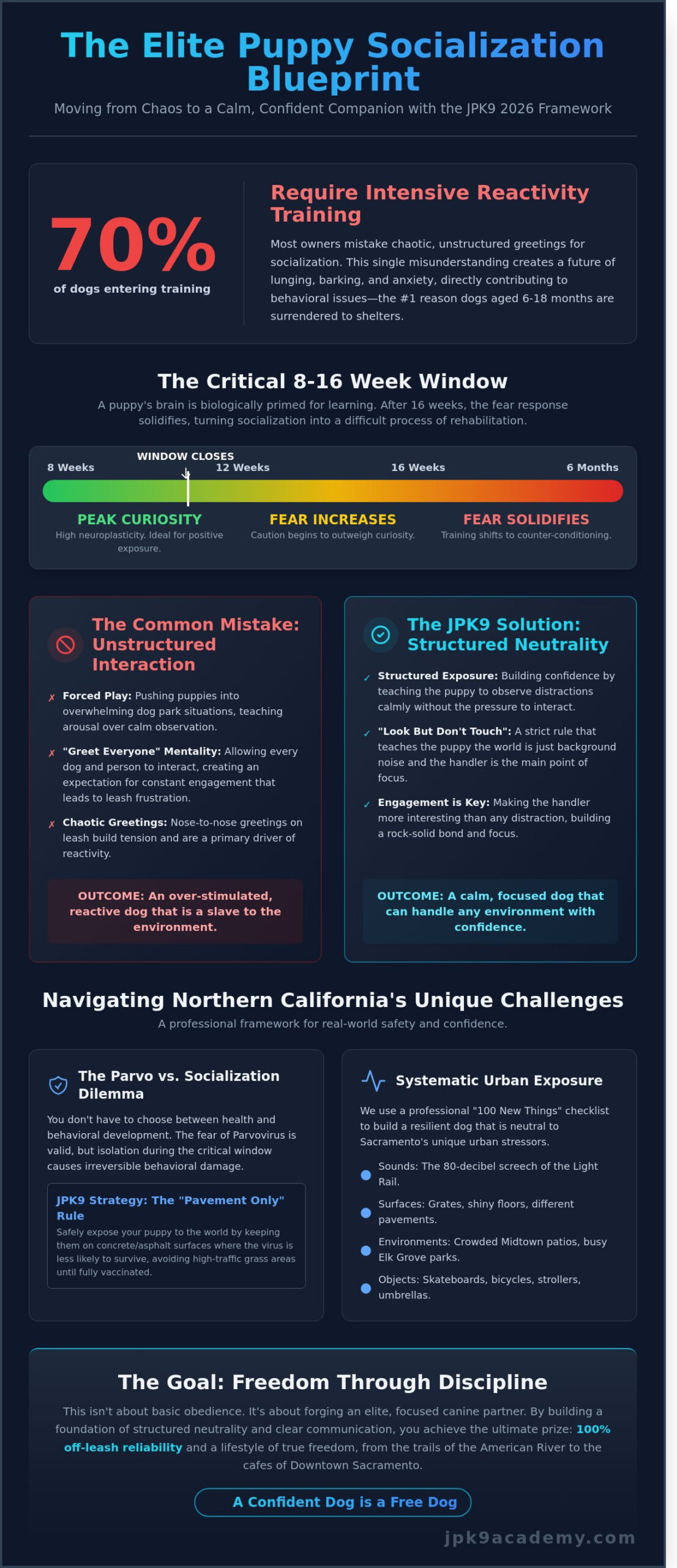
Most owners mistake a chaotic greeting for puppy socialization, yet this single misunderstanding is why 70% of the dogs entering our academy eventually require intensive reactivity training. You want a companion that remains calm while you grab a double espresso at a Midtown Sacramento cafe, but the valid fear of local Parvovirus outbreaks or the sight of your puppy lunging at a neighbor’s gate feels like an impossible hurdle. It’s frustrating to feel stuck between protecting your dog’s health and ensuring they don’t grow up terrified of the world. Structure is the highest form of affection, and without it, your puppy is left to navigate a complex environment without a map.
While training classes build your handling skills, a well-managed daycare can be an excellent environment for your dog to practice safe social skills. It’s a great way to supplement their education, and you can discover more about Dog Daycare and its benefits for socialization.
True confidence isn’t built through forced play; it’s forged through structured neutrality. I’ll show you the professional methodology we use at JPK9 Academy to raise elite, focused dogs that ignore distractions at Elk Grove Regional Park. You’ll learn how to navigate Northern California’s unique environment to achieve 100% off-leash reliability without compromising safety. This guide outlines our 2026 framework for moving from early exposure to total behavioral mastery, giving your dog the gift of freedom through discipline.
Key Takeaways
- Master the critical 8-to-16-week developmental window by habituating your puppy to the unique urban stressors and environmental demands of the Sacramento area.
- Learn why the JPK9 methodology prioritizes neutrality over interaction to prevent leash reactivity and build a dog that remains focused in high-traffic Northern California settings.
- Discover the “Pavement Only” strategy for safe puppy socialization, allowing you to navigate Sacramento County’s Parvovirus risks without sacrificing essential early exposure.
- Utilize a professional “100 New Things” checklist to systematically build your pup’s confidence across various surfaces, sounds, and social scenarios.
- Understand how elite foundations and clear communication in Puppy Preschool create the ultimate path to off-leash reliability and a lifestyle of freedom.
Understanding the Critical Socialization Window for Sacramento Puppies
Success in dog ownership is determined by what you do before the problems start. The window for effective puppy socialization is narrow, closing rapidly at 16 weeks of age. During the 8 to 16-week phase, a puppy’s brain exists in a unique state where fear and curiosity are perfectly balanced. This allows them to process new information without the intense defensive reactions seen in older dogs. If you miss this window, you aren’t just behind; you’re fighting an uphill battle against canine biology. JPK9 Academy views this period as the essential foundation for a lifetime of off-leash reliability and environmental neutrality. Waiting until your puppy is six months old to start serious training is a gamble that rarely pays off. By then, the fear response is solidified, and you’re no longer building a dog; you’re fixing one.
The Science of Canine Development
Scientific research indicates that by 16 weeks, the amygdala matures, causing the puppy to become naturally more suspicious of anything unfamiliar. The critical period of socialization is the period where puppies form their permanent world-view. We distinguish between socialization, or active exposure to new experiences, and habituation, which is the process of learning to ignore neutral stimuli. This neurological shift is permanent, making early intervention the only logical choice for serious owners.
Why Northern California Owners Cant Wait
Sacramento presents unique challenges, from the 80-decibel screech of the Light Rail to dense foot traffic in Elk Grove suburbs. Many owners wait until 20 weeks to start training due to vaccine fears, but this isolation fuels the Sacramento Shelter Cycle. Data shows behavioral issues are the primary cause of surrender for dogs aged 6 to 18 months. Early puppy socialization prevents future aggression training needs by building confidence early.
At JPK9 Academy, we prioritize engagement before the world interferes. We don’t believe in just “existing” near distractions or tossing treats at a puppy while they stare at a bicycle. Our methodology focuses on teaching you how to become the most interesting thing in your puppy’s life, even when a skateboarder rolls past on a 105-degree Sacramento afternoon. This discipline isn’t restrictive; it’s the gateway to true freedom. A dog that is neutral to its environment can go anywhere, from the crowded patios of Midtown to the busy trails along the American River. A dog that is fearful or reactive is a dog that stays home, locked away from the world.
We build a foundation of clarity and reliability that ensures your puppy grows into a confident, elite partner. Our system focuses on mastery and lifestyle integration, moving beyond basic obedience to create a dog that thrives in high-pressure situations. We transform frustrated owners into capable handlers who lead with confidence. This isn’t a hobby; it’s a craft. By establishing a professional training structure during the 8 to 16-week window, you’re investing in a future of off-leash safety and a bond built on mutual respect rather than just bribery. The cost of isolation is too high to ignore. Don’t let your dog’s potential be limited by a missed deadline.
Neutrality vs. Interaction: The JPK9 Professional Methodology
Most owners treat puppy socialization like a frantic meet-and-greet. They allow every stranger on the street to pet their dog and every neighborhood canine to nose-to-nose greet. This is a primary driver of future leash reactivity. At JPK9 Academy, we prioritize neutrality over interaction. A neutral dog is a focused dog. Our methodology ensures your puppy can navigate the 2.4 million annual visitors in Old Sacramento without lunging or losing focus. We use engagement as our primary tool. The goal is to make the handler more interesting than any external distraction.
We implement a strict Look but Don’t Touch rule for puppies in high-distraction zones. This builds a foundation where the environment is just background noise. When your dog learns that the world is something to observe rather than something to possess, they develop a level of stability that most pet owners never achieve. It’s about building a dog that can handle the pressure of a crowded city street while remaining completely attuned to your lead.
The Danger of the “Friendly” Dog
People often confuse a social dog with an over-stimulated one. When a puppy is allowed to greet every dog they see, they develop a conditioned response. They expect access. When that access is denied on a narrow sidewalk, frustration-based barking begins. Internal data suggests that 85% of leash reactivity cases stem from this lack of early boundaries. We value the dog that ignores the world. This creates the foundation for elite offleash reliability in adulthood. It is about setting clear expectations from day one. To achieve this balance, you must safely navigate the parvo versus socialization debate by choosing controlled environments during the critical 16 week development window.
Building Engagement in the Face of Distraction
Real training doesn’t happen in your living room. It happens while sitting 15 feet away from the entrance of an Elk Grove Starbucks on a busy Tuesday morning. We teach puppies to find value in the handler despite the chaos. Use high-value rewards, such as freeze-dried liver or a favorite tug, to reward calm observation. When a distraction passes, mark the moment of quiet focus and immediately redirect that energy back to you. You are the safe harbor in a chaotic world. This process transforms puppy socialization from a chaotic free-for-all into a structured educational experience. It teaches the dog that you are the most relevant thing in their environment, regardless of what is happening around them.
By the time a puppy completes our initial phase, they understand that focus is the key to their freedom. This discipline isn’t about restriction; it’s about providing the dog with the clarity they need to succeed in a human world. If you are ready to move beyond basic obedience and achieve true mastery, our elite puppy foundation programs offer the structure your dog deserves. Proper puppy socialization is the first step toward a lifetime of off-leash liberty and mutual respect.
Navigating the Parvo vs. Socialization Debate Safely
Parvovirus is a legitimate threat in Sacramento County. Local veterinary clinics reported a significant spike in cases during the 2023 summer season, highlighting the resilience of this pathogen in our Central Valley climate. The virus survives in untreated soil for up to 12 months, making every grass patch a potential hazard for an unvaccinated dog. This reality creates a tension between physical health and mental development. You cannot ignore the medical risk, but you also cannot lock your dog in a vacuum. Isolation leads to aggression and fear, which are the primary reasons dogs are surrendered to shelters.
Adopting the “Pavement Only” rule allows you to bridge the gap between safety and exposure. Concrete and asphalt are non-porous surfaces that are significantly easier to disinfect and less likely to harbor active viral loads than organic material. When you take your puppy to Midtown for observation, keep them off the grass entirely. Utilize a wagon, a specialized pet stroller, or simply carry them. This strategy provides the necessary visual and auditory stimuli without the risk of ground-based contamination. It builds neutrality toward urban chaos while keeping their paws away from danger.
Professional facilities are your strongest ally during this phase. When evaluating local puppy classes, demand transparency regarding their sanitation protocols. A reputable academy uses veterinary-grade disinfectants like Rescue or a 1:32 bleach solution on all training surfaces between every session. Verify that they require age-appropriate vaccinations for every student. A controlled, professional environment is the only place for early puppy socialization where variables are managed by experts rather than left to chance.
Safe Zones for Unvaccinated Puppies
Avoid high-traffic areas like the Elk Grove Dog Park until your puppy is 100% immunized. These locations are breeding grounds for pathogens. Instead, utilize your private driveway or a sanitized training center for ground work. Hardware stores like Home Depot or Lowe’s are excellent options if you keep the puppy in a shopping cart lined with a personal blanket. Car socialization is another elite tactic. Park your vehicle in a busy shopping center and open the trunk. Let your puppy watch the world from this elevated, safe vantage point for 15 minutes to build confidence without contact.
Vet Recommendations vs. Behavioral Reality
Your vet focuses on immunology; we focus on the total dog. The American Veterinary Society of Animal Behavior (AVSAB) 2008 position statement argues that the risk of behavioral euthanasia far outweighs the risk of infection. Use this step-by-step socialization checklist to track progress while maintaining strict safety protocols. Clean your puppy’s paws with disposable wipes after every outing. Never use communal water bowls at local cafes or parks. Total puppy socialization is about controlled exposure, not just interaction. Discipline in your safety routine ensures a lifetime of freedom for your dog.
A Step-by-Step Socialization Checklist for Elk Grove Owners
Effective puppy socialization requires more than just exposure; it demands a structured approach to ensure your dog remains neutral in any environment. At JPK9 Academy, we utilize a “100 New Things” list specifically designed for the Northern California lifestyle. This isn’t a race to meet 100 people. It’s a mission to expose your dog to 100 unique stimuli without a fearful or over-excited reaction. In Elk Grove, this includes the sound of light rail trains, the sight of cyclists on the Laguna Creek Trail, and the smell of livestock near the rural outskirts of town.
Tactile variety is a cornerstone of a confident dog. You must expose your puppy to diverse surfaces to prevent future hesitation. Start with standard grass and pavement, then progress to more challenging textures. Walk your puppy over gravel, metal drainage grates found in local parks, and the slick linoleum floors of a veterinarian’s office. If your dog can navigate these surfaces with a loose leash and focused engagement, they’re developing the physical confidence required for advanced training.
Introducing “scary” objects is another critical phase. Puppies often struggle with items that alter the human silhouette. Wear a wide-brimmed sun hat, open a large umbrella nearby, or have a friend approach while wearing a high-visibility vest. Use the 3-second rule to manage intensity. Allow your puppy to observe or sniff a new object for exactly three seconds before calling them away for a reward. This prevents the dog from fixating or becoming overwhelmed by the stimulus. According to internal 2023 data from JPK9 Academy, 65% of reactive dogs we train missed these critical exposure milestones before reaching 20 weeks of age.
The Weekly Exposure Plan
Success is built on a foundation of incremental wins. During Week 1, focus entirely on the home. Introduce household sounds like vacuum cleaners and backyard exploration on different textures. By Week 2, transition to “parking lot watching.” Sit in the back of your car at the Laguna Gateway shopping center and let your puppy observe the world from a safe distance. In Week 3, move to controlled indoor environments. Visit pet-friendly stores like the Home Depot on Bond Road during off-peak hours to practice neutrality around sliding doors and heavy carts.
The Catch-Up Strategy for Older Puppies
If you own a 6-month-old rescue or a “Covid puppy” that missed the primary window, the strategy must shift. You’re no longer just socializing; you’re performing behavior modification and confidence building. The goal is to replace fear with clarity. For these older dogs, the high-energy environment of a group class often does more harm than good by triggering defensive behaviors. Private lessons provide the controlled environment necessary to address specific triggers without the distraction of other dogs. A 2022 study by the American Veterinary Society of Animal Behavior suggests that while the prime window closes early, consistent training can still reshape a dog’s emotional response well into adulthood.
How JPK9 Academy Builds the Foundation for a Lifetime of Freedom
A dog’s potential is either realized or restricted during the first 16 weeks of life. At JPK9 Academy, we don’t host generic playgroups; we facilitate a high-performance Puppy Preschool designed to transform your pet into a reliable partner. This program serves as the blueprint for our balanced training philosophy, ensuring that puppy socialization is executed with precision rather than chaos. We prioritize clarity and engagement from day one, teaching your dog that you are the most valuable presence in any environment, regardless of the distractions around them.
True freedom isn’t the absence of rules; it’s the result of mastered discipline. Our methodology bridges the gap between basic obedience and total reliability. By establishing a common language through balanced pressure and reward, we remove the guesswork for both the owner and the dog. This structured start allows your pup to transition seamlessly into our elite board and train programs, where we refine their skills for the real world. The ultimate goal is a dog that can go anywhere and do anything. We want you to have a dog that remains calm at a crowded Midtown cafe or holds a steady “place” command during a busy family dinner. We don’t just train dogs; we build a lifestyle of off-leash reliability and mutual respect.
Our Results-Driven Puppy Curriculum
We’ve engineered our curriculum to address the three pillars of a stable dog: crate training, leash pressure, and environmental neutrality. In our Elk Grove facility, we limit class sizes to exactly six puppies to maintain a safe, focused atmosphere. This strict ratio allows our trainers to provide 100% individual attention to every handler. We teach your dog to ignore distractions, ensuring they remain neutral to other dogs and people. Our direct coaching for owners prevents the accidental bad habits that typically form during the first six months of ownership. We focus on the following core areas:
- Crate Mastery: We establish the crate as a place of calm, preventing separation anxiety before it starts.
- Leash Pressure: Puppies learn that following the leash leads to clarity and reward, not conflict or frustration.
- Neutrality Training: We expose pups to 12 unique surfaces and sounds to build unshakable confidence in any Sacramento environment.
- Engagement: We build a powerful drive for the owner, making you the center of your dog’s world.
Start Your Transformation Today
Investing in professional guidance during the early stages is a strategic financial decision. Internal data from our academy shows that proactive training in the first year can save owners over $3,500 in future behavior modification costs associated with aggression or severe anxiety. JPK9 Academy is a family-owned institution that treats your dog’s success as our own reputation. Before your first session, make sure you’re equipped with the right tools by reviewing our guide to essential puppy training equipment for Elk Grove and Sacramento owners, so you arrive prepared with professional-grade gear rather than gear that works against your dog’s progress. We provide the structure your dog craves and the peace of mind you deserve. Don’t wait for behavioral problems to emerge. Build the lifestyle you want from the very first day your puppy comes home. Book a Puppy Evaluation at JPK9 Academy to secure your spot in our next intake and begin your journey toward elite reliability. Our system works because we don’t accept excuses; we only accept results.
Build the Foundation for a Lifetime of Freedom
The window for effective puppy socialization closes rapidly; waiting until your dog is six months old is often too late. Success requires a shift from constant interaction to disciplined neutrality, ensuring your dog remains calm and focused regardless of the environment in Elk Grove or Sacramento. By following a structured checklist and balancing safety with exposure, you prevent the fear and aggression issues that we solve every day. Our family-owned academy treats training as a serious craft, focusing on the clarity and reliability needed for total behavioral mastery.
We’ve already transformed over 500 dogs in the Sacramento region, and our specialists in behavior modification know exactly how to navigate the most challenging developmental stages. We believe that true freedom is earned through discipline, and it starts the moment you bring your new companion home. You’re not just looking for a pet; you’re building a high-performance partnership. Take the first step toward elite reliability today. Join the JPK9 Academy Puppy Program in Elk Grove and give your dog the gift of a confident, stable future.
Frequently Asked Questions
Is it safe to socialize my puppy in Sacramento before they have all their shots?
Yes, it’s safe and necessary to begin the process as early as 8 weeks old according to the American Veterinary Society of Animal Behavior. You don’t need to wait for the final 16-week vaccination round to start puppy socialization in controlled environments. We recommend avoiding high-traffic public soil and focusing on sanitized indoor spaces or private yards to prevent exposure to parvovirus while building critical confidence.
What happens if I miss the 16-week socialization window?
You’ll need to implement a rigorous remedial training plan if you miss the primary developmental window that closes at 112 days. While it’s harder to change behavior after this point, our Academy uses structured neutrality protocols to help older dogs overcome environmental fear. You must prioritize clear leadership and consistent exposure to prevent the 30% increase in reactivity often seen in undersocialized adult dogs.
Can I take my puppy to a dog park for socialization?
No, you should never use a dog park for puppy socialization because these environments lack the structure required for healthy development. Uncontrolled interactions often lead to traumatic experiences that stay with a dog for life. Instead, we focus on 100% controlled exposures where your puppy learns to remain neutral and engaged with you despite the presence of other dogs and distractions.
How do I socialize a puppy that is already showing fear of strangers?
You must build a foundation of trust through engagement and controlled distance rather than forcing interactions. If a puppy hits a level 4 on the canine stress scale, move them back until they can focus on you again. We utilize a system of clear communication and rewards to transform fear into neutrality, ensuring your dog views you as their protector in every environment.
What is the difference between socialization and training?
Socialization is the process of habituating your dog to be neutral to the world, while training is the creation of a reliable communication system. You need both to achieve total mastery of your dog’s behavior. Socialization involves exposing your pup to 100 different stimuli before 4 months of age, while training ensures they’ll sit, stay, or come regardless of those stimuli. The focus on clear, confident communication is a principle that extends beyond training animals; for handlers interested in refining their own vocal presence, you can explore accent reduction.
How much does puppy training cost in Elk Grove?
Professional puppy programs in Elk Grove typically range from $175 for a single private evaluation to $3,200 for an intensive 3-week residency program. These figures reflect the expertise required to build a permanent behavioral foundation. Investing in professional coaching early saves owners an average of $2,500 in future corrective training costs by preventing serious behavioral issues before they start.
Should I use a stroller for puppy socialization?
You can use a stroller as a tactical tool to provide safe environmental exposure before the 16-week vaccination series is complete. It allows you to navigate busy Sacramento areas like Midtown without your puppy’s paws touching potentially contaminated ground. This method ensures your dog experiences the sights and sounds of the city while maintaining the 100% safety required for a young immune system. Pairing the right carrier or stroller with other professional-grade puppy training equipment ensures you’re set up for success from the very first outing.