Your dog isn’t pulling because they’re simply “excited.” They’re pulling because there’s a fundamental breakdown in clarity and engagement between you. Every time your dog drags you toward a distraction at Johnson-Springview Park, they’re disregarding your leadership and risking a citation under Rocklin Municipal Code 6.04.050. If you’re tired of the physical pain and public embarrassment of being towed down the street, you’re likely ready for a solution that actually works. Securing effective leash pulling training rocklin owners can rely on requires moving past “cutesy” rewards and into a disciplined, results-oriented system.
You deserve a walk characterized by zero tension and total focus, regardless of the environment. We promise to show you the professional strategy used to transform frustrated pullers into elite companions who remain neutral to their surroundings. This guide previews our balanced methodology for achieving reliable loose-leash manners and explains why structure is the highest form of affection. It’s time to stop the tug-of-war and start building a partnership based on clear communication and unwavering authority. You’ll discover how to reclaim your walks and give your dog the gift of freedom through discipline.
Key Takeaways
- Understand the “Opposition Reflex” and how typical reactions to pulling accidentally reward your dog’s bad behavior.
- Identify why standard flat collars and “no-pull” harnesses fail to provide the clarity required for powerful, high-drive pullers.
- Learn the step-by-step process for leash pulling training rocklin owners use to build engagement before ever stepping onto a busy trail.
- Discover the “Freedom through Discipline” philosophy and how structured walks actually strengthen the bond between you and your dog.
- See how professional, results-oriented programs like Board and Trains provide the foundation for total behavioral reliability in real-world environments.
Stop the Tug-of-War: Why Leash Pulling Training in Rocklin is Essential
Walking a high-drive dog through Rocklin should be a point of pride, not a source of dread. When your dog lunges toward a squirrel or drags you across the pavement, the human-canine bond suffers a massive blow. You stop seeing your dog as a partner and start seeing them as a liability. This lack of control limits your freedom. You stop visiting the places that make living here great because the stress of managing a 70-pound anchor outweighs the benefit of the outing. Effective leash pulling training rocklin owners invest in isn’t just about walking nice; it’s about reclaiming your lifestyle.
Waiting for a dog to grow out of pulling is a dangerous gamble. Dogs are masters of repetition. Every successful pull toward a scent or another dog reinforces the behavior, making it a permanent part of their repertoire. In high-traffic areas near Sierra College Boulevard or Pacific Street, where traffic volume peaks during afternoon commutes, a single lunge can lead to a dropped leash or a fall into traffic. Relying on hope rather than a proven system is how accidents happen. Discipline is the only path to safety.
The Rocklin Lifestyle: Why Your Dog Needs Manners
Rocklin offers incredible outdoor spaces, but they require a dog with a high level of neutrality. Navigating the crowded paths at Johnson-Springview Park becomes impossible when your dog treats every passerby as a challenge. Specialized leash pulling training rocklin services prepare your dog for the narrow trails at the Sunset Whitney Recreation Area, where passing other hikers without tension is a non-negotiable safety requirement. If you want to enjoy a meal at the dog-friendly patios in Rocklin Commons, your dog must understand how to exist in a calm, settled state despite the surrounding chaos.
The Physical and Mental Toll of Leash Tension
Constant pulling does more than just hurt your arm. It places immense strain on a dog’s neck and musculoskeletal system, potentially leading to long-term health issues. Mentally, leash tension acts as a funnel for arousal. When a dog feels that constant pressure, their fight or flight response stays engaged, which frequently transitions into leash reactivity. A dog that is always “on” is a dog that is never truly at peace.
This is why the application of behavior analysis is so critical in our approach. We look at the underlying mechanics of why the dog pulls rather than just treating the symptom. A frustrated owner inevitably creates a frustrated, unconfident dog. By removing the tension, we provide the clarity your dog needs to feel secure and focused under your leadership. True freedom is only possible when your dog is reliable enough to handle the distractions of a busy suburban environment.
The Psychology of the Pull: Understanding Why Your Dog Won’t Walk Nicely
Pulling is rarely an act of defiance. It’s usually the result of a physiological response combined with a history of accidental reinforcement. Your dog isn’t trying to be the “alpha” when they drag you toward a scent; they’re simply responding to their environment without a clear framework for success. Effective leash pulling training rocklin owners seek must address these psychological foundations to create lasting change. Without understanding the “why” behind the behavior, you’re just managing symptoms rather than solving the problem.
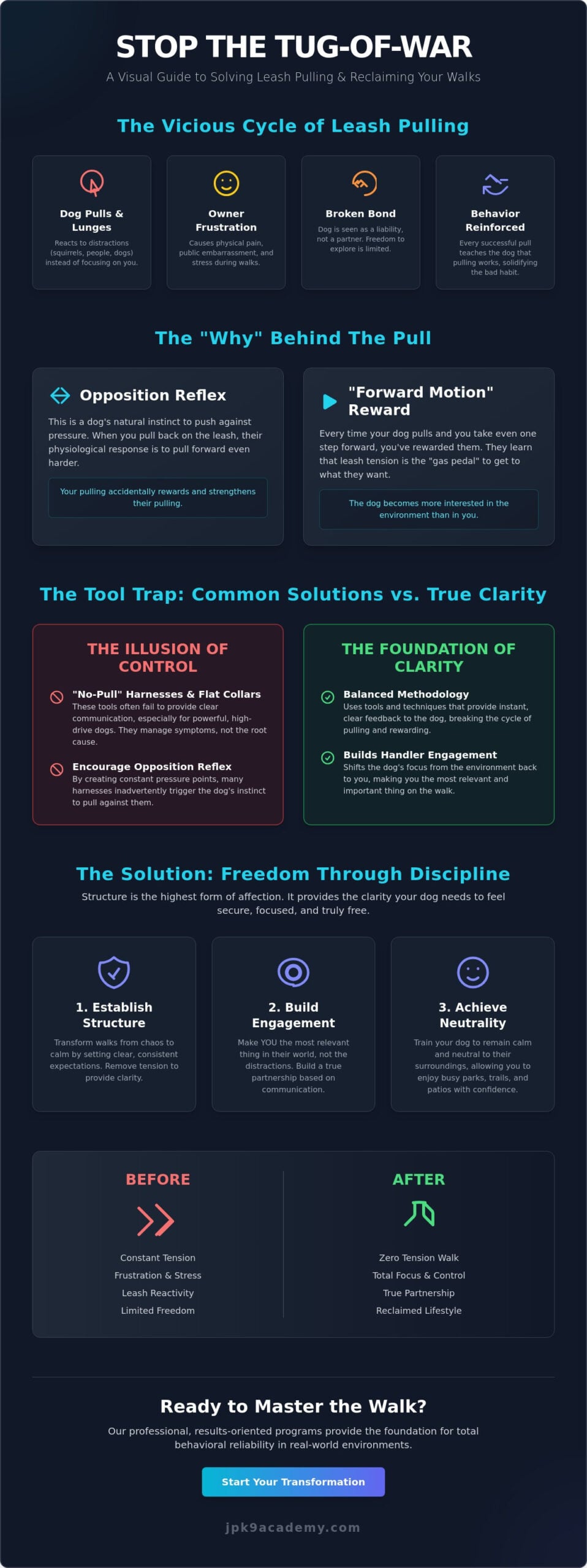
The “Forward Motion” reward is the most common culprit in suburban environments. Every time your dog pulls and you continue to walk, you’ve rewarded that behavior. They learn that tension on the leash is the gas pedal that gets them to the next squirrel or fire hydrant. This creates a powerful reinforcement loop that is difficult to break with treats alone. Over time, the dog becomes more interested in the external environment than the person holding the other end of the leash. This lack of engagement is a leadership failure, not a dog failure. If your dog doesn’t see you as the most relevant thing in their world, they’ll find relevance elsewhere.
Genetic drive also plays a significant role in how a dog perceives the leash. High-drive breeds, such as German Shepherds, Malinois, or Huskies, possess an innate desire to move forward and explore. Without a structured outlet or clear communication, this drive manifests as frantic pulling. If you’re struggling to manage this intensity, a professional consultation can help identify your dog’s specific motivators and drive levels. We don’t suppress this drive; we channel it into focused engagement.
What is Opposition Reflex in Dog Training?
Opposition reflex is a natural canine physical response to being restrained. When you feel your dog pull and instinctively pull back, you trigger a biological urge in the dog to lean even harder into the pressure. Traditional flat collars and harnesses often exacerbate this problem by providing a large surface area for the dog to push against. This allows them to use their entire body weight to tow you along, turning a simple walk into a physical battle you’re destined to lose. To fix this, we must move away from physical restraint and toward mental clarity and yielding to pressure.
The Difference Between Obedience and Engagement
Many owners are baffled when a dog who sits perfectly in the kitchen becomes a nightmare on the street. This happens because obedience is a set of commands, while engagement is a mental state of partnership. A dog can be obedient but completely disengaged. True mastery on the leash requires the dog to choose you over the distractions of the Rocklin streets. You can measure this mental focus by observing how often your dog checks in with you voluntarily. If their ears are pinned forward and their eyes are locked on the horizon, they’re in a “command” mindset at best, or a “disengaged” mindset at worst. We teach you how to build a partnership where the dog remains neutral to the world and focused on your lead.
Harnesses vs. Balanced Tools: What Actually Works for High-Drive Pullers?
Most pet owners are sold a lie that a specific piece of equipment will magically solve their dog’s behavior. In reality, a tool is only as effective as the clarity of the communication behind it. If you’re struggling with a powerful dog, you’ve likely realized that standard equipment often fails when distractions peak. Achieving effective leash pulling training rocklin owners can trust requires moving beyond management and toward actual education. We don’t use tools to restrain; we use them to communicate.
The flat collar is a staple for every dog, but it serves a limited purpose. It’s excellent for holding identification tags and Rabies licenses, which are required for all dogs aged four months and older in Rocklin. However, as a training tool for a high-drive puller, the flat collar is often inadequate. It provides a very narrow point of pressure on the neck. For a dog in a high state of arousal, this pressure is easily ignored or, worse, leads to physical damage over time. To change a behavior as ingrained as pulling, we need a tool that provides sophisticated feedback.
Why Front-Clip Harnesses Are Often a Temporary Band-Aid
The “no-pull” harness is one of the most misunderstood tools in the industry. While it may provide temporary relief by redirecting the dog’s momentum, it fails to address the underlying lack of engagement. Many front-clip designs actually restrict the dog’s natural shoulder movement. This can lead to long-term gait issues and musculoskeletal imbalances if used consistently on a dog that continues to lean into the pressure. For more information on professional-grade equipment, see The Ultimate Guide to Sprenger Dog Collars for Sacramento Owners (2026). Harnesses often create a “muffled” signal, leaving the dog confused and the owner frustrated when the dog eventually learns to pull through the discomfort.
Mastering Communication with Balanced Tools
Balanced training utilizes tools that offer the highest level of clarity. This is rooted in the science of “pressure on/pressure off.” When the dog is in the correct position, there is zero tension. When they move out of position, they feel a clear, immediate signal. Herm Sprenger prong collars are the gold standard for this because they distribute pressure evenly around the neck, mimicking a natural correction from another dog. This isn’t about pain; it’s about providing a signal that the dog cannot ignore.
- Clarity: Balanced tools remove the ambiguity of “gray area” training.
- Reliability: They provide a safety net for high-distraction environments like Rocklin Commons.
- Neutrality: Proper tool use helps the dog remain calm and focused rather than reactive.
- Freedom: E-collars act as a “digital leash,” allowing for off-leash liberty while maintaining total control.
Ultimately, the goal is to phase out the heavy use of these tools as the dog’s foundation of engagement becomes rock solid. We train the dog to yield to the lightest possible pressure. This creates a focused companion who chooses to walk by your side because they understand the rules of the game. Mastery is found in the partnership, not just the hardware.
Master the Walk: Step-by-Step Guidance for Rocklin’s Busy Trails
Transformation doesn’t happen on the street; it begins in the absence of distraction. Many owners fail because they attempt to teach new concepts while their dog is already overstimulated by the sights and sounds of a busy neighborhood. Effective leash pulling training rocklin experts provide follows a linear progression that builds confidence and clarity. You must earn the right to walk through high-distraction areas by first mastering the fundamentals in a controlled environment. We don’t just hope for a good walk. We engineer it through a structured, four-step process.
- Step 1: Engagement in the Living Room. Your training starts in your Rocklin living room. If your dog won’t offer you eye contact and focus in a quiet environment, they certainly won’t do it when a squirrel crosses their path. Establish that you are the most relevant thing in the room.
- Step 2: Yielding to Pressure. Introduce the concept that leash pressure is a communication signal, not a challenge. Teach your dog to move toward the pressure to find the “off” switch. This removes the opposition reflex discussed earlier.
- Step 3: The Driveway Transition. Move to your driveway to introduce minimal environmental variables. The goal is to maintain the same level of focus you had indoors while the dog processes the neighborhood’s ambient noise.
- Step 4: The Neutrality Test. Once the foundation is solid, head to local spots like the Sunset Whitney Recreation Area. Here, you proof the behavior by expecting total neutrality as you pass other hikers and dogs.
If you’re struggling to move past the driveway phase, it’s time for professional intervention. You can schedule a consultation with our trainers to identify where your communication is breaking down. Consistency is the only path to reliability.
The 180-Degree Turn: Regaining Focus Instantly
Directional changes are the most effective way to remind a dog that you are leading the walk. When a dog fixates on a distraction or moves ahead of your leg, they’ve mentally checked out. To perform a 180-degree turn, pivot away from your dog the moment they move ahead of your leg, applying a brief, firm signal to reset their focus back to your position. This forces the dog to pay attention to your body language rather than the horizon. Timing is everything. You must deliver the signal the split second the dog’s focus drifts, followed immediately by a release of pressure when they return to your side.
Proofing the Walk in Real-World Rocklin Scenarios
Rocklin’s trails are notorious for high-drive triggers, particularly the local squirrel population. A dog with high prey drive will naturally want to lunge. Your job is to maintain the standard of neutrality regardless of what runs across the path. Another common challenge is the “friendly” off-leash dog that approaches you in public spaces. These encounters often lead to tension and can trigger defensive behavior. If your dog’s pulling has escalated into lunging or snapping, you may need to explore Dog Aggression Training in Sacramento: Transformative Solutions for Lasting Change. We teach you how to advocate for your dog’s space while maintaining total control of the leash. Structure provides the safety your dog needs to navigate these unpredictable moments with confidence.
Professional Transformation: JPK9 Academy’s Results-Driven Leash Training
Professional dog training is a serious craft. At JPK9 Academy, we don’t offer casual hobby classes; we provide a comprehensive behavioral overhaul for owners who are truly committed to the work. If you’ve struggled with leash pulling training rocklin programs that didn’t deliver, it’s likely because they lacked the necessary structure and immersion. Our system focuses on total neutrality and engagement. We address the root cause of the tug-of-war by building a foundation of discipline that translates into real-world freedom. When your dog understands the rules of engagement, the walk becomes a shared experience of clarity rather than a battle of wills. We don’t just train for the street; we train for a lifetime of partnership.
The JPK9 difference lies in our dual-phase approach. We first establish a reliable foundation with the dog, removing the confusion and conflict that characterizes most walks. Once the dog understands the mechanics of yielding to pressure and maintaining focus, we shift our attention to you. Coaching the human is just as vital as training the dog. You must lead with the same unwavering authority and precision to maintain the results we achieve. This transition ensures that the mastery gained in our academy carries over to your daily lifestyle in Rocklin.
Our Intensive Board and Train for Total Leash Mastery
Our Board and Train program is the gold standard for owners seeking total leash reliability. During our popular 4-week immersive program, your dog lives with our professional trainers to receive consistent, high-repetition instruction. We remove the “gray areas” that cause frustration and replace them with clear, binary communication. A typical day involves multiple structured training sessions where we proof behaviors against real-world distractions. This immersion is vital for powerful or reactive pullers who need to learn neutrality in a professional setting. Once the training is complete, we provide graduate support to ensure your long-term success. Discover Expert Dog Training in Sacramento: The Path to Off-Leash Freedom and Reliability.
Private Lessons for the Committed Rocklin Owner
For the owner who wants to be hands-on from the start, we offer private coaching sessions. These one-on-one lessons allow us to troubleshoot your specific walking routes in neighborhoods like Whitney Ranch or shopping centers like Rocklin Commons. We don’t just provide a list of commands; we build your skills as a high-performance handler. You’ll learn to read your dog’s body language, anticipate triggers, and deliver signals with perfect timing. This lifestyle overhaul ensures that your dog remains a focused companion in every environment, from quiet suburban trails to crowded outdoor patios. Your journey toward a harmonious life starts with a professional assessment of your dog’s potential. Stop settling for a mediocre relationship and start demanding excellence.
Book Your Training Evaluation with JPK9 Academy Today and finally reclaim your walks.
Reclaim Your Leadership on the Rocklin Streets
Reclaiming your walk requires more than just a loose leash; it demands a total behavioral transformation. You now understand that the opposition reflex and a lack of mental engagement are the true drivers behind the tug-of-war. By moving away from restrictive harnesses and toward clear, balanced communication, you provide your dog with the structure they crave. High-drive dogs don’t need more restraint. They need a leader who can channel their energy into focus and neutrality. Every walk is an opportunity to reinforce your partnership or allow it to degrade through inconsistency.
Finding the right leash pulling training rocklin owners can rely on means choosing a system that delivers reliability in the real world. JPK9 Academy is family-owned and operated by experts Justin and Priscilla. Since 2018, we’ve functioned as specialists in high-drive and reactive dog behavior modification for the greater Sacramento area. We don’t just fix symptoms; we overhaul the human-canine relationship from the ground up. Transform your dog’s walk—Book an evaluation at JPK9 Academy today. Your dog possesses incredible potential. It’s time to unlock it through discipline and clear communication.
Frequently Asked Questions
How long does it take to train a dog to stop pulling on the leash?
Establishing a reliable foundation typically takes 28 days in our immersive Board and Train environment. While you’ll see immediate improvements in clarity, true reliability requires the owner to maintain the standard at home. We focus on this 4-week window to ensure the behavior is proofed against the high-level distractions found in Rocklin’s public spaces. Consistency from the handler is the final piece of the puzzle.
Will a prong collar hurt my dog during leash training?
No, a high-quality Herm Sprenger prong collar functions as a sophisticated communication device, not a tool of pain. It utilizes the “pressure on/pressure off” principle to provide the dog with instant, clear feedback. This is significantly safer and more humane than the constant, choking tension of a flat collar. Proper fit and professional guidance are essential to ensure the tool remains a bridge for clear communication.
Can an older dog learn to stop pulling, or is it too late?
Dogs of any age can learn to walk with neutrality if provided with a clear, disciplined system. While an older dog may have years of reinforced pulling behavior, our methodology replaces those old habits with a new foundation of engagement. We’ve successfully rehabilitated senior dogs through specialized leash pulling training rocklin owners rely on for total behavioral overhauls. Clarity is effective regardless of the dog’s age.
What is the best leash for a dog that pulls in Rocklin?
The most effective tool is a high-quality 6-foot leather or biothane lead. Rocklin Municipal Code 6.04.050 mandates that all dogs in public areas must be on a leash with a maximum length of 6 feet. Retractable leashes are prohibited for training purposes at our Academy because they encourage pulling and offer zero control. A fixed-length lead provides the necessary tension-free communication required for a focused walk.
Should I use treats to stop my dog from pulling?
Treats can serve as a lure for teaching new positions, but they are rarely the solution for a high-drive puller. Relying solely on food often fails when a dog finds a squirrel or another dog more rewarding than a biscuit. Our Academy prioritizes engagement and leadership over simple bribery. We build a partnership where the dog chooses to follow your lead because the communication is clear and the boundaries are firm.
What happens if my dog is reactive to other dogs while on the leash?
Reactivity is a sign that your dog lacks neutrality and is overwhelmed by environmental arousal. If your dog lunges or barks at others, they require a comprehensive behavioral modification plan rather than a basic obedience class. We specialize in transforming reactive dogs into neutral companions who can navigate busy areas like Rocklin Commons without incident. We address the underlying mindset to ensure long-term reliability and safety.
Do you offer leash training for puppies in Rocklin?
Yes, we offer specialized puppy programs to establish a foundation of focus before bad habits take root. The critical socialization window for puppies closes at 16 weeks, making early intervention vital. By teaching engagement and leash pressure early, we prevent the “tug-of-war” from ever starting. Our goal is to set your puppy on the path to elite performance and off-leash freedom through early, structured discipline.
How much does professional leash pulling training cost in Rocklin?
Professional training rates in the Rocklin area reflect the expertise required for behavioral transformation. A single private in-home session typically costs between $100 and $180, while a 6-week group obedience class generally ranges from $200 to $350. For owners seeking the highest level of reliability, our immersive 4-week Academy programs provide a total overhaul. We provide custom quotes after a professional evaluation to ensure the program matches your dog’s specific needs.