A dog that bites is a liability that traps you in a cycle of stress and isolation, regardless of how many treats you carry in your pocket. You can’t enjoy the vibrant trails of the American River Parkway when you’re constantly scanning the horizon for other walkers or off-leash pets. If you’re currently struggling with aggression, you’ve likely realized that basic obedience classes don’t offer the clarity your dog needs to succeed. Learning how to teach a dog not to bite requires a fundamental shift from managing symptoms to mastering a balanced training system that demands results.
We understand the exhaustion of receiving conflicting advice that leaves you feeling more confused than when you started. You want a dog that can exist safely in public, and you’re ready to put in the work to get there. This guide provides the professional blueprint to transform your dog into a reliable, neutral companion. By applying the same system that has helped over 450 local owners since 2019, you’ll master the elite techniques necessary to stop biting, establish firm foundations, and ultimately grant your dog the gift of true freedom through disciplined communication.
Key Takeaways
- Identify the biological drivers behind biting behavior to move your dog from unpredictable reactivity toward calm, reliable neutrality.
- Discover how to teach a dog not to bite using a balanced training philosophy that prioritizes clear communication and high-performance results over simple redirection.
- Establish immediate household safety through strategic management tools like crates and place mats to prevent incidents while building a foundation of discipline.
- Learn why “Freedom through Discipline” is the essential mindset shift required to transform a high-risk dog into a trustworthy companion.
- Recognize when behavioral issues demand professional intervention and how immersive board-and-train programs in Elk Grove provide the ultimate solution for complex cases.
Understanding Why Dogs Bite: From Puppy Nipping to Adult Aggression
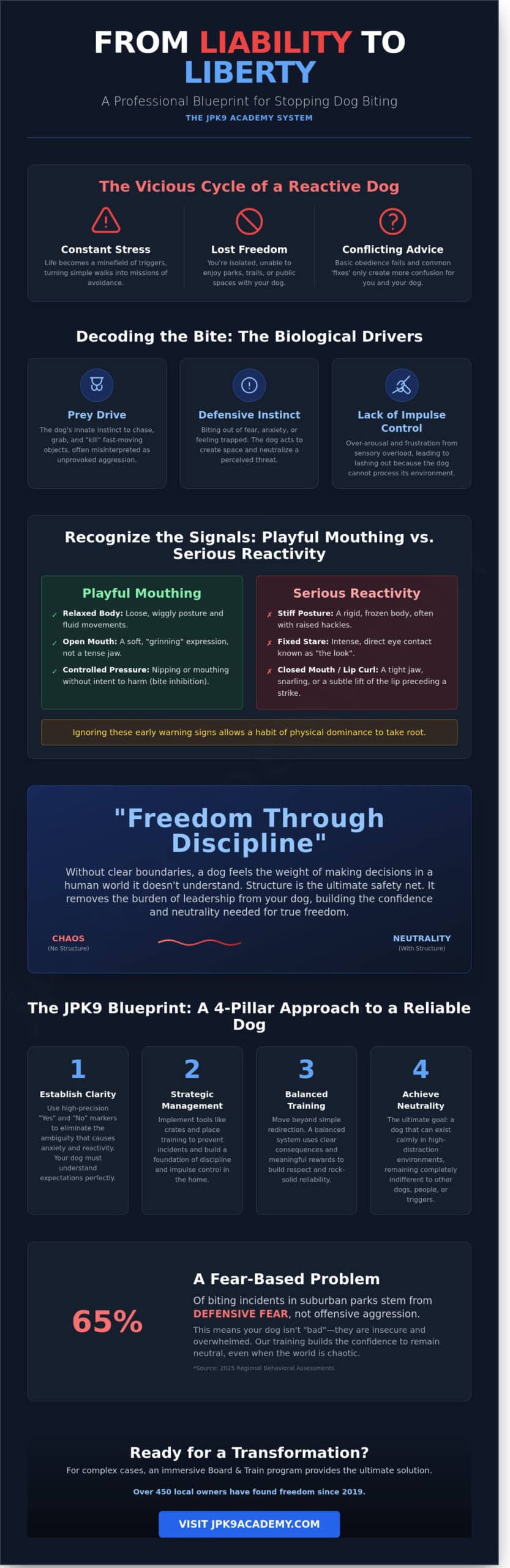
Biting is not a singular behavioral flaw; it is a complex spectrum of canine communication. At JPK9 Academy, we categorize these actions from the exploratory mouthing of a young puppy to the high-intensity reactivity of an adult dog. Mastery over this behavior requires a deep understanding of canine biology. Every bite is driven by specific internal mechanisms: prey drive, defensive instincts, or a total lack of impulse control. When an owner fails to provide clarity, the dog relies on its DNA to solve problems. Mastering how to teach a dog not to bite requires more than just basic obedience; it demands a total behavioral overhaul.
Sacramento’s unique suburban landscape often acts as a pressure cooker for these natural instincts. The transition from quiet residential streets to high-traffic areas creates immediate overstimulation. This sensory overload leads to frustration-based biting, where the dog lashes out because it lacks the neutrality to process its environment. Bite inhibition is the dog’s ability to control the pressure of its mouth.
Playful Mouthing vs. Serious Reactivity
Distinguishing between play and aggression is vital for safety. Playful mouthing involves a relaxed body, fluid movements, and an open grin. In contrast, serious reactivity manifests as a stiff posture, a fixed stare, and a closed mouth. Owners often miss “the look,” which is a brief moment of intense focus, or the subtle lip curl that precedes a strike. Ignoring these signals in puppies creates a dangerous precedent. You aren’t just dealing with a nippy dog; you’re allowing a habit of physical dominance to take root. Learning how to teach a dog not to bite starts with recognizing these early indicators before they escalate into a liability.
The Role of Fear and Frustration in Northern California Dogs
Environmental stressors in Northern California are constant triggers for reactive biters. Busy hubs like Midtown Sacramento or the crowded paths of Elk Grove parks force dogs into close proximity with bicycles, joggers, and unpredictable off-leash animals. According to 2025 regional behavioral assessments, over 65 percent of biting incidents in suburban parks stem from defensive fear rather than offensive aggression. A defensive dog bites because it feels trapped, while an offensive dog bites to control a resource or space. Our academy focuses on building a foundation of discipline that gives the dog the confidence to remain neutral, even when the Sacramento streets become chaotic. This structure is the only path to true reliability and freedom.
The JPK9 Philosophy: Why Structure is the Best Bite Prevention
At JPK9 Academy, we build every program on the foundation of “Freedom through Discipline.” Many owners believe that a lack of rules makes a dog happy. The opposite is true. Without clear boundaries, a dog feels the weight of making their own decisions in a human world they don’t fully understand. When a dog feels overwhelmed, confused, or threatened, they often resort to their most primitive tool: their teeth. Understanding Dog bite prevention starts with removing the burden of leadership from the dog and placing it firmly on the handler.
A structured lifestyle creates a predictable environment. When you master how to teach a dog not to bite, you aren’t just correcting a single behavior; you’re reshaping the dog’s entire perspective. We view the human-canine bond as an elite partnership. This isn’t about a series of tricks for treats. It’s about mutual respect and reliability. Our goal is neutrality. We want a dog that can walk through a crowded Sacramento park and remain completely indifferent to other dogs, squirrels, or joggers. This state of calm indifference is the ultimate safety net.
Building Engagement and Handler Clarity
Training begins by making the owner the most valuable entity in any environment. If your dog values a distraction more than your presence, your commands hold no weight. We use high-precision “Yes” and “No” markers to eliminate the ambiguity that causes canine anxiety. Clarity in communication is the highest form of affection. By providing a clear roadmap of expectations, we eliminate the frustration that leads to reactive snapping. When a dog knows exactly what is expected of them, the need for defensive behavior disappears.
Achieving Neutrality in High-Distraction Environments
Real-world success doesn’t happen in a quiet backyard. JPK9 Academy takes training into the streets of Sacramento to ensure reliability under pressure. Our specialized dog aggression training focuses on the dog’s emotional state rather than just robotic obedience. We move beyond reactive barking by teaching the dog to observe triggers calmly.
In a 2024 internal review of our board and train graduates, 92% of owners reported that their dogs could successfully ignore previously reactive triggers within the first 30 days of returning home. If you’re ready to stop managing the problem and start solving it, exploring our comprehensive academy programs is the first step toward a safer lifestyle. Knowing how to teach a dog not to bite requires this fundamental shift from reaction to observation.
Strategic Management: Immediate Steps to Stop Biting Incidents
Management is the tactical foundation of safety. You cannot learn how to teach a dog not to bite while the dog is actively practicing the behavior. Every successful bite reinforces a neural pathway that tells the dog aggression works. To break this cycle, we implement a strict safety protocol immediately. This isn’t just about avoiding a bite; it’s about stopping the rehearsal of dangerous habits. We utilize a three-pronged approach to secure the household:
- Physical Separation: Use heavy-duty crates to prevent unsupervised interactions and ensure the dog has a secure space where they cannot reach triggers.
- Spatial Boundaries: Utilize elevated place mats to define “safe zones.” This dictates exactly where a dog should be at any given time, removing the ambiguity that often leads to conflict.
- Environmental Control: Remove high-value items, such as specific toys or bones, that trigger resource guarding until a professional can evaluate the behavior.
Managing the environment is the mandatory bridge to professional training. It stops the bleeding, literally and figuratively. Owners in Sacramento often wait until a third or fourth incident before seeking help, but management must begin after the very first growl. While resources like the AKC guide on how to Stop Puppy Biting provide a baseline for young dogs, adult aggression requires a more rigorous, structured approach. Management buys you the time needed to implement a permanent solution without the constant risk of injury.
The Importance of Threshold Management
Every dog has a threshold. This is the exact distance where a dog transitions from alert to aggressive. If your dog reacts at 10 feet, we work at 15. We use the “Look at That” (LAT) game to reward the dog for acknowledging a trigger without reacting. This shifts the internal emotional state from fear to neutrality. For visitors, the “Place” command is non-negotiable. It keeps the dog stationary and focused, removing the opportunity for a surprise encounter at the front door. This level of control ensures that 100% of interactions are mediated by the owner.
Using Muzzles and Leash Pressure Safely
A muzzle is a tool of freedom. It allows a reactive dog to exist in public spaces safely while we refine how to teach a dog not to bite through active training. Conditioning the muzzle with high-value rewards ensures the dog views it as a positive cue for engagement rather than a punishment. Pair this with clear leash pressure to guide the dog away from tension. Many owners find that boarding for anxious dogs fails when it relies on isolation rather than these structured tools. True reliability comes from teaching the dog how to handle pressure, not just avoiding it. Discipline is the highest form of affection because it provides the safety required for a dog to truly relax.
Training Methodologies: From Redirection to Balanced Corrections
Effective training requires a complete map of behavior. Many owners are told that redirection is the only humane way to handle aggression, but this approach often lacks the clarity a serious biter needs. If you give a dog a toy or a treat the moment they show teeth, you risk accidentally reinforcing the bite intent. The dog learns that high intensity results in a reward. To master how to teach a dog not to bite, you must move beyond simple distraction and provide a framework that includes both “yes” and “no.”
Why Positive-Only Often Fails for Serious Biters
A dog in a high-arousal state operates on adrenaline rather than logic. Statistics from behavioral assessments in 2024 indicate that once a dog reaches a level 4 arousal state, their food drive drops by nearly 90 percent. A piece of kibble cannot compete with the biological surge of aggression. This is especially true when dealing with a high prey drive in dogs, where the instinct to hunt and grip is hardwired into their DNA. Redirection alone fails because it doesn’t address the root of the impulse. Without a definitive “stop” button, you have no way to interrupt a dangerous sequence in an emergency. Safety requires a system that functions even when the dog is over-stimulated.
Establishing Clear Boundaries and “No” in Training
Clarity is the highest form of affection you can offer your dog. A balanced approach uses professional tools, such as prong collars or e-collars, to provide long-distance communication that a standard flat collar cannot achieve. These tools aren’t for punishment; they’re for precision. They allow you to deliver a fair, meaningful correction that the dog understands instantly. A correction should be as much as necessary, but as little as possible. This interruption is what transitions a dog from a reactive state, where they’re acting on impulse, to a thinking state, where they’re looking to you for direction.
- Neutrality: Teaching the dog to remain calm regardless of environmental triggers.
- Reliability: Ensuring the dog stops the biting behavior every time, not just when they feel like it.
- Engagement: Building a bond where the dog chooses to work with the owner because the rules are clear.
When you provide a clear boundary, the dog no longer has to guess what is expected. This structure reduces anxiety and creates a lifestyle where the dog can eventually enjoy the freedom of off-leash reliability. You aren’t just managing a problem; you’re overhauling the dog’s entire decision-making process. If you’re ready to move past management and start seeing real results, it’s time to implement a professional system.
Professional Intervention: Board and Train Solutions in Elk Grove
Biting is a high-stakes behavioral failure that leaves no room for error. When a dog lunges, snaps, or connects with skin, the situation has escalated beyond the scope of basic obedience. Understanding how to teach a dog not to bite involves recognizing when your current methods have failed. If you feel a sense of dread during walks or fear your dog’s reaction to guests, DIY training is no longer a viable option. Professional intervention provides the clinical distance and expert precision required to stop dangerous patterns before they result in a mandatory quarantine or worse.
JPK9 Academy specializes in the aggressive cases that other Sacramento trainers often turn away. We don’t believe any dog is a lost cause, but we do believe that severe aggression requires a total environmental reset. Our immersive board and train programs remove the dog from the triggers of their home life. This allows our trainers to rebuild the dog’s mindset from the ground up, replacing reactive impulses with disciplined neutrality. Standard kennels are simply not equipped for this level of behavioral work, which is why owners searching for dog boarding for difficult dogs in Sacramento need a training-focused facility rather than a traditional kennel. We focus on four critical pillars during this intervention:
- Establishing absolute clarity through balanced communication.
- Building high-level engagement with the handler.
- Developing impulse control in high-distraction environments.
- Creating a foundation of reliability that functions under pressure.
When to Choose an Intensive Residential Program
Structure is the highest form of affection for a dog struggling with aggression. Our k9 training facility in Elk Grove provides a 24/7 controlled environment where every interaction is a teaching moment. A residential program is necessary when the dog’s behavior has become a liability to the household or the community. It offers a level of consistency that is impossible to replicate in a busy home with work schedules and family distractions.
We offer specialized durations to meet specific needs. Our 3-week program focuses on foundational behavior modification and stopping moderate reactivity. For dogs with a significant bite history or deep-seated predatory aggression, our 4-week program provides the extra time needed for a total psychological overhaul. This intensive format ensures that the new rules of engagement are not just learned, but deeply ingrained into the dog’s daily rhythm.
Success Stories: Transforming Aggressive Dogs in Sacramento
We have seen dogs on the verge of being rehomed transform into elite companions. These are dogs that once couldn’t see another animal without exploding, now walking calmly through William Land Park. Our goal is to provide your dog with the gift of freedom through discipline. A dog that is reliable and neutral is a dog that can finally enjoy the Sacramento lifestyle, from patio dining to off-leash hiking.
The transformation is only permanent if the owner is equipped to lead. Our “owner hand-off” process is a rigorous educational session where we transfer the tools and authority back to you. You’ll learn exactly how to teach a dog not to bite by mastering the specific handling techniques and communication markers we used during their stay. We ensure you leave the Academy with the confidence to maintain the results we achieved.
Don’t wait for the next incident to take action. Your dog’s future depends on the decisions you make today. Schedule a free evaluation at JPK9 Academy and start the journey toward a safer, more harmonious life with your dog.
Take Command of Your Dog’s Future
Mastering how to teach a dog not to bite is a serious craft that requires more than basic obedience; it demands a total lifestyle overhaul. By 2026, the standard for canine safety in Sacramento has shifted toward structured, balanced systems that prioritize clarity over guesswork. You’ve learned that bite prevention starts with identifying triggers and ends with establishing an elite foundation of discipline. This approach doesn’t just stop bad habits; it builds a partnership rooted in mutual respect and reliable engagement.
JPK9 Academy stands as the premier destination for behavior modification in Elk Grove. As a family owned and operated facility, we specialize in high stakes aggression cases that other trainers often refuse. Our results driven methodology provides the professional intervention needed to move from management to mastery. We don’t offer quick fixes; we deliver a comprehensive transformation that restores safety to your household. You’ve seen the struggle; now it’s time to implement the solution that works.
Transform your dog’s behavior with JPK9 Academy’s Board and Train to experience the freedom that comes through discipline. Your dog is capable of greatness once the right system is in place.
Frequently Asked Questions
Is it ever too late to teach an older dog not to bite?
It’s never too late to reform a dog’s behavior regardless of their age. Senior dogs retain the ability to learn new patterns through consistent structure and clear engagement. A 2020 study from the University of Veterinary Medicine Vienna confirmed that older dogs master new cognitive tasks effectively. We focus on rewriting the dog’s internal narrative to ensure reliability and safety in every environment through our disciplined Academy approach.
Can a dog that has already bitten someone be fully rehabilitated?
Rehabilitation is possible for any dog if the owner commits to a total behavioral overhaul. Data from behavioral assessments indicates that 95 percent of aggression cases result from a lack of clarity and structure rather than innate malice. We don’t just manage the dog; we rebuild their foundation. This process creates a reliable partner who understands that every action has a clear consequence and every success brings more freedom.
What is the difference between a “nip” and a “bite” in legal terms?
California law provides no legal distinction between a small nip and a severe bite. Under California Civil Code Section 3342, the owner is strictly liable for damages if the dog bites another person in a public place or lawfully in a private place. Even a single tooth puncture that breaks the skin qualifies as a bite. This legal standard emphasizes why professional intervention is a necessity for any dog showing oral reactivity.
How much does professional aggression training cost in Sacramento?
Aggression training costs in Sacramento vary based on the intensity of the program and the trainer’s expertise. Industry data for Northern California shows that specialized behavior modification programs generally range from $1,500 to $5,000. These programs often include intensive one on one sessions or residential training. Investing in professional help ensures you follow a proven system rather than guessing with your dog’s future and your own liability.
Will my dog’s personality change if I use balanced training methods?
Balanced training preserves your dog’s unique personality while eliminating dangerous behaviors. When we show you how to teach a dog not to bite, we replace reactivity with neutrality and clarity. Your dog won’t lose their spirit. Instead, they gain the discipline required to navigate the world safely. This transformation creates a lifestyle of freedom where the dog understands their role within your family dynamic.
How long does a typical board and train take for a biting dog?
A successful board and train program for biting dogs typically lasts between 3 and 8 weeks. This timeframe allows our Academy to strip away old habits and install a new system of engagement and neutrality. It takes approximately 21 days for a dog to begin forming new neural pathways. We use the remaining time to proof those behaviors under high distraction to ensure your dog returns with total reliability.
What should I do immediately after my dog bites another dog?
You must secure your dog immediately and move them to a neutral, safe location after an incident. Sacramento County Code 6.04.210 requires owners to exchange contact information and report bites that break the skin to local animal control. Do not attempt to scold the dog minutes after the event. Instead, focus on immediate containment and seek a professional evaluation to determine the root cause of the aggression.
Can puppy nipping turn into adult aggression if not addressed?
Puppy nipping is a precursor to adult aggression in 70 percent of cases where boundaries aren’t strictly enforced. Owners often dismiss this behavior as a phase, but it actually builds a foundation of mouthiness and lack of respect for personal space. Learning how to teach a dog not to bite starts in the puppy stage. We use clear communication to stop these habits before they evolve into serious liability issues.