
High-pitched yelping and turning your back isn’t just ineffective; it’s a signal of submission that often increases a puppy’s arousal levels. With dog bites accounting for nearly 1,000 emergency room visits every day in the United States, treating “mouthiness” as a harmless phase is a strategic error. Learning how to stop puppy biting fast isn’t about waiting for maturity. It requires the immediate implementation of a professional framework that replaces chaotic reactivity with disciplined clarity.
You’re likely exhausted by the constant nips at your ankles and the lingering fear that this behavior signals future aggression. It’s a common struggle that demands a sophisticated, results-oriented solution. This article provides the exact protocol professional trainers use to extinguish nipping and establish elite impulse control. We will explore the mechanics of arousal management, the necessity of clear boundaries, and the structural shifts required to transform your puppy into a focused, reliable partner. By the end of this guide, you’ll have the tools to handle high-arousal situations with total confidence and restore order to your home.
Key Takeaways
- Master the distinction between bite inhibition and bite extinction to understand why passive methods like yelping fail high-drive puppies.
- Implement the JPK9 Protocol to learn how to stop puppy biting fast by neutralizing rewards and utilizing clear verbal markers.
- Deploy environmental management tools like the house line technique to maintain constant control and prevent high-arousal nipping before it begins.
- Identify the behavioral red flags that separate normal play biting from serious issues like resource guarding or defensive aggression.
- Explore how professional interventions, such as a 4-week Board and Train, provide the immersive structure needed for a total behavioral overhaul.
Why Passive Methods Fail to Stop Puppy Biting Fast
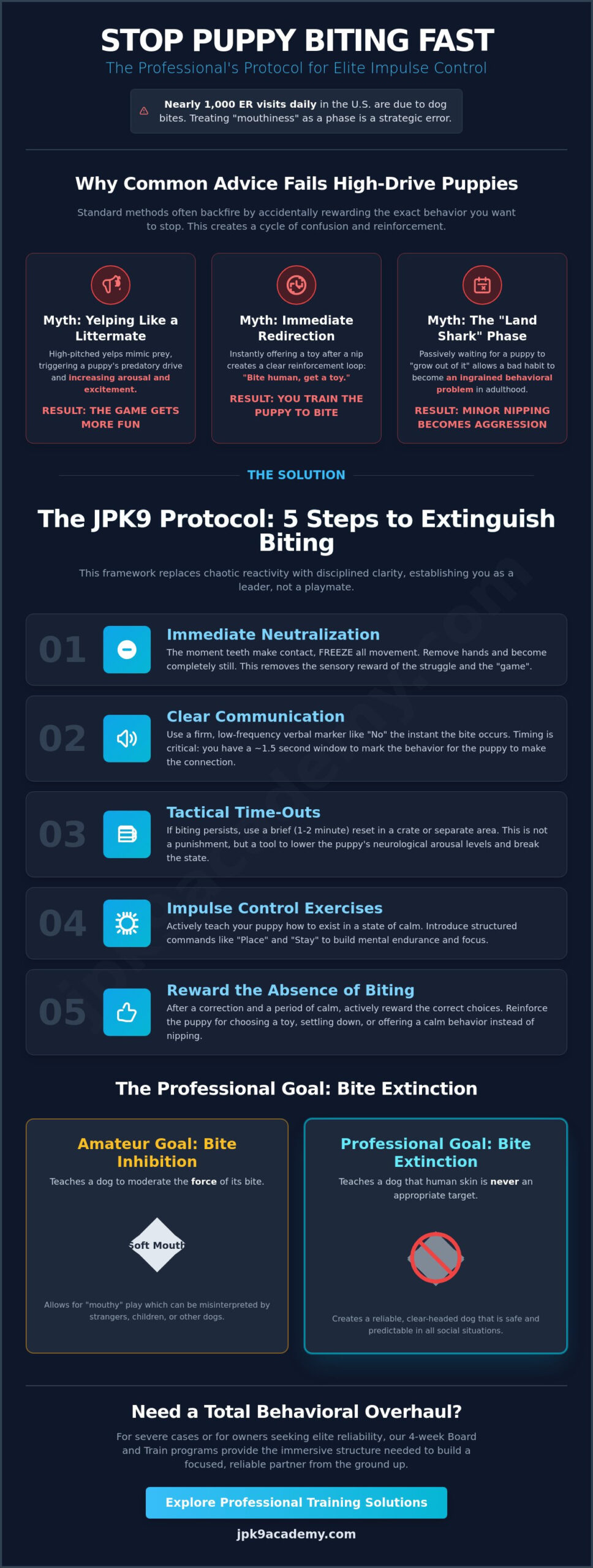
Many owners fail to learn how to stop puppy biting fast because they apply human logic to a canine drive. Standard advice often suggests yelping like a littermate or turning your back to “ignore” the behavior. These passive methods are fundamentally flawed. While Bite inhibition focuses on teaching a dog to moderate the force of its jaws, professional trainers aim for total behavior extinction in inappropriate contexts. Relying on “ows” and yelps often backfires with high-drive breeds. To a puppy with a high predatory drive, a high-pitched squeal mimics the sound of wounded prey. Instead of discouraging the bite, you’ve just signaled that the game has reached an exciting new level of intensity.
If you want to know how to stop puppy biting fast, you must transition from a passive victim to a disciplined handler. Biting is a self-rewarding behavior. The physical sensation of teeth on skin provides sensory feedback that reinforces the habit every time it happens. Simply “ignoring” a puppy that is currently latched onto your calf allows that reinforcement to continue. You aren’t teaching a lesson; you’re providing a chew toy. Elite reliability requires a shift in mindset. You must establish yourself as a high-performance coach who provides clear, unwavering boundaries rather than a playmate who occasionally complains.
The Myth of the “Land Shark” Phase
Labeling destructive nipping as a “phase” is a dangerous dismissal of a developing behavioral problem. While teething involves a physical need to soothe sore gums, behavioral biting is a test of boundaries and authority. Waiting for a puppy to “grow out of it” frequently leads to adult dogs that use their mouths to manipulate or control their environments. This passivity is how minor nipping evolves into the statistics seen in emergency rooms. Rigorous structure is the highest form of care for a developing dog, providing the essential safety of clear expectations.
When Redirection Becomes a Reward
One of the most common mistakes handlers make is immediate redirection. When a puppy bites your hand and you instantly shove a toy into its mouth, you’ve completed a reinforcement loop. The puppy learns a simple sequence: “Bite the human, get the toy.” You are accidentally training your dog to nip you whenever they want to play. To break this cycle, you must establish a “clear air” period. A correction must be distinct and final before any alternative reward is offered. This separation ensures the puppy understands that the toy is a reward for calm focus, not a prize for aggression.
The JPK9 Protocol: 5 Steps to Stop Puppy Biting
Stopping unwanted behavior requires a systematic approach that leaves no room for ambiguity. The JPK9 Protocol is designed for those who want to learn how to stop puppy biting fast through a rigorous, five-step framework. While organizations like the ASPCA provide resources on Mouthing, Nipping and Biting in Puppies, our protocol focuses on the immediate shift from play to precision. This process begins with neutralization. You must remove the reward of your movement or skin the moment teeth make contact. If the puppy doesn’t get the reaction they seek, the behavior loses its value.
The protocol follows these five essential pillars of development:
- Step 1: Immediate Neutralization – Freeze all movement and remove your hands from the puppy’s reach to eliminate the sensory reward.
- Step 2: Clear Communication – Apply a verbal marker the instant the bite occurs to identify the error.
- Step 3: Tactical Time-Outs – Use a brief reset in a crate to lower the puppy’s neurological arousal levels.
- Step 4: Impulse Control Exercises – Introduce commands like “Place” and “Stay” to teach the puppy how to exist in a state of calm.
- Step 5: Rewarding the Absence of Biting – Actively capture and reinforce moments where the puppy chooses a toy or a calm sit over nipping.
Mastering the Verbal Correction
Precision in communication is the hallmark of a disciplined handler. You must use a firm, low-frequency “No” to interrupt the biting reflex. This isn’t a shout; it’s a command delivered with unwavering authority. Timing is everything. You have a window of approximately 1.5 seconds to mark the behavior for the puppy to make the cognitive connection. Stay calm and stay disciplined. If you become emotional or high-pitched, you’ll likely increase the puppy’s excitement, defeating the purpose of the correction. If you find these mechanics challenging to implement alone, our Private Lessons provide the one-on-one coaching necessary to refine your timing and learn how to stop puppy biting fast.
Implementing Effective Time-Outs
A tactical time-out is a 2-minute reset, not a punishment. When a puppy enters a state of over-arousal, they lose the ability to process commands. Placing them in a crate for a short duration allows their heart rate to drop and their mind to settle. The crate must remain a neutral, safe space; never throw the dog in or show anger. Once the two minutes have passed and the puppy is quiet, re-introduce them to the environment. This reset confirms that calm behavior is the only ticket back to the social group.
Environmental Control: Preventing the Bite Before it Happens
Elite reliability is built on a foundation of environmental management. If you’re serious about learning how to stop puppy biting fast, you must stop the cycle of reaction and start engineering the environment to prevent the behavior from occurring. We utilize the House Line technique to maintain constant control. This involves a short, handle-free leash that the puppy wears indoors under supervision. It provides a physical connection that allows you to guide the dog away from forbidden targets without the physical struggle of grabbing a collar or chasing them. By eliminating the catch-me-if-you-can game, you remove the arousal that often fuels nipping.
Managing the Witching Hour requires identifying specific triggers like fatigue, hunger, or over-stimulation. In 2024, homeowners insurance companies paid $1.56 billion for liability claims involving dog bites and other injuries. This staggering figure underscores the necessity of early, rigorous control. While resources like Dealing with Normal Puppy Behavior often suggest simple redirection, we advocate for the strategic use of crates and exercise pens to manage arousal cycles. A puppy that has reached its neurological threshold cannot learn or self-regulate. They must be placed in a structured rest environment to reset their nervous system.
The Tactical Use of Tethers
Tethering is a powerful tool for teaching a puppy to exist calmly in your presence without constant access to your hands or ankles. By securing the puppy to a fixed point, you create a controlled space where they learn that access to the handler is a privilege, not a right. This management phase is the essential precursor for transitioning from tethered management to off-leash freedom and reliability. It removes the option of failure and ensures that every interaction remains productive and handler-led.
Managing High-Arousal Triggers
Free play in the house is a privilege earned through consistent obedience. High-arousal events like the zoomies are often symptoms of mental under-stimulation rather than a lack of physical exercise. You should replace chaotic running with structured engagement sessions that prioritize mental focus. When you control the beginning, middle, and end of every play session, you eliminate the opportunities for the puppy to practice mouthiness. This level of environmental control is the only way to achieve the results needed to stop puppy biting fast and establish long-term boundaries.
When Play Biting Signals a Deeper Issue
Distinguishing between biological play and emerging behavioral pathology is critical for the safety of your household. While most nipping is rooted in exploration, certain physical markers indicate a move toward aggression. You must watch for the “hard eye,” a fixed, unblinking stare accompanied by a rigid, stiff body posture. This differs significantly from the loose, wiggly movements of healthy social play. Learning how to stop puppy biting fast involves recognizing these signals before they escalate into a dangerous confrontation. If the puppy’s body goes still and their ears pin back, you are no longer dealing with a playmate; you are dealing with a dog testing its capacity for conflict.
Resource guarding often manifests during play, where a puppy bites to protect a toy, food, or even a specific person. In Northern California, owners of high-drive working breeds like German Shepherds or Belgian Malinois must be especially vigilant. These breeds possess an innate intensity that requires a higher standard of leadership. When boundaries are inconsistent, puppies often resort to frustration-based biting as a way to demand attention or control their environment. This is not a phase. It’s a communication of perceived dominance that requires a rigorous, professional framework to resolve.
Reactivity vs. Normal Development
If your puppy bites when cornered, startled, or handled, they may be operating from a state of fear or anxiety rather than playfulness. This is known as reactivity. Many entry-level “positive only” approaches fail high-drive or reactive puppies because they lack the necessary structure to address the underlying neurological state. If you observe your dog snapping with a closed mouth or growling with bared teeth, it is time to seek a professional evaluation in Sacramento. Our Behavior Modification programs are specifically designed to resolve these deep-seated issues through disciplined, evidence-based protocols.
The Risk of Adult Biting Habits
The transition from a puppy nipping to an adult dog biting is a matter of jaw strength and learned success. In the United States, there are about 4.5 million dog bites each year, and California Civil Code 3342 imposes strict liability on owners for any damages. An adult dog that never learned skin sensitivity is a significant legal and physical liability. Investing in professional puppy training in Elk Grove prevents the development of these lifelong habits. As a dog matures, their ability to inflict damage increases exponentially. You must learn how to stop puppy biting fast now to ensure the ultimate gift of safety and liberty for your dog in the future.
Elite Solutions: Professional Puppy Training in Sacramento
For owners who demand elite reliability, a professional intervention is often the most efficient path forward. You’ve learned the protocols, but implementing them with surgical precision requires a level of consistency that a busy lifestyle may not always allow. This is where JPK9 Academy provides the definitive solution for those wondering how to stop puppy biting fast. Our professional environment is engineered to remove distractions and focus entirely on the total behavioral overhaul of your dog. We treat the training process as a serious craft, ensuring that every repetition moves the puppy closer to a state of disciplined focus.
Serving the Sacramento region, we provide customized methodologies that address the specific drive and temperament of your dog. Whether you’re struggling with a high-drive working breed or a family companion that has developed a habit of testing boundaries, our framework is designed for transformation. We move quickly past basic tips to the core of behavioral principles, providing a structured environment where failure is not an option. This level of professional oversight is the only way to ensure that the progress made is both immediate and permanent.
The Board and Train Advantage
A 3-week or 4-week Board and Train program offers an immersive experience that weekly classes simply cannot replicate. In our facility, the puppy is under professional supervision throughout the day, ensuring that every interaction reinforces the desired outcome. This constant feedback loop is the most effective way to break entrenched habits and learn how to stop puppy biting fast. We address the root cause of mouthiness through k9 training in Sacramento, focusing on neurological calm and impulse control. While entry-level puppy classes might offer generic suggestions, our residential programs provide the foundational strength required for elite performance.
Partnering with JPK9 Academy
The most critical component of our methodology is the Hand-Off process. We don’t just train the dog; we mentor the owner to maintain the high standards established during the program. Families in Sacramento and Elk Grove trust our balanced, results-driven approach because we prioritize the bond between handler and dog as a partnership requiring clear communication. You deserve a home environment defined by order rather than the chaos of constant nipping. Your next step is to book a professional evaluation to determine which of our programs is the correct fit for your goals. Reclaim your home and transform your puppy into a reliable, disciplined companion.
Establishing the Standard for a Lifetime of Reliability
Mastering how to stop puppy biting fast is the first step in a larger journey toward elite canine performance. You’ve learned that passive reactions only fuel arousal and that true progress requires a combination of environmental management and immediate, clear communication. By moving beyond the land shark myth, you ensure your dog develops the impulse control necessary for total safety and liberty. This disciplined approach transforms a chaotic household into a structured partnership defined by mutual respect.
Since 2018, JPK9 Academy has served the Sacramento, Elk Grove, and Northern California regions by specializing in behavior modification for even the most challenging breeds. Our results-driven methodology is designed for owners who refuse to settle for mediocrity and are truly committed to the training process. If you’re ready to transition from managing a struggle to leading a disciplined partner, it is time to take the next step. Success is the only acceptable outcome when the correct framework is applied with consistency.
Apply for an Elite Puppy Evaluation at JPK9 Academy today to reclaim your home and set the foundation for elite reliability. We’re here to guide you through every stage of this transformation with the authority and expertise your dog deserves. Your commitment to this process is the ultimate gift of freedom for your dog.
Frequently Asked Questions
How long does it take to stop puppy biting using professional methods?
Professional methods provide immediate clarity, though total extinction of the biting habit typically occurs within two to four weeks of rigorous consistency. The timeline for how to stop puppy biting fast depends on the handler’s ability to maintain unwavering boundaries. Immersive programs like our 4-week Board and Train accelerate this process by removing the opportunity for the puppy to practice incorrect behaviors in a controlled, professional setting.
Is it okay to tap a puppy on the nose to stop them from biting?
Avoid tapping the nose; it’s a weak tactic that often triggers a “fight” response or increases arousal. Professional frameworks prioritize clear communication and environmental management over physical confrontation. If you use physical taps, you risk damaging the bond of trust and causing the puppy to become hand-shy or defensively reactive during future handling. Disciplined handlers focus on neutralizing rewards rather than physical intimidation.
Why does my puppy bite me more when I tell them “No”?
If your puppy bites more after a “No,” it’s likely because your correction lacks authority or carries too much emotional arousal. High-pitched or repetitive commands can mimic play signals, causing the puppy to increase their intensity. Learning how to stop puppy biting fast requires a low-frequency, firm verbal marker that is immediately followed by the removal of all interaction and rewards. This ensures the puppy understands that “No” signals the end of the game.
Can a 4-week board and train really fix my puppy’s nipping issues?
A 4-week Board and Train is the most effective way to resolve nipping because it establishes a baseline of elite reliability through hundreds of professional repetitions. This immersive environment allows us to identify the root cause of the behavior and install a clear communication system. It’s designed for owners who are committed to a total behavioral overhaul and want to reclaim their home from the stress of a “land shark” puppy.
What is the best toy to redirect a biting puppy toward?
Utilize long toys like flirt poles or long tugs to create physical distance between your skin and the puppy’s mouth. The goal is to satisfy the biological urge to bite while keeping your hands outside the strike zone. Redirecting to small toys often leads to accidental nipping, which undermines the progress of your training protocol and reinforces the very behavior you are trying to extinguish. Structure every play session to be handler-led.
What should I do if my puppy starts biting my children?
You must implement immediate environmental control by using crates and house lines to prevent unsupervised access to children. Children’s erratic movements and high-pitched voices naturally trigger a puppy’s predatory drive. Every interaction between a puppy and a child must be handler-led and highly structured to ensure safety. This management phase is essential until the puppy has demonstrated consistent impulse control under the guidance of an adult handler.
How do I know if my puppy’s biting is aggressive or just play?
Healthy play biting is characterized by loose, bouncy body language and a relaxed mouth. Conversely, emerging aggression involves a “hard eye,” a stiffened torso, and ears pinned back. If your puppy exhibits these rigid physiological markers, you are no longer dealing with a developmental phase. You need a professional evaluation to address potential behavioral pathology before the dog reaches maturity and becomes a significant liability.
Does neutering or spaying my puppy stop the biting behavior?
Neutering or spaying will not resolve biting behaviors because nipping is a learned behavioral response rather than a hormonal drive. Relying on medical procedures to fix a training deficit is a strategic failure. Long-term success is only achieved through a rigorous framework of structure, clear consequences, and the development of impulse control. Our methodology focuses on the relationship between rigorous standards and eventual autonomy regardless of the dog’s reproductive status.