A Belgian Malinois that doesn’t get a job will invent one. Fence fighting. Herding the kids. Taking a couch apart cushion by cushion while you’re at work. All three showed up in the same dog inside a single year: a two-year-old Malinois in Roseville who chewed through two Adirondack chairs before his owner called a trainer.
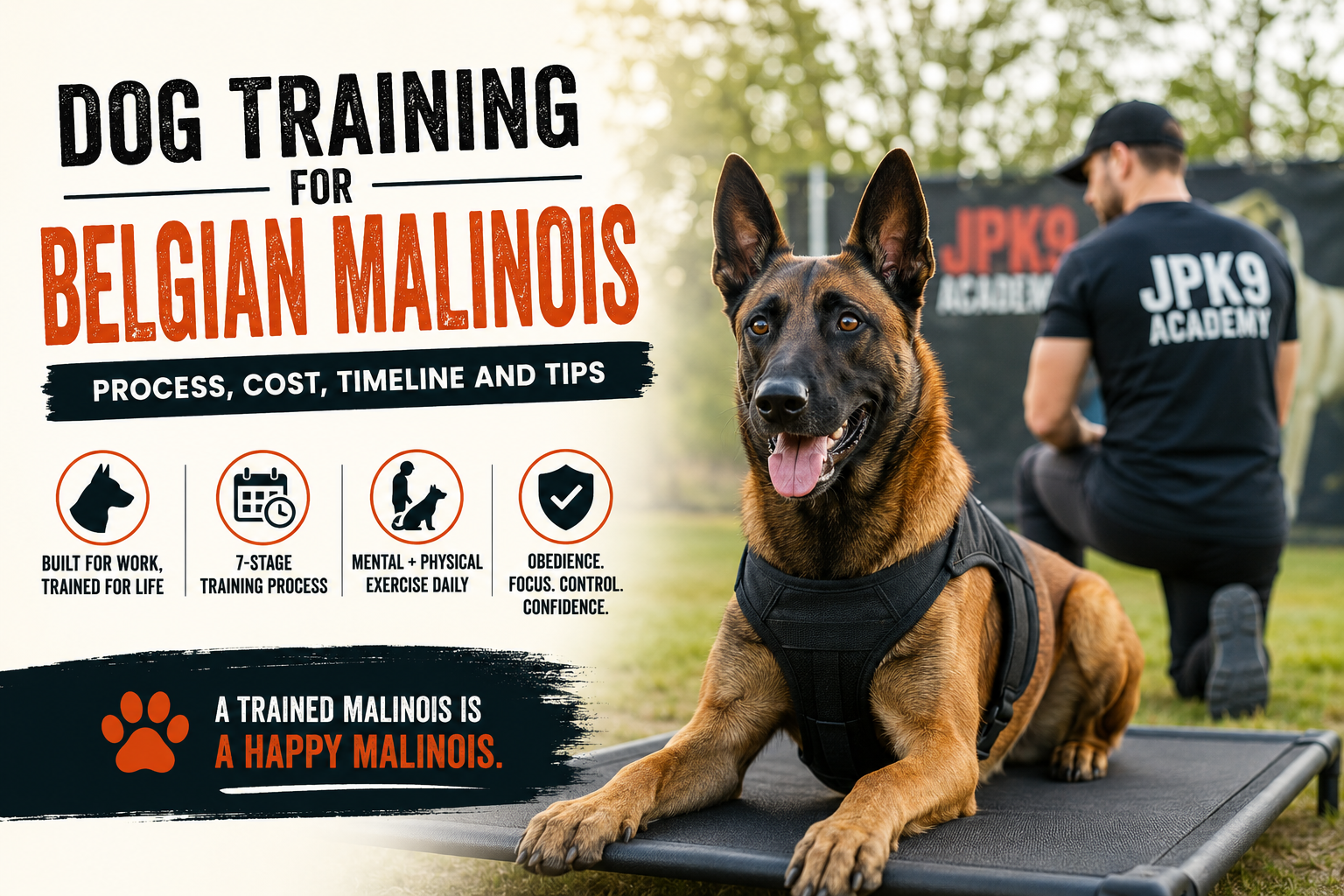
That’s not a warning label. It’s the starting point for understanding what this breed actually needs. Malinois training runs on seven stages, from socialization at eight weeks to advanced drive work near a year old, and it asks for a minimum of two hours of real physical and mental work every single day. Skip that, and the dog doesn’t get calmer. It gets creative.
What Is Belgian Malinois Training, Really?
Most obedience programs teach commands. Malinois training does something closer to redirection. It takes the exact same drive that makes the breed exceptional at detection work, protection sport, and search and rescue, and points it somewhere useful before the dog points it somewhere destructive.
The breed came out of Belgium in the 1880s as a herding dog, and within a few decades it had become the preferred choice for military and police units worldwide, including the U.S. Secret Service. That history isn’t trivia. It’s the reason a Malinois in a suburban living room carries genetics built for work that no living room requires. Training this breed means managing three things at once: extreme drive, extreme intelligence, and an attachment to one handler that borders on obsessive. None of the three responds to a standard six-week puppy class.
Why Standard Obedience Programs Don’t Cut It
Four traits force the specialization, and each one on its own would be manageable. Together, they’re not.
Working energy. An adult Malinois needs two or more hours of hard exercise daily. A thirty-minute leash walk covers maybe fifteen percent of that. The other eighty-five percent goes somewhere. Usually into your furniture.
Prey drive. Decades of ring sport and police work selected for dogs that chase and grip without hesitation. Bikes, joggers, cats, running kids: all of it fires the same circuitry a stranger with no training background has no idea is even there.
Handler intensity. The bond a Malinois forms with one person is closer to a shadow than a pet-owner relationship. Done right, that intensity speeds up training enormously. Left unmanaged, it turns into separation anxiety severe enough to put a dog through a door.
Speed of learning. Here’s the trap: a Malinois learns bad habits exactly as fast as good ones. One successful counter-surf and you’ve got a permanent counter-surfer. The training has to outrun what the dog is already teaching itself, every single day.
The Seven-Stage Process
Every stage builds on the one before it. Skip one, and the gap shows up later, usually at the worst possible moment.
- Socialization, 8 to 16 weeks. Get the puppy exposed to a hundred-plus people, surfaces, sounds, and calm dogs while that window’s still open. Miss it, and novelty reads as threat for the rest of the dog’s life.
- Foundation obedience, 8 weeks onward. Sit, down, recall, name response: five to ten minutes at a time, three or four times a day. Short sessions beat long ones here, every time.
- Impulse control, 12 weeks onward. Waiting at doors. Calm crate behavior. Leaving food alone until released. This is the stage that separates a working dog from a wild one, and it’s the one owners are most tempted to rush.
- Drive outlets, 4 months onward. Give the drive a legal job: tug with rules, flirt pole work, scent games. A Malinois with a job stops inventing one.
- Leash and public neutrality, 4 to 8 months. Proof calm behavior around bikes, dogs, joggers, and crowds, at increasing intensity. This is what prevents the leash reactivity this breed is known for.
- Off-leash reliability, 6 to 12 months. Extend recall and heel to distance and distraction, long line first, then free. Off-leash freedom gets earned in stages. It’s never just granted.
- Advanced work, 12 months onward. Sport, agility, scent detection, or a structured daily routine that keeps a working brain employed for the next decade-plus.
What Age Should Training Start?
Eight weeks, the week the puppy comes home. The socialization window closes around sixteen weeks, and for this breed that closing matters more than it does for almost any other. A Malinois that misses it carries suspicion of strangers into adulthood, and the breed’s protective instincts turn that suspicion into something closer to a liability than a personality trait.
Adult and rescue Malinois start immediately, whatever their age. The program just gets built around whatever habits the dog already taught itself before anyone stepped in.
Training a Malinois Puppy
Short reward-based sessions, three or four times a day. Cap the physical exercise. Growing joints don’t need a Malinois’s enthusiasm working against them. And treat biting as lesson one, not an afterthought, because Malinois puppies bite harder and longer than nearly any other breed. Gripping is in the blueprint.
The fix is consistent: redirect to a tug, end play instantly the second teeth touch skin, and get everyone in the house doing it the same way. Three rules protect the outcome here. Exercise stays capped at five minutes per month of age per session until the dog turns one. A leggy ten-month-old Malinois begging for more is not a reason to give it. Crate training starts day one, because a dog without an off-switch location never develops an off switch. And herding nips at ankles or kids get redirected immediately, since a behavior that’s mildly funny at ten pounds stops being funny at sixty-five. JPK9 Academy’s puppy training program builds this whole foundation starting at eight weeks.
How Much Exercise Does a Malinois Actually Need?
Two hours minimum, daily, split between physical and mental work. Running, structured fetch, swimming, and bike work cover the physical side. Scent games, obedience sessions, and puzzle feeding cover the mental side. Twenty minutes of scent work will tire a Malinois out faster than an hour of running does.
Sacramento adds its own wrinkle. Once summer temperatures push past ninety-five, hard exercise moves to early morning and mental work carries the midday load instead.
What Does Belgian Malinois Training Cost?
In the Sacramento area, expect to pay somewhere between $1,300 and $4,200, depending on the format. At JPK9, private lesson packages run $1,300 for four sessions or $3,000 for eight. Board and train programs, generally the better fit for a high-drive working breed, run $3,200 for three to four weeks, or $4,200 for four to five. Phone consultations are free. An in-person evaluation is $100 anywhere in the greater Sacramento area.
|
Format |
Cost |
Duration |
Best For |
|
Private lessons (4) |
$1,300 |
4–6 weeks |
Committed owners building foundation skills with coaching |
|
Private lessons (8) |
$2,800 |
8–12 weeks |
Puppy-to-adolescent full foundation, owner as handler |
|
Board and train (3–4 wk) |
$3,200 |
21–28 days |
Adolescent Malinois with installed bad habits needing immersion |
|
Board and train (4–5 wk) |
$4,200 |
28–35 days |
Reactivity, severe drive issues, or full off-leash goals |
Training it yourself costs less money and, for this specific breed, more in outcomes. A Malinois punishes inconsistency faster than almost any family dog, and the most expensive Malinois out there is the one that gets retrained at eighteen months after a year of self-teaching nobody caught in time. For the full price breakdown across every format, see how much dog training costs in Sacramento.
How Long Does It Actually Take?
Basic obedience: 8 to 12 weeks. Public neutrality: 4 to 6 months. Full off-leash reliability: 6 to 12 months. The breed learns individual commands in days, which misleads a lot of new owners. The timeline was never about how fast the dog learns. It’s about proofing drive control against distraction that keeps getting harder. After that, training continues at a maintenance level for the dog’s fourteen to sixteen years, because a working brain doesn’t retire on its own.
What Does a Fully Trained Malinois Cost to Buy?
Somewhere between $15,000 and $60,000 from professional protection programs, with elite executive-protection lines running past $100,000. That price covers eighteen to thirty-six months of professional development, working-line genetics, health testing, and, for protection dogs specifically, certified bite work under a professional decoy.
The market splits roughly into three tiers. Started dogs with foundation obedience: $8,000 to $15,000. Fully trained family and estate protection dogs: $15,000 to $60,000. Titled competition and executive-protection dogs: $60,000 to $150,000. Buying a finished dog trades money for time. Training a dog you already own through a professional program costs $1,300 to $4,200 in this area, and it builds the handler skills a purchased dog still demands from you. A finished dog handed to an unprepared owner loses its training within months. That’s exactly why handler education is part of any honest sale in this market, not an upsell.
Common Mistakes to Avoid
Buying the breed for its look. A Malinois is a fourteen-plus-year commitment of two-plus daily hours, not a striking addition to a family photo.
Exercising the body, starving the brain. A physically exhausted Malinois with nothing for its brain to do just becomes a fitter version of the same problem.
Punishing drive instead of channeling it. Suppressed prey drive doesn’t disappear. It resurfaces as reactivity, which is exactly what aggressive dog training exists to undo. Drive needs an outlet, not a lid.
Waiting until adolescence to start. The dog’s been training itself since day one. By eight months, you’re competing against six months of habits it installed without you.
Granting off-leash freedom before it’s earned. One successful chase of a jogger rehearses the exact behavior the training was supposed to prevent.
Inconsistent rules across the household. A Malinois finds the gaps between household members within days and keeps a separate rulebook for each person.
Attempting protection work without a foundation. Bite sport stacked on weak obedience doesn’t produce a protection dog. It produces a liability. Foundation first, always. No exception to this has ever worked out well.
Is a Malinois a Good Family Dog?
For the right family, yes. For most families, no, and it’s better to say that upfront than to see the dog surrendered at ten months.
The honest screening question: does your household already hike, run, or train daily without a dog? If yes, you’ll likely gain a genuinely spectacular partner. If no, you’re looking at a sixty-five-pound problem with a fourteen-year warranty. First-time owners get steered toward other breeds constantly by trainers who love this breed the most. Loving it means being honest about what it costs the people living with it.
Belgian Malinois vs. German Shepherd: Which Is Harder to Train?
For the average owner, it’s the Malinois, not close. Both breeds pick up commands at an elite pace. The real difference sits in the energy floor and how much room there is for owner error.
|
Trait |
Belgian Malinois |
German Shepherd |
|
Daily exercise floor |
2+ hours, non-negotiable |
60–90 minutes |
|
Indoor off switch |
Trained, never default |
More natural settle |
|
Forgiveness of owner mistakes |
Low, errors install fast |
Moderate |
|
Weight |
40–80 lbs |
50–90 lbs |
|
Best owner profile |
Working-dog experience or trainer support |
Committed active family |
Getting Trained in Sacramento
JPK9 Academy in Elk Grove runs this program, working with high-drive breeds across Sacramento, Elk Grove, Roseville, Vacaville, and Fairfield. Owners searching for Malinois training near Roseville’s Fiddyment Farm subdivisions or Vacaville’s commuter neighborhoods, where a dog often spends long stretches alone, are within an hour of the facility from any of the cities listed above. Board and train tends to suit this breed particularly well: the dog lives inside structured work for three to five weeks, drive outlets become daily routine, and the handoff session transfers the whole system back to you. Start with the free phone consultation, then book the $100 in-person evaluation when you’re ready.
One Malinois puppy, Vander, arrived at JPK9 at ten months for board and train after his owners realized a thirty-minute walk wasn’t touching the surface of what he needed. Three weeks later he went home with real focus and manners neither of them had seen from him before. Not because Vander suddenly became a different dog. Because he finally had somewhere to put all that drive.