
Training isn’t a finished product you purchase; it’s a high-performance lifestyle you inherit. You’ve invested in an elite program because you demand excellence, but the transition from a structured facility to a busy home often triggers a valid fear of regression. It’s natural to feel a sense of pressure when you first take the leash back, wondering if you can truly uphold the standard of off-leash reliability in high-distraction environments like Sacramento’s public parks. You aren’t looking for a temporary fix; you’re seeking a total behavioral overhaul that lasts.
Mastering how to maintain board and train results is the critical difference between a dog that listens only in a vacuum and one that offers total reliability in the real world. This blueprint provides the professional framework you need to transfer leadership seamlessly and handle your tools with absolute certainty. We’ll explore the specific protocols to bridge the gap between our facility and your daily routine, ensuring your household remains harmonious and your dog remains safe. You’re about to learn the disciplined mechanics of lasting success and the true path to off-leash liberty.
Key Takeaways
- Implement the “Homecoming Protocol” during the critical first 48 hours to prevent testing behavior and secure the leadership transfer.
- Learn how to maintain board and train results by treating every command as a non-negotiable contract rather than a suggestion.
- Utilize the “Place” command as a foundational anchor to lower household stress and manage high-distraction environments effectively.
- Apply the 15-Minute Rule for daily reinforcement, ensuring elite performance translates from the facility to Sacramento’s public parks.
- Leverage private follow-up lessons to refine your handling mechanics and maintain the rigorous standards established during the program.
The Critical Transfer of Leadership: Navigating the First 48 Hours
The first 48 hours after your dog returns home are not a vacation; they are the most intense phase of the leadership transfer. Your dog has spent weeks under a rigorous, professional framework, but they are now returning to the environment where their old, unwanted habits were born. Dogs are highly situational learners. They remember the version of you that allowed leash pulling or ignored a “Sit” command. If you don’t disrupt those old associations immediately, you risk a rapid decline in performance. Understanding how to maintain board and train results starts with recognizing that your dog will “test” the boundaries of their new home to see if the rules from the academy still apply to you.
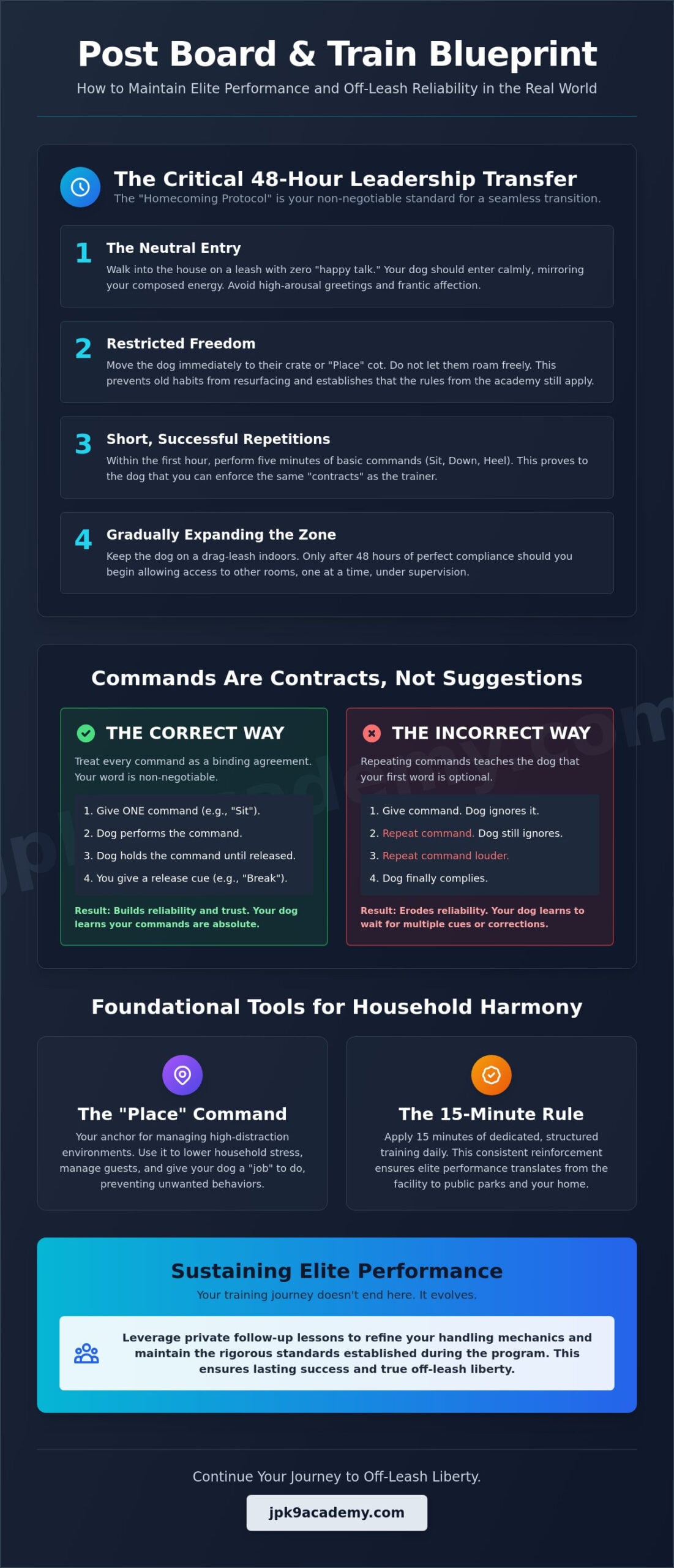
The “Homecoming Protocol” is our non-negotiable standard for this transition. It requires you to eliminate high-arousal greetings, frantic affection, and immediate freedom. When your dog walks through the front door, they should be on a leash and moved directly to a designated “Place” or their crate. This emotional discipline signals that while the location has changed, the standards remain elite. You are no longer just a provider of resources; you are the primary source of direction and safety. Using the crate during the first week is your most effective tool for success. It prevents the dog from making self-rewarding mistakes, like jumping on guests or counter-surfing, before you’ve had the chance to establish your authority in the home.
The Psychology of the Transition
Environmental triggers are powerful. The sight of your backyard or the sound of the doorbell can spark muscle memory of past reactivity. This is why “affection without direction” leads to immediate regression. If you shower your dog with unearned praise the moment they return, you dissolve the “work mode” mindset they developed at our facility. By adhering to foundational dog training principles, you ensure that every interaction reinforces the new hierarchy. Maintaining this mindset requires you to treat every movement as a deliberate choice, ensuring your dog looks to you for permission before engaging with their surroundings.
Your Step-by-Step Homecoming Schedule
- Step 1: The Neutral Entry. Walk into the house on a leash with zero “happy talk.” Your dog should enter calmly, mirroring your composed energy.
- Step 2: Restricted Freedom. Move the dog immediately to their crate or a “Place” cot. Do not let them roam the house to “sniff around,” as this encourages territorial marking or searching for old triggers.
- Step 3: Short, Successful Repetitions. Within the first hour, perform five minutes of basic commands: Sit, Down, and Heel. This proves to the dog that you are capable of giving and enforcing the same “contracts” the trainer did.
- Step 4: Gradually Expanding the Zone. Keep the dog on a drag-leash even inside. Only after 48 hours of perfect compliance should you begin allowing access to other rooms, one at a time.
Mastering the Language of Consistency: Commands as Contracts
At JPK9 Academy, we don’t view obedience as a series of tricks. We view every command as a non-negotiable contract. When you tell your dog to “Sit,” you are establishing a binding agreement that they remain in that position until you provide a release. This mindset is the bedrock of how to maintain board and train results long after the graduation ceremony. If you allow your dog to break a command without a correction, you aren’t just being lenient; you’re teaching them that your word is negotiable. Reliability is born from the certainty that every command will be seen through to completion.
Consistency across the entire household is paramount. If one family member uses “Down” while another says “Lay down,” the dog receives conflicting data. This confusion erodes the foundation we built. You must standardize every verbal and visual cue among all handlers in the home. Most importantly, you must stop repeating yourself. Saying a command twice is the fastest way to lose reliability. It teaches the dog that the first command is optional and the second or third is the one that actually matters. If the dog doesn’t respond to the first command, you don’t repeat the word; you apply a correction using the established framework.
Tool Proficiency for the Handler
Clear communication requires the right hardware. The sprenger dog collar acts as a communication bridge, providing clear, tactile feedback that mimics the natural corrections dogs use with one another. It must be placed high on the neck, directly behind the ears, and fitted snugly enough that it doesn’t rotate. A loose collar creates “noise” and inconsistent signals, which frustrates the dog and undermines your authority.
When using the Dogtra 280c, you must identify your dog’s working level. This is the lowest setting where the dog perceives the sensation without showing signs of stress or flinching. Timing is everything. A correction must occur within 1.5 seconds of the infraction to be effective. If your timing is off, you’re merely creating confusion rather than clarity. Mastering these mechanics is often easier with the professional guidance found in our private lessons, where we refine your handler skills in real time.
Eliminating Command Confusion
In our system, “Sit,” “Down,” and “Place” all have implied duration. Your dog stays in the command until you say “Break” or “OK.” The release command is the most vital part of the contract because it marks the end of the work. Without a clear release, the dog is forced to guess when they are finished, which leads to self-releasing and boundary testing. When a correction is necessary, use the “No” marker with absolute confidence. It isn’t an emotional outburst; it’s a calm, authoritative signal that the current behavior has failed to meet the standard.
Structure as a Gateway to Freedom: Re-establishing Household Boundaries
Many owners mistakenly equate structure with restriction. In reality, a total lack of clear boundaries is what forces a dog into a state of hyper-vigilance and chronic stress. When a dog doesn’t understand the rules of the home, they feel a self-imposed responsibility to manage every doorbell ring, guest arrival, and passing squirrel. This mental burden leads directly to anxiety and reactivity. By implementing a rigorous framework of household boundaries, you relieve your dog of the need to make executive decisions. This psychological relief is a core pillar of how to maintain board and train results; you are providing the mental peace that only comes from knowing exactly what is expected at all times.
Respect for thresholds is the first step in reclaiming your home’s energy. Every door, gate, or car hatch represents a transition point where your dog must look to you for permission. They should sit and wait for a release command before crossing any boundary. This isn’t just about politeness. It’s a foundational exercise in impulse control that reinforces your role as the decision-maker. Similarly, feeding rituals should be treated as a training session. Requiring your dog to remain in a “Sit” or “Down” until you give the release to eat transforms a frantic, high-arousal event into a calm exercise in patience and focus.
The “Place” Command Blueprint
The “Place” command is the ultimate anchor for a high-distraction household. We utilize a raised cot or specific mat because the physical boundary provides the dog with absolute mental clarity; they are either on the bed or they aren’t. Use “Place” during dinner, when guests arrive, or whenever the household becomes chaotic. You must build duration systematically. Start with 15-minute sessions and gradually work toward a two-hour stay. This duration work is what develops a dog’s “off switch,” allowing them to exist calmly in the same room as you without demanding constant attention or management.
Managing Freedom in the House
Freedom is an earned privilege, not a birthright. For the first several weeks post-graduation, we recommend the “drag leash” method. A light leash trailing behind your dog allows you to provide immediate, low-level corrections if they test a boundary, such as sniffing the counter or approaching the front door without permission. High-value areas like the couch or your bed should be off-limits initially. These spaces represent high status in a dog’s mind. They should only be accessible via a specific invitation once your dog has proven they can maintain elite standards of behavior without constant supervision. Your goal is a transition to total autonomy, but rushing this phase is the most frequent cause of regression.
Proofing Results in the Real World: From Elk Grove Living Rooms to Sacramento Parks
Real-world reliability is the ultimate objective of any elite training program. While your dog may perform flawlessly in the quiet of your Elk Grove living room, the true test occurs when you step into the high-stakes environments of Land Park or Old Sacramento. A 2026 report indicates that nearly 40% of dog owners cannot control their pets in public spaces. You aren’t part of that statistic. Understanding how to maintain board and train results requires a commitment to proofing commands against increasingly difficult distractions. We utilize the JPK9 “Distraction Ladder” to ensure your dog remains focused regardless of the chaos surrounding them. You start in low-distraction zones and only climb to the next rung once your dog demonstrates 100% compliance.
The 15-Minute Rule is your tactical advantage for daily success. It doesn’t require a massive time commitment, but it demands absolute focus. By dedicating three five-minute blocks throughout your day to reinforcement, you solidify the “work mode” mindset. This is especially critical when proofing for dog aggression training in local environments. You must be the calm, authoritative presence that guides your dog through high-arousal triggers. If you allow your standards to slip during a casual walk, you are effectively telling your dog that the rules are situational. Consistency in the real world is what transforms a trained dog into a reliable partner.
Daily Maintenance Drills
- The Morning Routine: Spend five minutes practicing basic obedience like “Sit” and “Down” before breakfast. This reinforces that all resources come through you.
- The Walk with a Mission: Turn a standard stroll into a training session. Incorporate frequent “Heel” turns and random “Sits” to keep the dog’s engagement on you rather than the environment.
- The Evening Reset: Utilize the “Place” command while the family winds down for the night. This builds the mental endurance necessary for long-term behavioral stability.
Local Proofing Spots for Sacramento Owners
Sacramento offers a diverse range of environments to test your dog’s reliability. Start at Elk Grove Regional Park during off-peak hours to practice long-distance recalls and stays. Once your dog is proficient, move to Midtown Sacramento coffee shops to manage reactivity in tight, high-traffic spaces. For the ultimate test of off-leash freedom and safety, the Folsom Lake trails provide advanced challenges that require perfect handler focus and tool proficiency. Each location serves as a new classroom where you prove your leadership. If you find your dog struggling with these transitions, our advanced obedience group class provides the structured environment needed to bridge the gap.
The Distraction Ladder: Increasing Difficulty Safely
Never rush the proofing process. If your dog fails a command at a busy park, you’ve likely climbed the ladder too quickly. Drop back down to a quieter street and rebuild the confidence. Your goal is to create a history of success that the dog can rely on when the environment becomes overwhelming. By systematically increasing the level of noise, movement, and presence of other animals, you build a resilient mindset that remains unshakable. This disciplined approach is the only way to ensure your dog’s safety and your own peace of mind in public.
Sustaining Elite Performance: The JPK9 Academy Support System
The work doesn’t end when you drive away from our facility. In fact, the true test of your commitment begins the moment you step back into your own environment. We don’t just train dogs; we build elite handlers. The “Handoff Lessons” included in our board and train sacramento programs are the most critical component of the entire process. This is where we transfer the mechanics, the timing, and the mindset necessary to uphold the standards we’ve established. You inherit a finely tuned athlete. Our job is to ensure you have the coaching skills to keep that athlete at peak performance.
Complacency is the enemy of reliability. Even the most dedicated owners can fall victim to “The Six-Month Slump,” a period where small infractions are overlooked and boundaries begin to blur. This is exactly how to maintain board and train results over the long term: by identifying and correcting handler errors before they become ingrained habits. Follow-up private lessons act as a diagnostic tool for your partnership. We recommend scheduling your first follow-up within seven to ten days of graduation. This allows us to address real-world challenges you’ve encountered in your specific home environment while the training is still fresh.
Leveraging Follow-Up Support
We encourage our graduates to record their training sessions at home. Reviewing footage allows us to provide precise feedback on your leash pressure, body language, and command timing. If your dog isn’t responding with the same urgency they did at the academy, the issue is rarely the dog’s memory; it’s usually a subtle shift in the handler’s delivery. By utilizing our support system, you ensure that your communication remains crystal clear. We are your partners for the life of the dog, providing the professional oversight needed to navigate every developmental stage and environmental challenge.
The Path to Elite Reliability
Once you’ve mastered the basics in your neighborhood, it’s time to advance to our group classes. These sessions provide a high-intensity setting where your dog must maintain focus amidst a dozen other disciplined handlers and their pets. This is the final stage of socialization, where “obedience” matures into “reliability.” You aren’t just practicing commands; you’re joining a community of like-minded owners who refuse to settle for average behavior. Transitioning from basic obedience to total off-leash freedom is a journey of consistent, incremental wins. Ready to start the transformation? Book your free evaluation today and take the first step toward a lifetime of liberty and safety.
Master Your Role in the Partnership
Success in dog training is not a destination; it’s a standard you must uphold every day. You’ve been given a professional framework designed for elite performance and off-leash freedom. By mastering the leadership transfer in the first 48 hours and treating every command as a non-negotiable contract, you ensure the work done at our facility translates into your daily life. Learning how to maintain board and train results is the final piece of the puzzle that turns a temporary behavioral shift into a permanent lifestyle overhaul.
At JPK9 Academy, our family-owned expertise in behavior modification has transformed the lives of owners handling even the most aggressive and reactive dogs in Sacramento. We don’t just hand you the leash and walk away. We provide comprehensive owner support and rigorous hand-off training to ensure you are never alone in this process. You have the tools and the methodology. Now, it’s time to lead with confidence. Secure your dog’s future with a JPK9 Board and Train evaluation. Your journey toward total reliability and safety starts with a single decision to commit to the process.
Frequently Asked Questions
Will my dog still have the same personality after a board and train?
Your dog’s core personality remains intact, but the behavioral noise that once masked it is removed. Training doesn’t change who a dog is; it changes how they respond to the world. By eliminating anxiety and reactivity, you’ll likely see a more relaxed, confident version of your pet. They can finally enjoy life without the constant stress of making their own decisions. A structured dog is a happy dog.
What should I do if my dog starts ignoring commands a month after coming home?
Ignoring commands is a clear signal that your leadership has become negotiable. If this occurs, you must immediately return to the strict protocols established during graduation. This is the most common challenge when learning how to maintain board and train results. Tighten your household boundaries, eliminate unearned affection, and ensure every command is followed by a correction if ignored. Consistency is the only path back to reliability.
How much time do I realistically need to spend training my dog every day?
You realistically need about 15 minutes of dedicated training daily, divided into three five-minute blocks. This “15-Minute Rule” prevents burnout while keeping the dog’s skills sharp. Beyond these drills, training is simply a lifestyle. Incorporate commands like “Heel” during your walks and “Place” while you eat dinner. These integrated moments reinforce your authority without requiring hours of additional labor or complex scheduling.
Do I have to use the training collar forever?
The training collar should be viewed as a safety device, similar to a seatbelt in a vehicle. While many dogs eventually achieve high levels of reliability, keeping the collar on in high-distraction environments provides a necessary insurance policy. It ensures you can always communicate clearly if an unexpected emergency arises. Over time, the tool becomes a silent partner that your dog respects without the need for constant active use.
Can I still cuddle my dog and let them on the furniture?
You can absolutely cuddle your dog, but these interactions must happen on your terms. Affection is a powerful reward that should be earned through calm behavior and compliance. Regarding furniture, treat it as an invitation-only privilege rather than an entitlement. By maintaining this distinction, you preserve the hierarchy and ensure that your dog continues to respect the boundaries and leadership you have established in the home.
What is the biggest mistake owners make after their dog graduates?
The most significant error is granting total freedom too quickly. Owners often feel a sense of relief after graduation and stop enforcing the “Homecoming Protocol” within the first week. This lack of structure invites the dog to resume old habits and test established limits. Maintaining elite performance requires a disciplined transition where freedom is expanded only after the dog proves they can handle the responsibility consistently.
How do I handle guests coming over for the first time after training?
Use the “Place” command to anchor your dog before you even open the door. Guests should be instructed to ignore the dog entirely upon entry. This prevents the high-arousal greetings that lead to jumping, barking, or overstimulation. Once the energy in the room is neutral and the dog is calm, you may choose to release them for a controlled introduction. This structured approach ensures you remain in control.
What if my dog regresses during a stressful event, like moving or a new baby?
Stressful life events require a temporary return to maximum structure. If your dog begins to struggle during a move or the arrival of a new family member, increase their crate and “Place” time immediately. The familiar rules of the framework provide a sense of security and clarity amidst the external chaos. Re-establishing these foundational boundaries prevents short-term stress from turning into long-term behavioral regression or unwanted habits.