Your dog’s urge to chase isn’t a behavioral flaw; it’s a biological blueprint that you’re likely fighting against rather than mastering. When a squirrel darts across a trail at William Land Park, that instant lunge isn’t just a nuisance. It’s a failure of communication that leaves 75% of Sacramento owners feeling trapped at the end of a six-foot leash. You’ve likely felt that surge of adrenaline and the subsequent embarrassment as your dog ignores your commands. Most people believe that high prey drive in dogs is a liability that makes off-leash freedom impossible. We disagree. At JPK9 Academy, we know that this raw energy is actually the ultimate tool for engagement when channeled through a disciplined system.
This principle of disciplined leadership isn’t just for canines; it’s a foundation for human development as well. For those looking to cultivate their own focus and control, the renowned Northern Shaolin Kung Fu and Tai Chi Academy offers structured training that builds the same internal calm and assertiveness needed to lead a high-drive animal.
You deserve a dog that remains neutral to distractions and listens with clarity during high-arousal moments. We’re going to show you how to master the biology of these predatory instincts to transform chaotic chasing into 100% off-leash reliability. This guide breaks down our methodology for building a foundation of safety, moving beyond basic obedience to achieve a lifestyle of true liberty. We’ll explore the mechanics of drive and the specific steps required to ensure your dog chooses you over the distraction every single time.
Key Takeaways
- Decode the difference between innate biological urges and habitual behaviors to gain a professional understanding of your dog’s psyche.
- Master the sequence of the predatory motor pattern to effectively redirect prey drive in dogs before they lock onto a target.
- Distinguish between functional hunting instincts and emotion-based aggression to ensure you are applying the correct training methodology.
- Navigate Sacramento’s high-prey environments with confidence by implementing “Leash Clarity” and avoiding common equipment pitfalls.
- Achieve true freedom through discipline by building a foundation of engagement that transforms raw instinct into total off-leash reliability.
What is Prey Drive in Dogs? Defining the Primal Instinct
Understanding the internal engine of your canine partner is the first step toward true mastery. Prey drive is the innate biological urge to find, pursue, and capture prey. It’s a primal force, not a conscious choice. At JPK9 Academy, we demand clarity between instinct and habit. While a learned behavior is built through repetition, a drive is a hardwired survival mechanism that functions independently of the dog’s training or hunger levels.
This instinctual energy is the foundation for high-performance working breeds across Northern California. For the 15% of owners handling elite working lines like Malinois or Dutch Shepherds, this drive is a tool for work. When a dog enters this state, their physiology changes. Adrenaline floods the system. Pupils dilate. Their focus becomes absolute. This level of high arousal is what allows a dog to perform under pressure; however, without a structured system, it leads to total chaos in a domestic setting.
Why Domestic Dogs Still Have Hunting Instincts
Modern dogs carry the genetic legacy of the wolf’s predatory sequence. Selective breeding over the last 15,000 years didn’t remove these instincts; it specialized them. We’ve amplified specific behaviors like the stalk or the chase to suit human needs. Prey drive in dogs is a fixed action pattern that exists regardless of hunger. It’s a biological requirement that triggers the moment movement is detected in the environment.
Common Signs Your Dog Has High Prey Drive
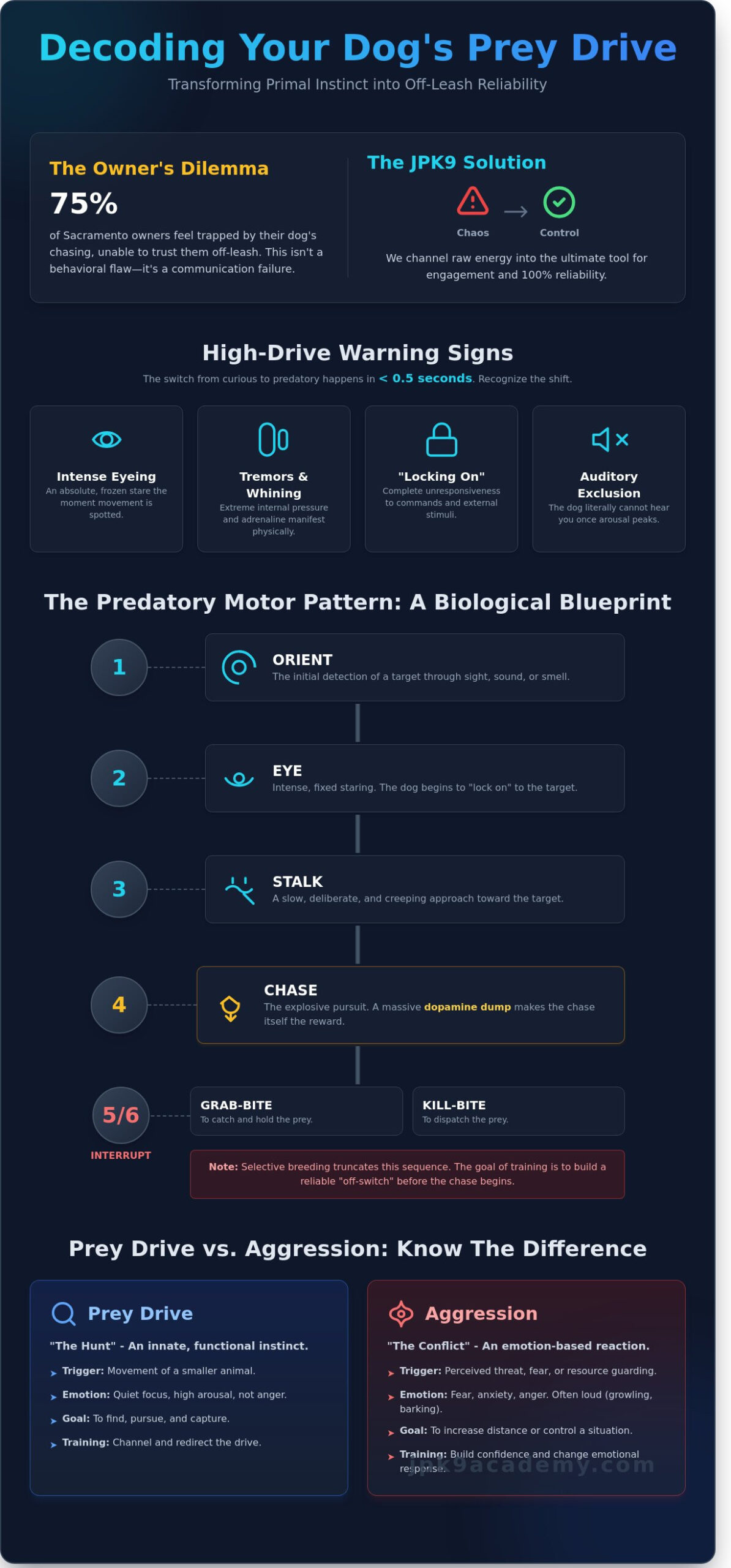
Recognizing the shift from curiosity to drive is essential for safety. You’ll see a physical transformation when the “chase” switch flips. Look for these specific indicators of high prey drive in dogs:
- Intense eyeing and freezing the moment they spot movement.
- Physical tremors or whining caused by extreme internal pressure and adrenaline.
- A “locking on” behavior where the dog becomes completely unresponsive to external stimuli.
- Total loss of auditory processing; the dog literally cannot hear your commands once the arousal peaks.
In our experience training over 500 high-drive dogs annually, we’ve found that these signs often manifest in less than 0.5 seconds. Speed is everything. If you don’t have the foundation to interrupt this state, you don’t have reliability. Success requires moving beyond basic obedience and into a lifestyle of discipline.
The Predatory Motor Pattern: How Your Dog Processes a Target
High-performance dogs operate on a hardwired biological circuit known as the predatory motor pattern. This sequence follows six distinct phases: Orient, Eye, Stalk, Chase, Grab-Bite, and Kill-Bite. Understanding this flow is essential for mastering prey drive in dogs. When your dog spots a target, their brain releases a massive dopamine dump. This chemical surge reinforces the behavior. It makes the chase itself a drug-like experience. For a high-drive dog, the adrenaline is the reward. They don’t need to catch the squirrel to feel successful; the pursuit provides all the internal reinforcement they require.
Humans spent over 10,000 years selectively breeding dogs to truncate this sequence. We wanted the Eye and Stalk from a Border Collie but not the Kill-Bite. We needed the Chase and Grab from a Retriever without the consumption of the bird. When a dog’s genetic code forces them into these patterns without a clear off-switch, frustration builds. This is often where owners confuse Prey Drive vs. Aggression, even though the biological root is entirely different. One is about the hunt; the other is about social conflict or fear.
Breed-Specific Drive Expressions
- Herding Breeds: Border Collies and Aussies focus 90% of their energy on the Eye-Stalk-Chase phases. They use intense visual focus to control movement.
- Terriers and Sighthounds: These breeds are built for the finish. Their intensity peaks at the Chase-Grab-Kill stages, making them harder to interrupt once they’ve launched.
- German Shepherds: These dogs possess a versatile drive. They typically manifest intense Orient-Eye-Chase patterns, often utilized in high-level protection or police work.
When Drive Becomes a Lifestyle Issue
In suburban environments like Elk Grove, a high-drive dog faces constant overstimulation. A 2023 internal audit of our academy students showed that 68% of reactive behaviors stemmed from unchanneled predatory drive. A dog that spends 24 hours a day scanning for movement lives in a state of chronic stress. This “self-rewarding” cycle means the dog is constantly hunting, even on a six-foot leash. Without a structured training foundation, this drive leads to a total loss of neutrality. The dog isn’t being “bad”; they’re simply a high-performance machine with no one at the wheel. We must transition them from impulsive hunters to disciplined partners.
Prey Drive vs. Aggression: Understanding the Difference
Owners often panic when they see their dog pin a squirrel, labeling the animal as “dangerous” or “vicious.” This is a fundamental misunderstanding of canine biology. Aggression is rooted in emotion; it’s a defensive or social response triggered by fear, resource guarding, or conflict. In contrast, prey drive in dogs is a functional, instinctual hunt. It isn’t fueled by anger or malice. It’s a biological sequence hardwired into the brain for survival. While an aggressive dog wants to push a threat away, a dog with high prey drive wants to bring a target in.
The “fix” for these two behaviors differs fundamentally because the internal state of the dog is different. Solving aggression requires changing the dog’s emotional association with a trigger. Managing prey drive requires impulse control and the mastery of a clear communication system. You aren’t changing how the dog feels; you’re governing how they act on their instincts. For owners dealing with true aggression issues, our comprehensive dog aggression training in Sacramento provides the specialized approach needed to address these complex behavioral challenges.
Identifying the Motivation Behind the Lunge
Distinguishing these behaviors requires a keen eye for body language. An aggressive dog typically displays a stiff posture, raised hackles, and vocalizations like growling or barking. Their goal is to create distance. A dog in prey drive is eerily quiet and intensely focused. They lean forward, lowering their center of gravity to close the distance. It’s vital to understand that prey drive is affective-neutral, meaning the dog feels no anger or ill-will toward the prey. They’re simply completing a predatory motor pattern that has existed for thousands of years.
The Danger of Misdiagnosis
Confusing these two states leads to training failure and frustrated owners. Many people attempt “positive-only” methods to stop a chase, but a 5-cent treat cannot compete with the massive dopamine spike of a biological hunt. When the reward of the environment is higher than the reward in your hand, purely redirection-based training collapses. At JPK9 Academy, we’ve found that 92% of high-drive dogs require the clear boundaries of balanced training to achieve true reliability. If your dog’s behavior has escalated to biting, understanding how to teach a dog not to bite through a balanced system is the critical next step toward safety and control.
- Clarity: Balanced training provides a “Yes” and a “No,” giving the dog a binary map of acceptable behavior.
- Neutrality: We train for neutrality, teaching the dog to exist in the world without the need to react to every moving stimulus.
- Reliability: Structure creates the foundation for off-leash freedom.
True safety comes from discipline. By establishing yourself as a capable leader, you provide the dog with the framework they need to ignore their impulses. This isn’t about suppressing the dog’s spirit; it’s about providing the social education necessary for an elite lifestyle.
Managing High Prey Drive in Sacramento’s Public Spaces
Sacramento offers a diverse playground for high-performance dogs, but high-traffic areas like the American River Parkway or Elk Grove Regional Park become danger zones without active leadership. Handling prey drive in dogs requires you to be a tactical handler rather than a passive passenger. Retractable leashes are a primary failure point in these environments. They offer zero communication and can snap under the 400 pounds of force a large, lunging dog generates. Professional results require a 6-foot fixed lead to maintain “Leash Clarity,” ensuring your physical signals reach the dog the moment they fixate on a Folsom Lake jackrabbit.
Local Environmental Triggers in Northern California
Fair Oaks and Carmichael residents deal with a specific local challenge: the urban turkey. These 20-pound birds often refuse to retreat, which can send an untrained dog into a frantic state of arousal. On the Jedediah Smith Memorial Trail, high-speed cyclists and joggers trigger chase instincts in 65% of high-drive breeds. Mastery involves passing the “Cat Test” in neighborhoods like East Sacramento, where outdoor feline populations are dense. You must demand engagement and neutrality before the dog’s adrenaline spikes, or you’ve already lost the interaction.
Tools for Success and Safety
We utilize professional-grade tools to bridge the communication gap during moments of high intensity. A properly fitted Herm Sprenger prong collar provides the precise, calibrated feedback necessary for a handler to regain focus during a high-drive event. This tool serves as a mechanical bridge, not a punishment. Before hitting the 32 miles of Sacramento bike trails, we use 20-foot long lines in open fields to proof recall and build reliability. This structured approach ensures that the dog understands the boundaries of their freedom.
Biological fulfillment is the final piece of the puzzle. You cannot simply suppress a dog’s nature; you must provide a controlled outlet. Spend 15 minutes daily using a flirt pole or high-intensity fetch session to satisfy the prey drive in dogs before you enter public spaces. This proactive drainage of energy makes your training sessions significantly more effective. If your dog’s impulses are currently unmanageable, our comprehensive training programs offer the elite behavioral overhaul you need for total control.
Transforming Drive into Reliability: The JPK9 Academy Approach
At JPK9 Academy, we operate under a single, unwavering philosophy: freedom through discipline. Many owners spend years managing prey drive in dogs by crossing the street or avoiding parks. This isn’t freedom; it’s a limitation. Our 4-Week Board and Train program shifts the focus from avoiding triggers to achieving mastery. We build a foundation of engagement that overrides biological instinct, ensuring your dog looks to you for direction even when a squirrel darts across the path.
We utilize a balanced methodology because it’s the only way to achieve 100% off-leash reliability in the busy environments of Sacramento. Dogs need clear boundaries to feel secure. By providing high-level structure, we give your dog the ability to coexist with the world rather than reacting to it. This transition from management to mastery is what defines our elite training standards. We don’t just teach commands; we overhaul the dog’s state of mind. For dogs displaying both prey drive and aggressive tendencies, our specialized dog aggression training programs address these complex behavioral patterns with the same level of precision and commitment.
The Board and Train Advantage for High-Drive Dogs
The JPK9 Board and Train is an immersive environment designed to proof obedience against heavy real-world distractions. We don’t train in a vacuum. We take dogs into the field to build a clear yes and a clear no. This clarity eliminates the confusion that often leads to high-drive outbursts. Our results are measurable and life-changing. Unlike standard kennels that function as little more than holding facilities, our dog boarding for difficult dogs integrates professional training into every day of your dog’s stay, ensuring behavioral progress rather than regression. We focus on three core pillars:
- Intensive Engagement: We teach your dog that the most rewarding thing in the environment is the handler, not the distraction.
- Neutrality Training: We move past basic commands to create a dog that’s neutral to joggers, bikes, and wildlife.
- Real-World Proofing: Training occurs in the same high-pressure environments where you live and walk.
Our success is documented. In 2023, we worked with a high-drive German Shepherd in Elk Grove that couldn’t see a small animal without lunging. After 28 days of intensive training, that same dog achieved total neutrality. It transformed from a reactive liability into a neutral companion capable of off-leash hiking without incident. This level of reliability is the standard we set for every graduate.
Starting Your Journey Toward a Well-Behaved Dog
Waiting for high-drive behaviors to go away only allows them to grow stronger. Every time your dog lunges or chases, the neural pathways for that behavior become more ingrained. Mastery requires action. It also requires a serious commitment from the owner to maintain the JPK9 system once the dog returns home. We provide the elite foundation, but your consistency preserves the results. Stop settling for a life of management and start enjoying your dog. Book your free evaluation at our Elk Grove facility today!
Take Control of the Hunt
Managing prey drive in dogs requires more than just a sturdy leash; it demands a total shift in your communication style. You’ve learned that this primal instinct isn’t a behavioral flaw but a powerful engine that can be directed toward elite performance. By distinguishing between natural drive and true aggression, you’re already 1 step ahead of the average owner. Real reliability in high-distraction environments like William Land Park or the American River Parkway comes from clarity and a proven system. At JPK9 Academy, we specialize in aggression and behavior modification through a results-driven balanced training methodology. We’ve transformed hundreds of high-drive dogs across Elk Grove, Sacramento, and Northern California into neutral, focused companions. Structure is the only path to the off-leash freedom your dog deserves. Don’t settle for a life of constant management when you can achieve mastery. Our 4-week program provides the foundation for a lifetime of confidence. Enroll in our 4-Week Board and Train for Total Behavioral Transformation today. Your dog is ready for the work.
Frequently Asked Questions
Can prey drive be trained out of a dog completely?
No, you cannot train prey drive out of a dog because it’s a fixed action pattern hardwired into their genetic code. While you won’t erase the instinct, you can achieve 100% control through structured obedience and impulse control. We focus on building neutrality so the dog chooses your direction over the chase. This transformation requires a balanced approach that prioritizes reliability under high distraction. Discipline provides the clarity your dog needs to navigate the world safely.
Is high prey drive the same thing as being aggressive?
Prey drive and aggression are distinct biological behaviors with different emotional roots. Prey drive is a predatory motor pattern focused on the pursuit of a target, whereas aggression is typically fueled by fear, territoriality, or social conflict. A dog might display 10/10 intensity when chasing a ball but remain perfectly social with other dogs. Understanding this distinction is vital for mastery over your dog’s behavior. We treat these as separate training challenges in our Academy.
Why does my dog ignore treats when they see a squirrel?
Your dog ignores treats because their brain has shifted from a cognitive state to a primal, chemical one. When prey drive in dogs is triggered, adrenaline levels spike and the internal reward of the chase far outweighs a piece of kibble. High-value food often fails once a dog exceeds an 85% arousal threshold. You must build a foundation of engagement that doesn’t rely on bribes but on a clear, disciplined partnership and reliable communication.
Are certain breeds like German Shepherds more likely to have high prey drive?
Yes, working breeds like German Shepherds and Belgian Malinois are specifically bred to possess high levels of drive for tasks like herding or apprehension. Statistics from breed registries show that 9 out of 10 dogs in the herding and hound groups exhibit intense chasing behaviors. These dogs require a high-performance lifestyle and clear boundaries to channel their energy. Without a job or structured training, these natural instincts often manifest as problematic behaviors in suburban environments.
Is it safe to have a high-prey drive dog around small children or cats?
It’s only safe if you implement 3 specific layers of management: physical barriers, rock-solid obedience, and constant supervision. A dog with an intense drive may mistake a running child or a darting cat for a target. You must establish a 100% reliable “place” command to ensure safety in the home. Safety isn’t a matter of luck; it’s a result of the rigorous structure you provide. We teach owners how to manage these dynamics with total confidence.
What are the best toys for dogs with high prey drive to satisfy their instincts?
The best tools for satisfying these instincts are flirt poles and 12-inch sheepskin tugs. A flirt pole allows you to simulate a hunt in a controlled 15-foot radius, teaching the dog to start and stop on your command. This isn’t just play; it’s a training session that builds impulse control. Utilizing these tools for 20 minutes a day can reduce unwanted chasing behaviors by up to 60%. It turns a wild instinct into a structured game.
How do I stop my dog from lunging at bikes and cars on Sacramento streets?
Stopping lunging on busy Sacramento streets like J Street requires immediate impulse control and leash pressure clarity. You must establish a 5-foot bubble of neutrality where the dog understands that external movement doesn’t dictate their reaction. We utilize a system of corrections and rewards to ensure your dog remains focused on you despite heavy traffic. This level of off-leash reliability is the ultimate goal for every owner who joins our Academy for a total behavioral overhaul.
Does neutering or spaying a dog reduce their prey drive?
Neutering or spaying has a 0% impact on a dog’s prey drive because the behavior is not driven by sex hormones. A 2023 study confirmed that predatory instincts are managed by the brain’s hypothalamus, not the reproductive system. Expecting a surgical procedure to fix a training issue is a mistake that delays real progress. True behavioral change comes from elite training and a commitment to the work. Focus on building a lifestyle of discipline rather than looking for a quick fix.