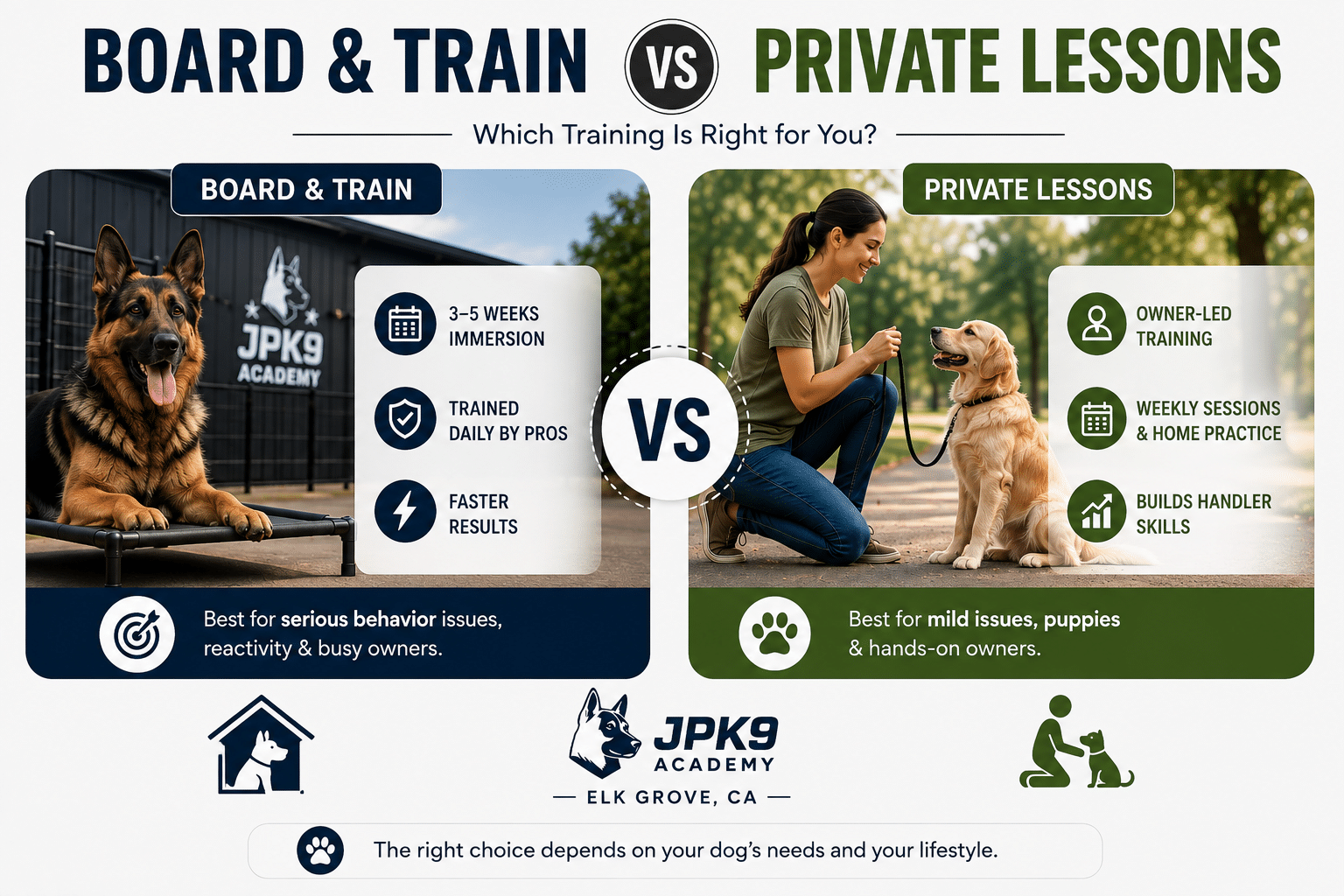
Board and train fits dogs that need fast habit change and owners who don’t have an hour a day to spare, delivering 3 to 5 weeks of immersion for $3,200 to $4,200 at JPK9 Academy in Elk Grove. Private lessons fit hands-on owners and milder issues, building handler skill across 4 to 8 sessions for $1,300 to $3,000. The dog’s history and the owner’s actual schedule decide the format, not the price tag.
A Roseville family brought in a two-year-old Malinois this past June who’d never once walked past a jogger without lunging. Around the same time, an Elk Grove family with a mellow lab puppy just wanted help with basic manners before their leash pulling turned into a real habit. The Malinois went into a four-week board and train. The lab puppy went into four private lessons. Both dogs are doing great now, and neither family would have gotten there by picking the other format. That’s the whole article in two sentences. Here’s the honest breakdown, written to help you match your dog to the right one instead of just the more popular one.
What Is Board and Train?
Board and train is a dog training format where the dog lives at a professional facility for a set period, usually two to five weeks, and receives daily hands-on training from a certified trainer. Instead of the owner learning to train the dog, the trainer does the daily work directly: obedience commands, impulse control, real-world proofing around distractions, and correcting specific behavior problems. At the end of the stay, a go-home session transfers everything the dog learned back to the owner, so the training carries over to life at home instead of staying at the facility. Board and train programs vary by facility, but the structure above is the core of how the format works everywhere.
What Are Private Lessons?
Private lessons are one-on-one training sessions where a certified trainer works directly with both the dog and the owner, usually at the training facility or occasionally at the owner’s home. Instead of the trainer doing the training for you, the trainer teaches you how to train your own dog: leash handling, timing, marker words, and the specific technique for whatever behavior you’re working on. Progress happens between sessions, through the homework the owner practices daily, with the trainer checking in, correcting technique, and building on it week to week. Private lesson packages are usually sold in blocks of sessions rather than billed one at a time.
What’s the Actual Difference Between Board and Train and Private Lessons?
Side by side, the practical differences come down to speed, cost, and who’s actually holding the leash day to day. Here’s the full comparison at a glance.
|
Factor |
Board and Train |
Private Lessons |
|
Who trains the dog |
A certified trainer, daily |
The owner, coached weekly |
|
Where the dog lives |
JPK9 facility, 3 to 5 weeks |
Home, the whole time |
|
Speed of change |
Fast — daily reps compress months into weeks |
Gradual — depends on homework between sessions |
|
When the owner builds skill |
At the go-home session and after |
From session one, continuously |
|
Best fit |
Rehearsed habits, reactivity, busy households, off-leash goals |
Mild issues, puppies, hands-on owners |
|
JPK9 Academy price |
$3,200 to $4,200 |
$1,300 (4 lessons) to $3,000 (8 lessons) |
Why Do the Two Formats Produce Different Results?
A weekly private lesson gives a dog one hour of professional training. The rest of that week (well over 150 hours) happens at home, where whatever habit the dog already has gets rehearsed again and again unless the owner is actively working against it every single day. Board and train sidesteps that gap completely: the dog is inside structure around the clock, gets dozens of repetitions daily, and never has a week to backslide between sessions.
Board and train earns its results when three things happen: daily structured training for the full stay, real-world proofing before graduation (not just facility drills), and a genuine handoff that transfers the system to the owner. Private lessons earn their results when one thing happens: the owner actually does the homework between sessions. Both formats fail in predictable ways when their one non-negotiable gets skipped, and most of the bad reviews you’ll find online for either format trace back to exactly that.
What Does Each Format Cost in the Sacramento Area?
At JPK9 Academy, board and train runs $3,200 for three to four weeks and $4,200 for four to five weeks. Private lesson packages run $1,300 for four sessions and $3,000 for eight. Phone consultations are free, and an in-person evaluation is $100 anywhere in the greater Sacramento area. For the full breakdown across every program, see what dog training actually costs in Sacramento.
The math points two different directions depending on how you slice it, and both are true at once. Per invoice, private lessons cost less: $1,300 buys a real foundation for an owner who’s willing to put in the work. Per hour of professional training delivered, board and train costs less: a four-week stay packs in more trainer hours than three years of weekly sessions would, which is exactly why the dogs with the biggest problems get the format with the biggest dose. The expensive mistake isn’t choosing the pricier option. It’s putting a serious case into the lighter format and paying for it twice once you upgrade later anyway.
Which Dogs Do Better With Board and Train?
- Dogs with a habit that’s already set in. Months or years of pulling, jumping, counter-surfing, or door-bolting need interruption, not just correction, and interruption takes immersion.
- Reactive or aggressive dogs. Lunging, growling, or a bite history needs daily, controlled repetition that a once-a-week session can’t deliver. Severe cases belong in a dedicated aggressive dog training program instead of general obedience work.
- High-drive working breeds. Malinois, working-line Shepherds, and huskies burn through the pace of weekly lessons; daily structure is the only thing that keeps up with them.
- Off-leash goals. Reliable off-leash obedience needs a volume of repetition and proofing that a weekly track just doesn’t reach in a reasonable timeframe.
- Households that can’t guarantee daily practice. Commuters and parents who can’t promise homework every day get more out of four weeks of professional consistency than four months of practice that keeps getting interrupted.
When Do Private Lessons Actually Win?
Being honest about this is the only way this comparison is worth reading, so here’s where board and train is the wrong call.
- Puppies under five months. The socialization window needs the owner learning right alongside the puppy, which is exactly why a good puppy training program is built to be owner-involved from day one, not a drop-off service.
- Mild, contained issues. Leash pulling on its own, or basic house manners, rarely justifies a four-week immersion invoice.
- Owners who want the skill themselves. Training the dog personally builds a handler who can use those same skills with every future dog in that household. A drop-off program doesn’t build that.
- Dogs whose main issue is separation from the family. Sometimes the deeper work on that specific problem goes better with the dog at home, not away from the people it’s anxious about losing.
How Long Before Each Format Shows Results?
Board and train shows visible change in 3 to 5 weeks. Private lessons show the same depth of change over roughly 6 to 12 weeks of weekly sessions plus daily homework. The gap isn’t quality, it’s dosage: a four-week stay contains dozens of repetitions a day, while a weekly session hands you one professional hour and leaves the rest of the practice to you. For a mild issue, the slower track works fine. For a rehearsed habit or real reactivity, slow progress against something the dog practices every day at home is often no progress at all.
What Does a Day at JPK9 Academy’s Board and Train Actually Look Like?
Structure runs from wake-up to lights-out. Mornings cover obedience reps while the dog is fresh and focused. Midday adds that day’s new skill on top of proofing everything from the day before, with distractions increasing gradually. Afternoons rotate between exercise, impulse control worked into the facility’s normal daily routine, and, as graduation gets closer, real outings where commands get tested against actual streets, actual dogs, and actual noise, not just a quiet training room. Owners get regular photo and video updates through the stay, which does something a written report can’t: it shows whether the dog is actually doing okay, instead of just claiming it.
What Actually Happens in a Private Lesson?
A JPK9 private lesson is one-on-one: the trainer teaches you the technique, coaches you through handling the dog live, and sends you home with that week’s assignment. Early sessions build mechanics: leash handling, reward timing, marker words, and reading what the dog’s body is actually telling you, because an owner who rewards two seconds late is teaching a completely different lesson than they intended to. Later sessions move to wherever the problem actually shows up: front-door greetings, the neighborhood walk, the dog park gate. The one thing that never changes about this format is that the daily practice between sessions is the real training. The weekly hour is just the steering wheel.
Can You Combine Board and Train With Private Lessons?
Yes, and it’s often the strongest path available. Board and train builds the foundation, then a short run of private lessons afterward deepens the handler skills that a single go-home session can’t fully cover. Every JPK9 program includes that go-home session at no extra cost, and families who want more than the essentials add follow-up private sessions at the regular private-lesson rate. It works in reverse too: owners who start with private lessons and hit a wall on one specific behavior can escalate just that issue into an immersion stay with a trainer who already knows their dog.
Five Questions That Usually Settle It
- Count your actual daily minutes. If your household can reliably find 15 focused training minutes every single day, private lessons are a real option. If you know you can’t, be honest about that now, because the format punishes the gap later.
- How old is the behavior? Something the dog has been rehearsing for months or years needs interruption, which is what immersion is built for. A behavior that’s a few weeks old is still soft enough for the weekly track to work on.
- How severe is it, really? Mild pulling and jumping sit comfortably in private-lesson territory. Lunging, growling, a bite history, or actual fights move the case into immersion, often into the aggression-focused program specifically.
- What’s the actual goal? Basic house manners work with either format. Reliable off-leash work only works with one, because it’s built on a volume of repetition that weekly sessions can’t provide.
- Is the whole household on the same page? Every adult in the home following the same rules roughly doubles either format’s results. A divided household cuts them in half, regardless of which format you pick.
What to Ask Before Choosing Either Format
This part isn’t about JPK9 specifically. It’s what any owner should check before handing a dog over to any board and train, or committing to any private lesson package, anywhere.
For board and train: Ask to see the actual space where dogs stay, not just a lobby. Ask exactly what training methods are used, and get specifics, not just “positive” or “balanced” as a label. Ask what happens if the dog struggles or shuts down partway through. Ask what the visit or update policy is, and whether “updates” means real photos and video or a generic form email. Ask what’s included in the price versus billed as an add-on later, since equipment fees sneaking in after the fact is a common complaint across this industry. And ask what the go-home session actually covers, because a fifteen-minute handoff and a ninety-minute one produce very different outcomes for the same weeks of training.
For private lessons: Ask how the trainer handles a dog that isn’t progressing, not just the dogs that are easy wins. Ask what happens between sessions, whether there’s any check-in on homework or you’re on your own until the next appointment. Ask about their experience with your dog’s specific issue, since a trainer who’s great with basic manners isn’t automatically equipped for reactivity or fear-based aggression.
Neither format is automatically safe just because it’s expensive, and neither is automatically risky just because it’s a newer business. The questions above matter more than the price tag or the reviews page, because they tell you what actually happens to your dog when you’re not in the room.
Is Board and Train Actually Worth It?
It’s worth the price when the problem has outgrown weekly coaching, the household genuinely can’t train daily, or the goal is off-leash reliability. It’s not worth it for mild manners issues that a committed owner could fix for a third of the cost through private lessons. The honest test is one question: has this behavior survived real, consistent effort already? If yes, the dog needs a bigger dose than a living-room session can deliver. If no, private lessons deserve the first shot, with board and train available as the next step if needed.
What Happens After Board and Train Ends?
A well-run board and train ends with a go-home session that walks the family through every command, rule, and routine the dog learned, plus a way to reach the trainer afterward if questions come up. Dogs that keep their training are almost always in households that kept the system going: about 10 minutes of daily maintenance protects a full month of professional work. The dogs behind board and train’s bad reputation in general almost always came from programs that skipped a real handoff, sending the dog home fluent in a language nobody in the family actually learned. The format works when the handoff is treated as the most important part of the program, not an afterthought tacked onto the last day.
How Sacramento and Elk Grove Area Owners Actually Choose
Across the Sacramento area, the choice tends to follow lifestyle more than anything else. Commuter households in Vacaville, Fairfield, and Roseville, where the dog is already alone nine hours a day, lean toward board and train because the daily homework hour genuinely doesn’t exist in their schedule. Owners in Midtown Sacramento and Davis with more flexible schedules and milder dogs tend to keep the skill for themselves and go with private lessons instead. Elk Grove families split close to evenly, helped by having a training facility just minutes from most of the city either way. A free phone consultation settles most undecided cases in about fifteen minutes, because the dog’s actual history usually answers the question before the price does.
Board and Train vs Private Lessons: Frequently Asked Questions
Is board and train worth the money?
It earns its price when the dog needs habit interruption, the owner doesn’t have daily training time, or the behavior has outgrown weekly coaching. For serious cases, three to four weeks of immersion regularly finishes what six months of inconsistent home practice couldn’t.
Does board and train actually work?
It works when three things hold: daily structured training for the full stay, real-world proofing before graduation, and a go-home session that actually transfers the system to the family. Skip that last part and you get a dog that listens to the trainer and ignores everyone at home, which is where most of the bad stories about this format come from.
How much more does board and train cost than private lessons?
At JPK9 Academy, board and train runs $3,200 to $4,200 for three to five weeks, versus $1,300 to $3,000 for private lesson packages of four to eight sessions. Per hour of professional training, board and train is the better value. Per invoice, private lessons cost less upfront.
Can private lessons fix aggression or reactivity?
They handle mild reactivity and early-stage issues well. Once a dog has a bite history, severe reactivity, or a well-rehearsed aggressive response, private lessons lose effectiveness because the seven days between sessions give the behavior room to rehearse itself at home. Serious cases need the daily repetition and controlled environment that only immersion provides.
Do dogs forget their training after board and train?
Dogs keep their training when the household keeps the system: the commands, rules, and structure covered at the go-home session. Regression comes from families who quietly drop the rules within a few weeks, not from the format itself. Ten minutes of daily maintenance protects a month of professional work.
Which is better for a puppy, board and train or private lessons?
Private lessons or a dedicated puppy program, almost always. The socialization window in early puppyhood needs the owner learning alongside the dog. Board and train earns its place later, from adolescence onward, once rehearsed habits and drive actually need interrupting.
Can I visit my dog during board and train?
Not mid-program. A visit partway through resets an immersion dog’s focus for days, so JPK9 replaces visits with regular photo and video updates instead. The go-home session at graduation is the reunion, plus the full training handoff, in one sitting.
How long does a board and train program run?
Three to four weeks at $3,200, or four to five weeks at $4,200, with the exact length set at the evaluation based on what the dog actually needs. Private lesson tracks cover similar ground spread across six to twelve weeks of weekly sessions.