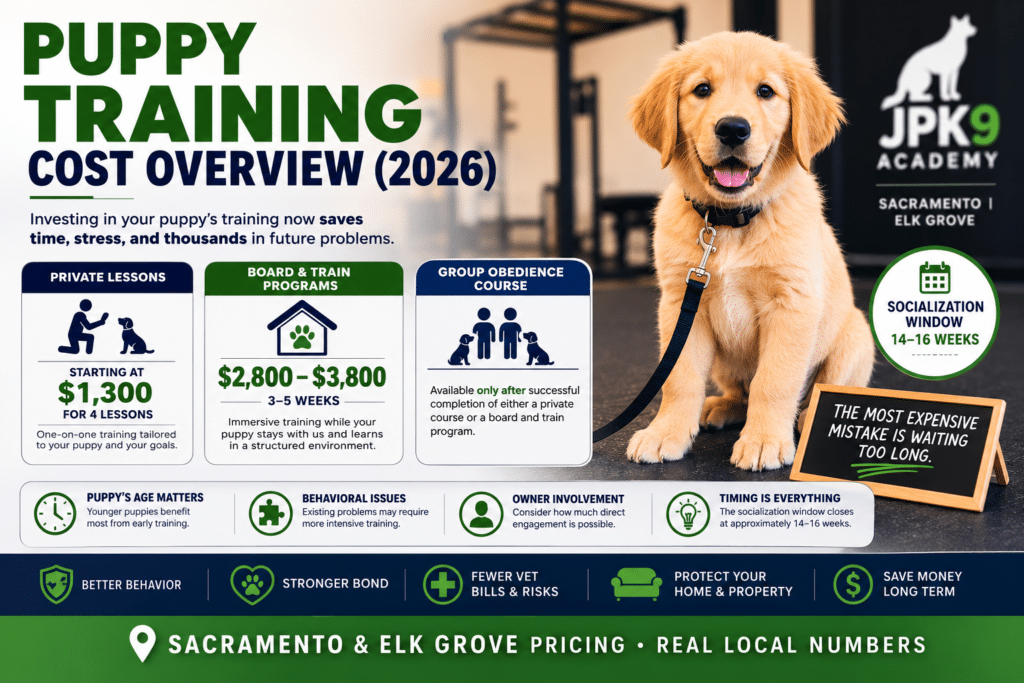
Puppy Training Cost Overview (2026)
Cost Ranges:
- Private Lessons: Starting at $1,300 for 4 lessons (no per-session pricing available).
- Board and Train Programs: $3,200 – $5,500.
Program Structure:
- Group Obedience Course: Available only after successful completion of either a private course or a board and train program.
Factors Influencing Program Choice:
- Puppy’s Age: Younger puppies benefit more from early training.
- Behavioral Issues: Existing problems may require more intensive training.
- Owner Involvement: Consider how much direct engagement is possible.
Critical Consideration:
- Timing of Training: The most crucial factor is when training begins. The puppy socialization window closes at approximately 14–16 weeks of age. Missing this window can lead to significant behavioral issues, making it the most expensive mistake a new dog owner can make.
Puppy Training Cost at a Glance (2026)
| Program Type | Cost Range | Duration | Best For | Owner Involvement |
|---|---|---|---|---|
| Group Puppy Classes | Available after private or board and train | 4–8 weeks | Socialization, basic obedience, first-time owners | High — attends every class |
| Private Lessons | $1300.00–$3500.00 | 4–8+ sessions | Fearful puppies, specific behavior problems, flexible scheduling | High — practices daily between sessions |
| Board & Train | $2,800–$3800.00 | 3–5 weeks | Busy owners, puppies with early behavior problems, off-leash foundation | Moderate — owner transfer sessions at end |
| Online/Virtual | $30–$100/session | Flexible | Supplement to in-person, rural owners, budget-constrained | Very high — owner executes everything |
| Day Training | $100.00 (pickup by 6 pm) | Weekly | Socialization during work hours, supplement to owner training | Low during sessions, moderate between |
Sacramento/Elk Grove market note: Prices in the Sacramento metro area run approximately 10–20% below San Francisco and Los Angeles rates but 10–15% above national rural averages. The figures in this guide reflect what local owners actually pay.
The Socialization Window : Why Puppy Training Timing Is a Financial Decision
Every other puppy training cost guide focuses on price per session. This section covers the cost that none of them mention: the behavioral price of missing the window.
The puppy socialization window is the developmental period during which a puppy’s brain is most receptive to learning that the world is safe. It opens at approximately 3 weeks of age and closes between 14 and 16 weeks. What a puppy experiences or does not experience during this window shapes its emotional responses for life.
According to the American Veterinary Society of Animal Behavior (AVSAB), puppies should begin socialization classes as early as 7–8 weeks of age, as long as they have received at least one round of vaccines and one deworming at least 7 days prior to the first class. The AVSAB explicitly states that the risks of behavioral problems from under-socialization outweigh the risks of disease exposure in a controlled, well-run training environment.
Why This Is a Financial Issue
A puppy that misses the socialization window is significantly more likely to develop fear, reactivity, and aggression as an adult dog. These are not minor inconveniences, they are expensive behavioral conditions that require behavior modification programs, not basic obedience training.
The cost difference is real:
- Basic puppy group obedience class (starting at 8–10 weeks): $1300.00–$1700.00 for a course
- Adult dog behavior modification for fear-based reactivity that developed because of under-socialization: $2,000–$8,000+ for a program
The math is not complicated. Starting puppy training during the socialization window is not just the best behavioral decision, it is the most cost-effective one by an enormous margin.
The owner who waits until the dog is 6 months old to “see if training is really necessary” is almost always paying for that decision later at 3–5 times the price.
Puppy Training Cost by Age : What Program Makes Sense When
No competitor covers this. The right training program and therefore the cost changes significantly depending on where the puppy is in its development.
8–10 Weeks (First Arrival Home)
This is the optimal window. The puppy has no established bad habits. Training costs are at their lowest because the puppy learns fastest and requires the fewest sessions to build foundation behaviors.
Best program: Group puppy kindergarten class or private sessions beginning immediately after the first veterinary visit and initial vaccines.
Cost: $1300.00 – $1700.00 for private/group course.
What to cover: Basic name recognition, sit, down, stay, come, leash introduction, bite inhibition, crate training, basic socialization with people and environments.
Owner time commitment: 10–15 minutes of practice per day at home.
10–14 Weeks (Socialization Window Still Open)
The window is narrowing. Socialization should be the primary focus controlled exposure to different people, surfaces, sounds, and environments. Basic obedience can run alongside.
Best program: Group puppy class that includes structured socialization, or private sessions if the puppy shows any signs of fearfulness or reactivity toward other dogs.
Cost: $1300.00 – $1700.00 for private/group course.
What to cover: Leash walking foundation, impulse control basics, sit/down with duration, come when called with low distraction, socialization to children, men, hats, bikes.
Red flag at this age: Avoiding group classes because “the puppy isn’t vaccinated enough.” The AVSAB guidelines support class attendance after one vaccine at 7 days prior. Missing this window to avoid disease risk is a real and documented behavioral risk.
16 Weeks – 6 Months (Post-Socialization Window)
The window is closed. New experiences are still important, but the emotional plasticity of the early window is gone. Any fear responses established before 16 weeks will require more work to modify. The focus now shifts to obedience reliability.
Best program: Group obedience class or private lessons. Board and train becomes more appropriate if the puppy has already developed problem behaviors.
Cost: $1300.00 – $1700.00 for private/group course. $3,200+ for board and train.
What to cover: Reliable sit, down, stay, come, heel on leash, leave it, place, polite greetings (no jumping).
Important: A 5-month-old puppy that has been practicing jumping, nipping, and pulling for four months is not a “puppy behavior” case anymore it is an established habit case and requires more sessions to modify than a puppy starting at 8 weeks.
6–12 Months (Adolescence Begins)
This is the most misunderstood age in dog training. Many owners assume that because the dog “went through puppy training,” it no longer needs training. The adolescence phase (6–18 months depending on breed) is when previously reliable behaviors often break down because of neurological changes and increasing independence.
Best program: Follow-up private lessons, a second group obedience course, or board and train if behavioral regression is significant.
Cost: Same as adult dog training programs.
What commonly happens: Owners skip training during this phase, behavior problems solidify, and they end up paying for a full adult dog behavior modification program at 18–24 months that could have been prevented with a adolescence follow-up course.
Puppy Group Classes — What You Pay and What You Get
Group puppy classes are the most affordable training option and the right starting point for most puppies with no serious behavioral concerns.
What group classes cost in 2026:
A standard puppy kindergarten course runs 4–8 weeks, meeting once per week for 45–60 minutes per session.
- 4-week course: $1300.00
- 6-week course: $1700.00
- 8-week course: $3000.00
- Drop-in single class (where available. Must be enrolled or alumni): $25.00
What Is Covered in a Standard Puppy Group Course
Most reputable group puppy classes cover sit, down, stay with duration, come when called, loose leash walking foundation, leave it, and basic impulse control. Some include structured puppy play sessions for socialization which is a meaningful add-on because it is one of the things owners cannot replicate at home.
The class size math that nobody explains:
In a group class with 10 dogs and one trainer, each dog-owner pair receives approximately 6 minutes of direct trainer attention per 60-minute session. In a class of 6 dogs, each pair receives 10 minutes. This is not a minor difference, it is a 40% increase in direct instruction time.
When evaluating group classes, ask specifically how many dogs are enrolled per trainer. JPK9 Academy caps group classes at 8 dogs per trainer. Anything over 8 significantly reduces the individual instruction that makes group classes worth paying for.
When group classes are NOT the right choice:
Group classes are the wrong program when the puppy shows fear or reactivity toward other dogs, when the puppy is behind the socialization curve and needs desensitization rather than obedience, when the owner cannot consistently attend weekly sessions, or when the puppy already has established behavior problems that require individual attention to address.
In those cases, private lessons or a board and train program will produce better results for the same or lower total investment.
Private Puppy Lessons — Cost and When They're Worth the Premium
Private lessons cost more per session than group classes but often cost less in total when the number of sessions required to reach the goal is factored in.
What private puppy lessons cost in 2026:
- Single session (45–60 minutes): $75–$200 depending on trainer credentials and location
- Package of 4–6 sessions: $350–$900
- Package of 8–10 sessions: $600–$1,800
- In-home premium: add $20–$50 per session for travel
Sacramento and Elk Grove market range: $100–$175 per session for an experienced trainer. Trainers offering sessions below $80 in the Sacramento area are typically newer to the profession.
Number of Sessions Most Puppies Need
| Goal | Typical Number of Sessions |
|---|---|
| Basic foundation (8–12 weeks old, no bad habits) | 4–6 |
| Basic obedience for adolescent puppy (5–9 months) | 6–10 |
| Bite inhibition + basic obedience | 4–8 |
| Puppy with early fear or reactivity | 8–16 |
| Puppy with separation anxiety beginning | 8–20+ |
These are estimates for owners who practice the assigned homework daily between sessions. Owners who do not practice should add 30–50% more sessions to the estimate.
When private lessons are the right choice:
Private lessons make the most sense when the puppy shows fear toward other dogs or people (group class would overwhelm rather than help), when the owner’s schedule makes consistent group class attendance impossible, when the home environment has specific dynamics that need to be trained directly (multiple children, other pets, specific household triggers), or when the owner is a first-time dog owner who benefits from hands-on instruction alongside their puppy.
Private lessons vs. board and train — the total cost comparison:
A puppy needing 8 private lessons at $150/session costs $1,200. A board and train program for the same puppy costs $3,200 at JPK9 Academy but includes daily training for 3 weeks, owner transfer sessions, and lifetime support. For owners with the schedule to do daily homework, private lessons can achieve comparable results. For owners who cannot commit to daily practice, the board and train program typically produces faster and more durable results even at the higher upfront cost.
Board and Train for Puppies — Is It Worth the Cost?
Board and train programs have historically been marketed primarily for adult dogs with problem behaviors. An increasing number of puppy owners are now choosing board and train as a foundation program and the results support it.
What puppy board and train costs in 2026:
- 2-week program: $1,800–$3,500
- 3-week program: $3,000–$5,000
- 4-week program: $4,000–$6,500
- JPK9 Academy: Starting at $3,200 (3-week program)
These prices include daily training sessions throughout the program, boarding and care, and owner transfer sessions at the end.
What makes puppy board and train different from adult dog board and train:
Puppies in a board and train program receive daily training during their peak learning phase. The rate of behavioral acquisition during the socialization window in a structured daily training environment is significantly faster than what weekly private lessons can achieve. A puppy receiving professional training every day for 3 weeks during weeks 10–13 of life is being shaped during the exact period when behavioral plasticity is highest.
The practical result: puppies that complete a board and train program during the socialization window typically arrive home with more reliable behavior than adult dogs who complete the same program, because the training is happening during the optimal developmental phase rather than working against established adult behavioral patterns.
What to expect from the owner transfer session:
The transfer session is where most of the long-term value of board and train is determined. This is when the trainer hands the dog back to the owner and teaches the owner how to handle the dog at the same level the dog has been trained. A puppy trained to a professional level and returned to an owner who does not know how to maintain that training will begin losing the training within 2–4 weeks.
Ask any board and train program specifically:
- How long is the owner transfer session?
- Is it included in the program price or an add-on?
- What happens if the owner struggles after going home?
- Is there any follow-up included?
At JPK9 Academy, owner transfer sessions are built into every program and lifetime support is standard not an upsell.
When board and train is NOT appropriate for a puppy:
Board and train programs that use aversive tools as primary training methods are not appropriate for puppies at any age. Prong collars, choke chains, and e-collars are not developmentally appropriate for puppies under 6 months and can cause significant anxiety and fallout behaviors in a developing dog. Ask explicitly about the tools used in any board and train program before enrollment.
Online Puppy Training — Honest Cost and Honest Assessment
Online puppy training courses and virtual sessions have grown significantly since 2020. Here is an honest assessment not a promotional one.
What online puppy training costs:
- Self-paced video course: $30–$150 (one-time)
- Single live virtual session: $50–$100
- Package of 4 virtual sessions: $175–$350
- Monthly subscription platforms (Pupford, etc.): $10–$30/month
Where online training works:
Online training is genuinely effective as a supplement to in-person training, for owners in rural areas with limited access to qualified trainers, for owners with scheduling constraints that prevent in-person attendance, and for basic foundation behaviors in a puppy with no behavioral concerns and a motivated, consistent owner.
Where online training fails:
Online training is not a substitute for in-person training when the puppy has fear, reactivity, or aggression because the trainer cannot read the dog’s full body language through a camera and cannot physically demonstrate or correct in real time. Online training also fails when the owner lacks the skill and consistency to execute the protocols without hands-on coaching. Most first-time puppy owners fall into this category.
The total cost reality of online-only training:
A puppy trained exclusively through online courses by a first-time owner with no prior dog experience frequently develops behavioral problems that require in-person professional intervention at 12–18 months. The total cost of the online courses plus the eventual professional behavior modification typically exceeds what a professional in-person puppy program would have cost at 8–12 weeks.
Online training as a supplement: excellent value. Online training as a replacement for professional in-person instruction in a puppy’s first year: usually a false economy.
7 Factors That Drive Puppy Training Cost Up or Down
-
Trainer credentials and experience
A trainer with a CPDT-KA certification, multiple years of documented client results, and an active professional development practice charges more and typically delivers faster results than the lower-cost alternative. The total cost of reaching the behavioral goal is often lower with the higher-cost trainer because fewer sessions are needed.
Cost impact: +$20–$80 per session above uncredentialed trainers
-
Location
Sacramento and Elk Grove trainers charge less than San Francisco or Los Angeles trainers but more than rural Central Valley markets. A qualified trainer in Elk Grove charging $140/session is typically competitive with the market.
Cost impact: Sacramento metro runs approximately 10–20% below Bay Area rates
-
Puppy’s age at start
An 8-week puppy starting training with no established bad habits needs fewer sessions to reach the same behavioral endpoint as a 5-month puppy who has been practicing jumping, nipping, and pulling for four months. Early start = lower total cost.
Cost impact: Waiting 4 months adds an estimated 3–6 additional sessions at $100–$175 each = $300–$1,050 in additional cost
-
Owner practice compliance
The single most controllable cost driver. Owners who practice the assigned behaviors 10–15 minutes per day between sessions need approximately 40–50% fewer sessions than owners who only practice during class. This is not a small difference on a 10-session private lesson package at $150/session, that is $600–$750 in savings.
Cost impact: Daily practice reduces total session count by 40–50%
-
Group vs. private format
Group classes cost less per session but provide less individual instruction time. Private lessons cost more per session but typically require fewer total sessions to reach the same goal for puppies with specific behavioral needs.
Cost impact: Group is $25–$60 per session equivalent; private is $75–$200 per session
-
Whether the program includes lifetime support
Programs that include ongoing support after the program ends have a higher upfront cost but lower total cost over the dog’s life because behavioral drift is caught early. Programs that sell sessions without support generate repeat business through behavioral backsliding.
Cost impact: Lifetime support programs typically cost 15–25% more upfront, save 1–3 follow-up program costs over the dog’s life
-
Severity of existing behavior problems at start
A puppy with established biting, reactivity, or separation anxiety at 5 months requires more sessions and a more complex protocol than a 10-week puppy with no bad habits. This is not the trainer’s pricing tactic, it is genuinely more work.
Cost impact: Behavior modification adds $500–$2,000+ to the total program cost compared to a clean-slate puppy
The Hidden Cost Nobody Talks About: Owner Compliance Between Sessions
Every pricing guide covers what the trainer charges. None of them cover the factor that has the most control over the total cost: what the owner does between sessions.
Dog training works through repetition. A behavior is not learned in a session, it is introduced in a session and learned through thousands of correct repetitions in daily life. The session introduces the behavior. The owner’s daily practice builds it into a reliable habit. The next session refines it.
When owners skip the daily practice, the session has to repeat what it covered the previous week rather than building on it. A 10-session program becomes a 15-session program. A 15-session program becomes a 20-session program. The trainer’s per-session rate has not changed but the total cost has increased by 50%.
What the practice requirement actually looks like:
For a puppy in a private lesson or group class program, the typical homework is 10–15 minutes of structured practice per day divided into 2–3 short sessions (5 minutes each). This is less time than a single television commercial break.
The sessions cover: reinforcing the commands introduced in class, practicing in different locations (living room, backyard, front sidewalk), building duration on sit and down, practicing the recall in low-distraction environments, and reinforcing bite inhibition protocols.
Owners who do this consistently reduce their total session count by an estimated 40–50% compared to owners who do not. On a $150/session program, that is real money.
What to ask any trainer about owner homework:
Before signing up for any program, ask: what specific homework will be given after each session, how long will it take daily, and how will progress be tracked between sessions. A trainer who does not assign specific homework and hold the owner accountable is not running a complete program.
The Cost of NOT Training Your Puppy in 2026
This section covers what no competitor addresses: the financial cost of skipping or delaying puppy training.
Furniture and property damage:
A puppy that does not learn impulse control, crate training, and appropriate chew behavior causes an average of $400–$1,000 in furniture, flooring, and household damage in its first year, according to pet industry surveys. This is not unusual, it is the expected outcome of an untrained puppy with access to a home.
Veterinary behavioral medicine:
Adult dogs that develop anxiety, aggression, or compulsive behaviors as a result of under-socialization or under-training frequently require veterinary behavioral medicine intervention. A consultation with a veterinary behaviorist costs $300–$600, and ongoing medication for behavioral conditions costs $50–$200/month.
Behavior modification programs:
An adult dog with established reactive or aggressive behavior requires behavior modification, not obedience training. The programs cost $2,000–$6,000 depending on severity. Compare this to a puppy group class at $150–$350.
Legal liability:
A dog that bites as a result of under-socialization or inadequate training creates legal liability for the owner. Dog bite claims in the United States average $58,545 per claim according to the Insurance Information Institute (2023 data). Homeowner’s insurance premiums often increase significantly after a bite claim.
Rehoming and shelter costs:
Behavioral problems are the number one reason dogs are surrendered to shelters. The emotional and financial cost of rehoming a dog the family is attached to is not easily quantifiable, but the process including the surrender process, potential adoption fees for a replacement dog, and the behavioral assessment required by many rescues can cost $300–$800 in direct expenses.
The bottom line:
A puppy group class at $200–$350 or a private lesson package at $600–$1,000 is not an optional expense. It is an investment that reduces the probability of each of the costs above. The return on a well-trained dog is measurable in avoided expenses, reduced veterinary costs, lower liability risk, and a fundamentally better daily quality of life.
Puppy Training Prices in Sacramento and Elk Grove, CA
The pricing tables in most national guides do not reflect what Sacramento and Elk Grove dog owners actually pay. Here is local market data.
Sacramento metro market (including Elk Grove, Roseville, Rancho Cordova, Folsom):
| Program Type | Low End | High End | JPK9 Academy |
|---|---|---|---|
| Group Puppy Class (4–6 weeks) | $150 | $350 | Call for current schedule |
| Group Puppy Class (8 weeks) | $200 | $450 | Call for current schedule |
| Private Lesson (per session) | $90 | $175 | Call for current rate |
| Private Lesson Package (6 sessions) | $480 | $900 | Call for package rate |
| Program Type | Low End | High End | JPK9 Academy |
|---|---|---|---|
| Board & Train (3 weeks) | $2,200 | $4,500 | From $3,200 |
| Board & Train (4 weeks) | $3,000 | $6,000 | Call for rate |
What Drives Sacramento Pricing Above or Below the Midpoint
Trainers at the high end of the Sacramento range typically have CPDT-KA or equivalent certification, 5+ years of documented professional experience, smaller class sizes, and robust owner support included. Trainers at the low end may be newer to the profession, use larger class sizes, or operate without formal credentialing.
Petsmart and Petco Group Class Pricing in Sacramento
National chains offer group obedience classes in the Sacramento area starting at approximately $119–$149 for a 6-week course. These are taught by employees who have completed a standardized corporate training certification. Class sizes are larger than at specialized training facilities.
For basic puppy socialization and foundation commands in a low-complexity household, these can work. For puppies with any behavioral concerns, fearfulness, or reactivity, a specialized trainer produces better results.
JPK9 Academy's Elk Grove location:
JPK9 Academy operates at 4202 Point Pleasant Road, Elk Grove, approximately 5–15 minutes from Laguna West, Stonelake, Franklin, and most South Sacramento neighborhoods. Puppy training programs are available year-round. Call (916) 571-0157 for current schedule, group class dates, and board and train availability.
How to Evaluate a Puppy Trainer Before Paying ?
What age do you accept puppies and why?
Any trainer who says they do not accept puppies under 12 or 16 weeks because “they are not ready” or “they need all their vaccines first” is either not current on behavioral science or is prioritizing facility liability over the puppy’s developmental needs. The AVSAB position statement recommends training beginning by 7–8 weeks after initial vaccines. A trainer who does not know this, or who dismisses it, has a knowledge gap.
What does a typical session look like for an 8-week-old puppy?
A qualified answer describes short sessions (5–10 minutes maximum per training block for very young puppies), luring-based introduction of behaviors, lots of positive reinforcement, no corrections, and owner coaching throughout. An answer that focuses on “establishing control” or “setting boundaries” early in a very young puppy is a red flag.
What is your class size cap and what happens if a puppy goes over threshold during group class?
This reveals both the trainer’s infrastructure (class size) and their skill (threshold management). A puppy that is afraid of other dogs in a group class setting should be removed from the situation not pushed through it. A trainer who does not have a clear protocol for managing overwhelmed puppies in group class should not be running puppy group classes
What homework will be assigned and how will you track our progress?
A trainer without a homework system is not providing a complete program. The homework is where the training actually happens. Ask specifically what the daily practice requirement looks like and whether you will receive written instructions.
What tools do you use and why?
For a puppy under 6 months, the appropriate training tools are a flat collar or harness, a 4–6 foot leash, high-value treats, and a marker (verbal or clicker). Any mention of prong collars, choke chains, e-collars, or alpha rolls in a puppy program is a disqualifying red flag. These tools are not developmentally appropriate for puppies and cause behavioral damage that creates more expensive problems to fix later.
What support is available after the program ends?
Puppies go through multiple developmental phases. Behavior that was solid at 12 weeks often shows regression during adolescence at 6–18 months. Ask whether the trainer provides any follow-up support, whether there is a maintenance program, and what the cost is to return for a tune-up if needed.
Red Flags Specific to Puppy Trainers (That Generic Lists Miss)
Generic “red flag” lists cover obvious things like dominance theory and no reviews. Here are puppy-specific red flags that competitors do not cover:
“We don’t take puppies until they have all their vaccines.” This means they don’t accept puppies until 16+ weeks — after the socialization window has closed. Framed as safety, it is actually a policy that contradicts AVSAB guidance and costs the puppy its most important developmental period.
Sessions are 60+ minutes long for puppies under 12 weeks. A puppy under 12 weeks cannot sustain focused learning for 60 minutes. Sessions for very young puppies should be 15–30 minutes maximum, broken into shorter active training blocks. A trainer who runs full-length sessions with very young puppies either doesn’t know developmental limitations or is optimizing for session billing rather than the puppy’s learning rate.
Group classes have more than 8 dogs per trainer. Puppy group classes should have small groups where the trainer can monitor every dog’s body language simultaneously. More than 8 dogs per trainer makes this impossible. At 10+ dogs, some puppies are going over threshold without the trainer noticing which is counter-productive to socialization goals.
No assessment of the puppy’s individual threshold before starting group class. A qualified trainer asks about the puppy’s current reaction to other dogs, strangers, and novel environments before placing them in a group setting. Enrolling a fearful puppy in a standard group class without this assessment can make fear-based reactivity significantly worse.
Using lure-and-bribe exclusively without fading the lure. This is a subtler red flag. Effective puppy training introduces behaviors using lures (treats held in hand) and then fades the lure within a few sessions so the puppy responds to the cue without food present. A trainer who is still using visible lures for every repetition after 4–6 weeks of training is not teaching the puppy to respond to the cue, they are teaching the puppy to respond to food.
No protocol for bite inhibition. Bite inhibition teaching a puppy to control the pressure of its bite is one of the most important things a young puppy can learn. A group puppy class or private lesson program with no bite inhibition protocol is missing a foundational component that, if not addressed, leads to significant problems at 5–9 months when the puppy is larger and still nipping.
JPK9 Academy Puppy Training — What's Available in Elk Grove
JPK9 Academy offers multiple program options for puppies from 8 weeks through 6 months at the facility on 4202 Point Pleasant Road, Elk Grove, CA 95757.
Puppy Group Classes
Small group format (max 8 puppies). Covers sit, down, stay, come, leash introduction, bite inhibition, impulse control, and structured socialization. Age appropriate for puppies 8 weeks through 20 weeks. Current schedule and pricing: call (916) 571-0157.
Private Puppy Lessons
One-on-one sessions at the JPK9 facility or in-home at any Elk Grove or Sacramento address. Recommended for puppies showing early fearfulness, reactivity, or households with complex dynamics (multiple children, other pets). Session-based or package pricing available.
Puppy Board and Train
Dog lives at the JPK9 facility for 2–4 weeks during the program. Daily professional training sessions. Puppy comes home with reliable sit, down, stay, place, leash walking, bite inhibition, and basic recall. Owner transfer sessions built in. Starting at $3,200.
What all JPK9 programs include:
- Assessment before any program recommendation
- Homework and owner education at every session
- Lifetime support after program completion one call to (916) 571-0157 for any follow-up questions
Frequently Asked Questions About Puppy Training Cost
How much does puppy training cost on average in 2026?
Puppy training costs an average of $150–$350 for a group obedience course, $75–$200 per session for private lessons, and $2,500–$5,500 for a board and train program in 2026. In the Sacramento and Elk Grove area, group puppy classes typically run $150–$300 for a 4–6 week course. Private lessons average $100–$175 per session with an experienced trainer. Board and train programs at JPK9 Academy start at $3,200 for a three-week program. The total cost depends on the program type, the trainer’s credentials, the puppy’s age at start, and how consistently the owner practices between sessions.
At what age should puppy training start and how does it affect cost?
Puppy training should start at 7–8 weeks of age, according to the American Veterinary Society of Animal Behavior. Starting at 8–10 weeks before any bad habits are established requires fewer sessions to reach the same behavioral endpoint than starting at 5–6 months. A puppy starting group classes at 8 weeks typically needs 4–6 weeks of training to build a solid foundation. A 5-month-old puppy with four months of practiced bad habits (jumping, nipping, pulling) typically needs 8–12 sessions to unlearn those habits and install new ones. The cost difference between early start and late start is an estimated $300–$1,000 in additional sessions or a more intensive program.
Is puppy group class or private lessons a better value?
Group classes are a better value for puppies with no serious behavioral concerns and owners who can attend consistently. The cost per session equivalent is lower ($25–$60 vs. $75–$200 for private), and the structured socialization with other dogs is a genuine benefit that cannot be replicated in private lessons. Private lessons are a better value when the puppy shows fearfulness, reactivity, or specific behavioral concerns that cannot be addressed in a group setting, or when the owner’s schedule prevents consistent group class attendance. The “better value” question should always be answered relative to the specific puppy’s needs not as a general rule.
How much does puppy board and train cost and is it worth it?
Puppy board and train programs cost $2,500–$6,500 nationally in 2026, with most quality programs falling between $3,000 and $5,000 for a 3–4 week program. In the Sacramento and Elk Grove area, JPK9 Academy’s board and train starts at $3,200. Whether it is worth it depends on the owner’s schedule and commitment to daily homework. For busy owners who cannot practice daily, board and train typically achieves faster and more durable results than private lessons at a lower total cost when the full comparison is made (private lessons multiplied by the number of sessions needed vs. a fixed program price with daily professional training).
What vaccinations does a puppy need before starting training?
The American Veterinary Society of Animal Behavior recommends that puppies can begin socialization classes after receiving at least one set of vaccines 7 days before the first class, along with at least one deworming. The core vaccines required are typically DHPP (distemper, hepatitis, parvovirus, parainfluenza) and the first bordetella (kennel cough) vaccine. Rabies is given at 12–16 weeks. Puppies should not wait until the full vaccine series is complete before starting training the behavioral cost of missing the socialization window exceeds the disease risk in a well-run, clean training environment. Check with a veterinarian for specific timing based on the puppy’s health history.
How many puppy training sessions does a dog need?
The number of sessions depends on the puppy’s age, the behavioral goal, and owner practice between sessions. A puppy starting at 8–10 weeks with no behavioral concerns typically needs 4–8 group classes or private sessions to establish a solid foundation of basic obedience and socialization. A puppy starting at 5–6 months with established problem behaviors needs 8–16 sessions. An owner who practices 10–15 minutes daily between sessions typically needs 30–50% fewer sessions to reach the same outcome than an owner who does not practice between sessions.
Does puppy training include socialization and is that covered in the cost?
Whether socialization is included in a puppy training program depends on the specific program. Group puppy kindergarten classes at most reputable facilities include structured socialization time controlled exposure to other dogs, different people, and novel experiences as part of the class structure. This is genuinely valuable because it is one experience owners cannot replicate alone at home. Private lessons typically do not include dog-to-dog socialization unless the trainer arranges it specifically. Board and train programs should include socialization with other dogs and controlled exposure to different environments as part of daily life at the facility ask specifically whether this is part of the program.
What is the difference between puppy training and dog obedience training?
Puppy training (8 weeks to approximately 6 months) focuses on the foundation phase introducing behaviors during the highest plasticity period of the dog’s life, building bite inhibition, establishing crate and housetraining habits, and socialization. The methods are positive reinforcement-based and use very short sessions appropriate to the puppy’s attention span. Dog obedience training for adult dogs (6 months+) focuses on building reliability of already-introduced behaviors across different environments and distractions, and on modifying problem behaviors that have become established habits. The programs are different in structure, methodology, and cost because the dog’s developmental phase and the behavioral goals are different.
Does puppy training help with separation anxiety?
Early puppy training can prevent separation anxiety from developing by establishing positive crate associations, building the puppy’s confidence in being alone for gradually increasing periods, and creating a predictable daily routine that the puppy learns to anticipate. This is significantly easier and far less expensive than treating true separation anxiety in an adult dog. A puppy training program that includes crate training and alone-time conditioning as standard components is a meaningful investment in preventing what is otherwise a $2,000–$5,000+ behavior modification process in adulthood. If a puppy is already showing signs of distress when left alone (whining, destructive behavior, eliminating indoors) before 4 months of age, early intervention with a behavior specialist is strongly recommended.
What should Sacramento and Elk Grove puppy owners look for when comparing training prices?
Sacramento and Elk Grove puppy owners comparing training prices should evaluate four things beyond the per-session rate: class size (max 8 dogs for group classes), whether the trainer accepts puppies at 8–10 weeks or requires full vaccination completion, whether homework and owner education are included in the session cost, and whether any support is available after the program ends. A group class at $300 from a trainer who limits enrollment to 6 puppies, accepts puppies at 8 weeks, assigns specific homework, and offers follow-up is a better value than a class at $150 with 12 puppies, delayed enrollment, and no homework structure.