
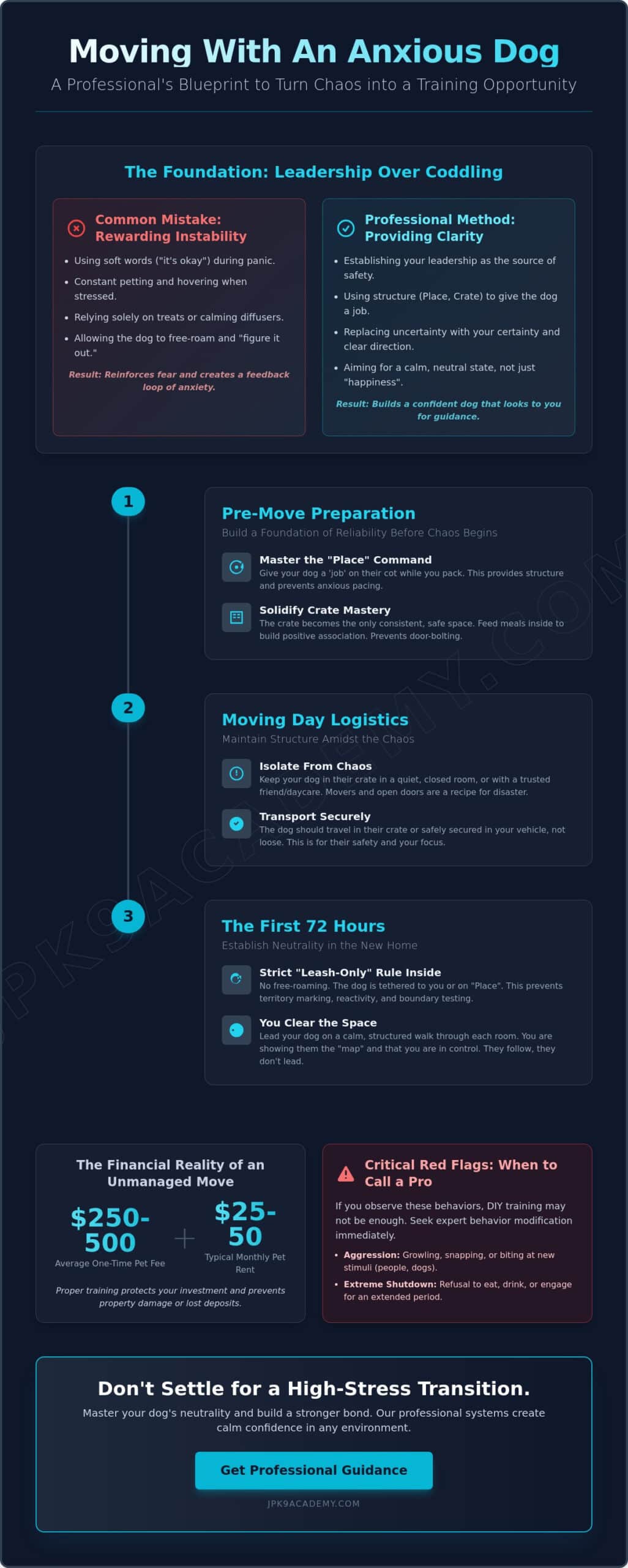
Most dog owners view a relocation as a crisis to be managed with treats and hope, but a move is actually the ultimate training opportunity to master your dog’s neutrality. You are likely worried about potential property damage in a new rental or the regression of house training; these fears are justified when the average pet fee in 2025 was between $250 and $500 per animal. It’s common to feel guilt over your dog’s visible stress, but hovering only reinforces their instability. In the Sacramento region, where monthly pet rent typically ranges from $25 to $50, the long-term cost of an unmanaged dog is significant.
You don’t have to settle for a high-stress transition that damages your bond. This guide teaches you how to move to a new home with an anxious dog by implementing a professional system of structure and unwavering leadership. At JPK9 Academy, we believe that clarity is the highest form of affection. We will cover the specific engagement strategies and foundational drills that prevent reactivity in neighborhoods from Elk Grove to Folsom. By the time you unpack the last box, you will have a dog that views the new environment with calm confidence rather than fear.
Key Takeaways
- Establish leadership by reframing environmental uncertainty as a call for handler clarity and disciplined structure.
- Master the “Place” command and crate reliability to build a portable foundation of safety before the transition begins.
- Enforce a strict “Leash-Only” rule inside the new home to prevent reactivity and maintain control during the first 72 hours.
- Learn the professional methodology for how to move to a new home with an anxious dog without regressing in house training or obedience.
- Identify critical red flags such as aggression or extreme shutdown that signal the need for expert behavior modification.
Understanding Why Moves Trigger Canine Anxiety
Anxiety isn’t a personality flaw; it’s a lack of information. When you research how to move to a new home with an anxious dog, you’ll find plenty of advice about pheromone diffusers or calming treats. These are Band-Aids. The core issue is that your dog has lost their “map” of how to exist. In their old home, they knew where the boundaries were. In the new home, every shadow and sound is a potential threat. Without a handler providing clear direction, the dog’s brain defaults to a state of hyper-vigilance. You’ll see this through obsessive pacing or a refusal to settle in any one spot. This is the dog trying to “clear” the room because you haven’t done it for them.
Move-related anxiety is rarely about the physical floor plan. It’s a total collapse of environmental clarity. To a dog, “new” equals “uncertain,” and uncertainty without a strong handler equals danger. Understanding canine personality traits helps us realize that some dogs are genetically predisposed to higher arousal, but every dog relies on the owner to define the new reality. You must replace their uncertainty with your certainty. If you don’t lead, your dog will try to fill the vacuum with defensive behaviors like barking at new neighbors or marking territory to claim the space.
The Myth of Comforting an Anxious Dog
Soft words like “it’s okay” or constant petting during a panic spike are massive training mistakes. You aren’t soothing the dog; you’re rewarding the instability. This creates a feedback loop where the dog believes their fear is the correct response to the new environment. We aim for neutrality, not just happiness. A neutral dog can observe a moving truck without reacting. Leadership provides more safety than affection during a move because it tells the dog exactly what to do when they don’t know where they are. Discipline is the highest form of affection you can offer a dog in crisis.
Environmental Stressors in the Sacramento Region
Local transitions present unique challenges that can overwhelm an untrained dog. Moving from a quiet, fenced-in suburb in Elk Grove to the high-density environment of Midtown Sacramento can shatter a dog’s confidence. The sudden presence of 24/7 sirens and a higher “dog density” per square foot triggers immediate reactivity. Even a move to El Dorado Hills brings new variables, such as heavy construction noise or wildlife sightings that weren’t present in your previous neighborhood. With 80% of rental apartments allowing pets, your dog will likely face more canine proximity than ever before. You must identify these triggers before they become ingrained habits that lead to property damage or lost pet deposits.
Pre-Move Preparation: Building a Foundation of Reliability
Success during a move is earned through preparation, not luck. You cannot wait until the moving truck arrives to establish boundaries. True reliability is built while the house is still quiet. Mastering dog obedience training serves as the backbone of this entire process. Without a clear communication system, your dog will interpret the packing of boxes as a signal for chaos. You must use this time to sharpen your dog’s “Place” command. When you are wrapping fragile items or dismantling furniture, your dog should be parked on their cot, neutral and calm. This isn’t just about convenience; it’s about providing the dog with a job that prevents them from spiraling into an anxious state.
If you are struggling with how to move to a new home with an anxious dog, start by increasing the frequency of your engagement drills. These short, high-intensity sessions ensure the dog stays focused on you rather than the changing environment. If the foundation is weak, now is the time to seek professional guidance through private lessons to ensure your handling is precise enough to guide your dog through the transition. Discipline is the highest form of affection you can provide during this time.
The Power of Crate Mastery
The crate is your dog’s safe harbor. It must be a neutral, non-negotiable space where the dog can decompress while the environment shifts. As rooms are emptied, the crate remains the only consistent piece of “furniture” in their lives. This prevents “door-bolting,” a dangerous behavior that often occurs when movers are cycling in and out of the house. Reinforce the value of the crate by feeding meals inside it and practicing “crate-up” commands during peak packing times. This ensures the dog views the crate as a position of security rather than a punishment.
Engagement Drills for High-Distraction Environments
Chaos is a training opportunity. Use high-value rewards to maintain the human-canine partnership during 5-minute sessions. As you clear out a room, bring the dog in and practice “Place” on the bare floor. The change in acoustics and the lack of familiar objects can be unsettling, but your direction provides the necessary clarity. This teaches the dog that the rules of engagement don’t change just because the scenery does.
- Practice “Place” in every room as it becomes empty.
- Use rapid-fire engagement drills to keep the dog’s head in the game.
- Proof all commands against the sounds of tape guns and moving dollies.
Moving Day Logistics: Maintaining Structure Amidst the Chaos
Moving day is the ultimate test of your leadership. While some suggest hiding your dog in a bathroom, we know that avoidance is not a strategy. You must maintain a “First In, Last Out” protocol for your dog’s essentials. Their crate, food, and training tools should be the very last items loaded and the first ones off. This ensures that the moment you arrive, the dog has a familiar, structured environment. You are the only constant in their world; your gear must reflect that consistency.
If you are wondering how to move to a new home with an anxious dog without a total behavioral collapse, the answer lies in strict scheduling. Do not let the chaos of movers, who typically charge between $90 and $180 per hour for a crew, dictate your dog’s day. Stick to their exact feeding and potty times. Allowing your dog to free-roam in a house full of strangers and open doors is a recipe for bolting or defensive aggression. Every open door is a boundary that you must manage personally.
Step-by-Step Moving Day Protocol
Start the morning with high-intensity exercise. A tired dog is a more neutral dog. Before the movers arrive at your Elk Grove home, secure the dog in their crate in a quiet area. This prevents them from rehearsing anxious behaviors as the house is emptied. During the actual transit, the crate becomes a mobile command center. Maintain calm, neutral energy in the vehicle. If you are stressed, your dog will be too. You’re the steady anchor in their shifting world.
Navigating the Sacramento Transition
Moving through Northern California traffic on I-80 or Highway 50 requires a dog with elite reliability. If you are stopping in high-distraction areas like Vacaville or Fairfield for potty breaks, your dog’s k9 training must be rock solid. Public rest stops are often chaotic, filled with other pets and engine noise. Use a short leash and demand focus. This isn’t the time for a casual sniff; it’s a structured break designed to reinforce your role as the leader. If you hired a local pet transport service for a trip under 100 miles, expect to pay between $75 and $200 for professional handling. By maintaining this level of discipline during the drive, you set the stage for a successful arrival at your new residence.
The First 72 Hours: Establishing Neutrality in Your New Home
The moment you cross the threshold of your new residence, the training clock starts. Most owners make the mistake of dropping the leash and letting the dog “explore.” This is a failure of leadership that invites anxiety. When you are learning how to move to a new home with an anxious dog, you must understand that “exploration” is often just a search for threats. Instead of letting them roam, implement the Leash-Only rule. Keep your dog on a leash inside the house for the first 24 to 48 hours. This tether prevents the dog from rehearsing unstable behaviors like pacing, obsessive sniffing, or marking new territory. By controlling their movement, you provide the environmental clarity they crave.
Mapping the home should be a structured process. Introduce one room at a time under your direct guidance. Establish new “Place” locations immediately by setting up their training cot in the living room or bedroom. Command the dog to the cot and require them to stay there until released. This gives them a clear job in an unfamiliar space. Implementing this level of structure in the first 72 hours prevents months of behavioral regression and protects your financial assets; the average pet deposit in 2025 was over $300, and a lack of boundaries is the fastest way to lose it.
The First Walk: Setting Boundaries in the New Neighborhood
Your first outing in neighborhoods like Folsom or Roseville shouldn’t be a casual stroll. It is a business trip. The goal is neutrality, not sniffing every bush or greeting every neighbor. Folsom trails and Roseville suburbs are high-distraction environments filled with barking dogs behind fences and local wildlife. Use a sprenger dog collar to maintain absolute clarity and prevent pulling or reactivity. Demand a perfect “Heel.” When your dog learns that you are handling the external environment, their internal anxiety begins to dissipate.
Preventing Separation Anxiety Before It Starts
Do not spend 24/7 with your dog during the first week. While it’s tempting to “settle them in” with constant attention, this creates a “spoiled” mindset that leads to severe separation anxiety. You must practice short departures immediately. Leave the house for 10 minutes to grab mail or coffee. This teaches the dog that the new home is a safe place to be alone. If your dog begins to show extreme signs of distress during these gaps, it may be time for professional behavior modification to reset their foundation. Discipline is the highest form of affection you can offer during this transition.
Professional Support: When DIY Training Isn’t Enough
Sometimes, the challenge of how to move to a new home with an anxious dog exceeds the capability of home-based management. You might follow every protocol, yet your dog still exhibits red flags that signal a deeper psychological struggle. If you see redirected aggression toward family members, an extreme physical shutdown where the dog refuses to eat or move, or destructive chewing that threatens your $300+ pet deposit, you must act. These aren’t just “adjustment periods”; they’re cries for a behavioral reset. Waiting for a dog to “settle in” on their own is a passive gamble that usually results in ingrained bad habits.
While some sources suggest turning to medication like Prozac or Xanax, we know that drugs only mask the symptoms of a fractured foundation. You don’t need a pill; you need a system. A professional intervention provides the environmental clarity your dog is missing. For dogs whose anxiety has manifested as reactivity toward new neighbors or local wildlife, specialized dog aggression training is the only path to lasting safety. We replace the dog’s internal chaos with a structured lifestyle that prioritizes neutrality and engagement.
The JPK9 Advantage for Anxious Movers
Our 4-Week Board and Train program is the gold standard for owners facing a difficult transition. We take the dog out of their high-stress environment and bring them to our Elk Grove facility for a total behavioral overhaul. Here, we build the elite off-leash reliability and social neutrality needed for busy Sacramento life. Your dog learns to look to the handler for direction, regardless of the distractions around them. We don’t just train the dog; we provide you with the mastery needed to maintain that same level of discipline when they return to your new home. This ensures the transition is permanent and the human-canine bond is restored.
Take the First Step Toward a Harmonious Lifestyle
Success in a new home requires more than just unpacking boxes; it requires a dog that respects the boundaries of the new space. If your move has triggered a regression in obedience or an escalation in fear, professional evaluation is the most responsible next step. We assess the root of the stress and provide a clear, results-oriented roadmap for recovery. Don’t let a relocation destroy the progress you’ve made with your canine partner. Schedule your free training evaluation at JPK9 Academy today.
Mastering the Transition Through Disciplined Leadership
A successful relocation is defined by your ability to lead when your dog is most uncertain. You’ve learned that environmental clarity is the only true cure for move-related stress. By enforcing the “Leash-Only” rule and maintaining strict crate reliability, you prevent the behavioral regression that often costs owners their $300 pet deposits. Learning how to move to a new home with an anxious dog requires a shift in mindset from sympathy to strategy. You must replace emotional coddling with professional structure to ensure your dog views their new neighborhood with neutrality rather than fear.
If the transition has revealed deep-seated reactivity or extreme shutdown, don’t wait for the problem to resolve itself. At JPK9 Academy, we are a family-owned and results-driven team specializing in high-level behavior modification and anxiety resolution. We serve the entire Sacramento and Northern California region with a commitment to total behavioral overhaul. Stop managing the symptoms and start building a foundation of elite performance. Transform your dog’s anxiety into elite reliability; contact JPK9 Academy today. Your journey toward a harmonious lifestyle starts with a single decision to lead.
Frequently Asked Questions
How long does it take for an anxious dog to adjust to a new home?
Adjustment depends entirely on the level of leadership and structure you provide. Without a clear system, a dog can remain in a state of hyper-vigilance for months; however, with strict discipline, most dogs find neutrality within 21 days. This three-week window is critical for establishing new habits. You must actively guide them through the transition using the “Place” command rather than waiting for them to settle in on their own.
Should I give my dog anxiety medication for the move?
Medication is a Band-Aid that masks symptoms rather than solving the underlying lack of environmental clarity. While some veterinarians suggest chemical intervention, these drugs don’t teach a dog how to exist confidently in a new space. We recommend a behavioral reset through training instead. Building a foundation of reliability provides the dog with the certainty they need to navigate the move without relying on sedation or mood-altering pills.
Is it better to board my dog or take them with me on moving day?
Taking your dog with you is a training opportunity if you utilize a crate as a mobile command center. While some suggest standalone boarding, a move is actually the perfect time for a 3-week Board and Train program. This removes the dog from the peak chaos and returns them to your new home with elite reliability. If you keep them with you, ensure they remain crated to prevent bolting or panic during the transition.
Why is my dog suddenly having potty accidents in the new house?
Potty regression occurs because the dog has lost their “map” of the house and doesn’t understand the new boundaries. Even a perfectly trained dog can fail when the environment changes. You must treat them like a puppy for the first 72 hours in the new residence. Use a leash indoors and strictly manage their access to different rooms until they prove they understand the new rules of your home.
Can a new home cause a dog to become aggressive or reactive?
Relocation can trigger defensive aggression if the dog feels they must fill a leadership vacuum in an uncertain space. When owners are learning how to move to a new home with an anxious dog, they often overlook how a dog perceives new neighbors as threats. This hyper-vigilance leads to barking or lunging. Professional behavior modification is necessary if your dog begins to show these red flags to prevent the behavior from becoming permanent.
What is the best way to introduce my dog to a new backyard?
Introduce the backyard on a leash to establish that you own the space. Allowing a dog to run wildly around an unfamiliar yard creates an over-aroused state that leads to fence-fighting or digging. Walk them around the perimeter and practice engagement drills. Once they can maintain a neutral state in the yard, you can gradually grant more freedom through disciplined training and off-leash reliability.
How can I stop my dog from barking at every new sound in our apartment?
Barking at new sounds is a sign that your dog is trying to “clear” the environment because they don’t trust your leadership. You must use the “Place” command to tell the dog exactly where to be when they hear a noise. This provides the clarity they crave. By requiring them to stay on their cot, you teach them that you are handling the apartment’s external environment, which allows them to finally relax.
What should I do if my dog refuses to eat after we move?
A refusal to eat is a common physiological response to high stress and a lack of routine. Do not coddle the dog or offer human food, as this only rewards the unstable state. Offer their regular meal for 15 minutes, then pick it up if they don’t eat. Maintaining a strict feeding schedule provides the rhythmic consistency they need. Most healthy dogs will resume eating within 48 hours once they realize the structure is consistent.