Is your German Shepherd’s coat a source of pride or a daily logistical nightmare? In Sacramento, where summer temperatures frequently exceed 105 degrees, german shepherd dog shedding isn’t just a nuisance; it’s a physiological challenge that requires professional-grade management. Most owners accept fur-covered furniture as an inevitable lifestyle choice, yet this chaos usually stems from a lack of clear protocol rather than the dog’s biology.
We understand the frustration of vacuuming three times a day only to find new “tumbleweeds” minutes later. It’s exhausting to see your clothes constantly coated in hair or to worry that those thick clumps indicate a serious skin condition. This guide provides the elite framework you need to master the coat of the “German Shedder” through disciplined routines and high-performance tools. You will learn the exact 20 minute grooming sequence and stress-reduction techniques that ensure your dog remains neutral, comfortable, and healthy throughout the 2026 season. We are moving beyond basic brushing to implement a total system for a cleaner home and a more focused canine partner.
Key Takeaways
- Master the biological mechanics of the double coat to transform your home from a fur-filled struggle into a managed environment.
- Navigate the extreme Sacramento heat by understanding thermoregulation and why shaving is a dangerous shortcut that compromises your dog’s health.
- Deploy the JPK9 “Elite Three” toolset and professional “Wet Rake” technique to achieve total mastery over german shepherd dog shedding.
- Optimize coat health from the inside out by addressing the critical link between high-performance nutrition, canine stress, and excessive fur loss.
- Establish a foundation of neutrality and discipline to turn grooming sessions into a stress-free lifestyle for both you and your dog.
Understanding the “German Shedder”: The Science of the GSD Double Coat
To achieve total mastery over your home environment, you must first understand the biological machinery of your dog. The German Shepherd isn’t just a pet; it’s a high-performance athlete equipped with a sophisticated climate control system. This system is the German Shepherd double coat, a dual-layer defense mechanism that allows the breed to thrive in diverse environments. While many owners feel overwhelmed by the volume of fur, this process is a sign of a functioning, healthy animal. Mastery begins with education, not frustration.
The reality of german shepherd dog shedding is that it never truly stops. You’ll hear myths about dogs that only shed once or twice a year. In the world of GSD ownership, the truth is that they shed once a year for 365 days straight. However, the intensity of that shed fluctuates based on environmental triggers and internal health. If you’re looking for a low-maintenance coat, you’ve chosen the wrong breed. If you’re looking for a resilient partner, you’ve chosen the best, but you must accept the fur as part of the lifestyle.
Guard Hairs vs. Undercoat: Who is the Real Culprit?
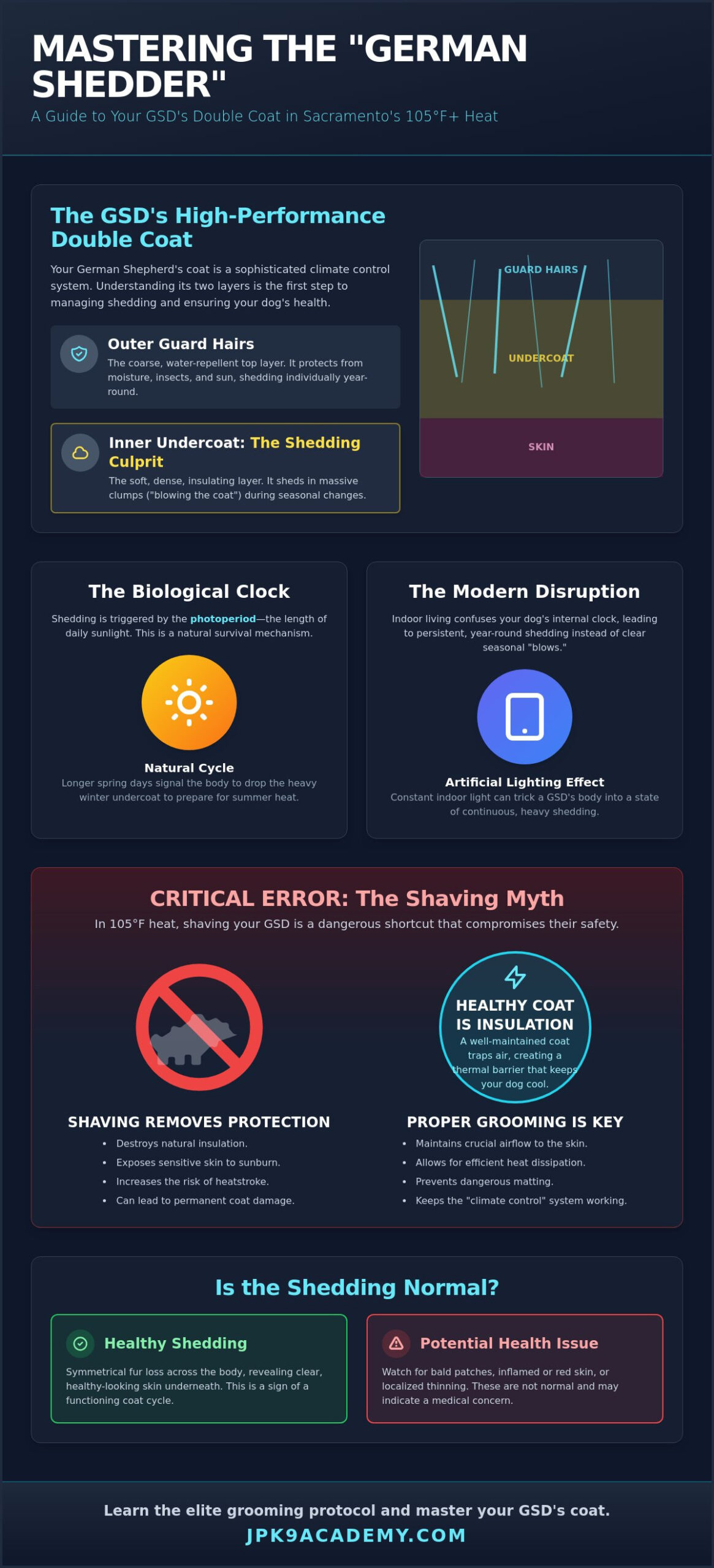
The GSD coat consists of two distinct layers with different functions. The outer layer is made of guard hairs. These are tough, coarse, and water-repellent. They protect the dog from brush, insects, and moisture. Guard hairs have a longer life cycle and drop off individually throughout the year. When you find long, stiff hairs on your suit or car upholstery, you’re looking at the guard hairs.
The undercoat is the real source of the “snowstorm” effect. This is a soft, dense, wool-like layer that sits close to the skin to provide insulation against both heat and cold. Unlike the guard hairs, the undercoat tends to release in large, soft clumps. Blowing the coat is the rapid seasonal transition of the undercoat where the dog sheds its entire insulating layer in a matter of weeks.
The Biological Clock: Why GSDs Shed More in Certain Seasons
Your dog’s body follows a strict internal rhythm dictated by the photoperiod, or the length of daily sunlight. As the days lengthen in the spring, the brain signals the body to drop the heavy winter undercoat to prepare for the heat. This is a survival mechanism. In Sacramento, where summer temperatures frequently exceed 100 degrees, this transition is vital for the dog’s thermoregulation. A lighter summer coat prevents overheating during high-intensity training sessions.
Modern living often confuses this biological clock. Artificial indoor lighting can trick a dog’s system into perceiving long days even in the middle of December. This results in a persistent, heavy shed rather than a clean seasonal break. To manage german shepherd dog shedding effectively, you must recognize that your dog’s skin is a reflection of its environment. Healthy shedding is symmetrical and leaves the skin looking clear. If you notice bald patches, inflamed skin, or localized thinning, you’re likely dealing with a medical issue rather than a natural cycle. Mastery requires the discipline to observe these nuances and act before a minor shed becomes a major health concern.
Sacramento’s Heat and Your GSD’s Coat: Local Climate Factors
Sacramento summers aren’t just uncomfortable; they’re a physiological challenge for your German Shepherd. When the thermometer hits 105 degrees in July, your dog’s coat becomes their primary defense mechanism. Mastering german shepherd dog shedding requires understanding how this coat functions as a high-performance climate control system rather than a heavy blanket. Your dog relies on you to maintain the integrity of this system through disciplined grooming protocols.
Thermoregulation in the Central Valley
The GSD undercoat serves as a vital thermal barrier. It traps a layer of air against the skin, maintaining a consistent body temperature despite the external heat. It functions like the R-value insulation in a modern Sacramento home. If you allow the coat to become matted or packed with dead hair, air circulation stops. This creates a dangerous greenhouse effect against the skin, spiking the risk of heatstroke during a training session at Elk Grove Regional Park. A well-maintained, de-shedded coat allows for 100% efficiency in heat dissipation and air flow.
The Shaving Myth: Why It Does More Harm Than Good
Owners often think shaving their GSD in Elk Grove provides relief from the valley heat. This is a critical error that compromises the dog’s safety. Shaving removes the guard hairs that block UV radiation, exposing pale skin to 100% of the sun’s intensity. This leads to rapid sunburn and long-term skin damage. Additionally, the coat often regenerates with a damaged texture, leading to permanent issues with the guard hair structure. Instead of reaching for clippers, focus on professional grooming techniques to reduce shedding. This removes the dead undercoat while keeping the protective outer layer intact to shield them from the California sun.
Implement these protocols to keep your GSD safe during Sacramento’s 100-degree streaks:
- Schedule strictly: Limit high-intensity engagement to before 8:00 AM or after 8:00 PM.
- Hydration targets: A 75-pound GSD needs at least 75 ounces of water daily during peak heat.
- Surface awareness: Asphalt temperatures can reach 140 degrees when the air is 90 degrees; stick to shaded grass.
- Active de-shedding: Use a high-velocity dryer to blast out the dead undercoat, ensuring maximum skin breathability.
True mastery of the GSD lifestyle involves protecting their physical health as much as their behavior. If you want to build a foundation of reliability and health that lasts a lifetime, start with a structured training assessment to ensure your dog thrives in the Sacramento climate.
The JPK9 Grooming Protocol: Professional Tools and Techniques
Managing german shepherd dog shedding is not a suggestion; it is a requirement for maintaining a high-performance lifestyle in Sacramento. You cannot achieve mastery over your home environment with a cheap, plastic brush from a big-box retailer. To control the “GSD glitter” that blankets your floors, you must adopt a professional system. The JPK9 Protocol relies on the Elite Three: the undercoat rake, the slicker brush, and the de-shedding blade. These tools provide the mechanical advantage necessary to penetrate a dense double coat and remove dead fur before it hits your carpet.
Selecting the Right Tools for GSD Fur
Standard pet store brushes fail because they only graze the surface of the guard hairs. For a German Shepherd, you need a 22-blade undercoat rake. This specific blade count provides the optimal spacing to grab the fuzzy undercoat without snagging or cutting the protective topcoat. While many owners reach for a Furminator, we recommend caution. The Furminator utilizes a bladed edge that can damage the guard hairs if used with too much pressure. A 22-blade rake is safer and more efficient for daily maintenance. Follow this with a firm slicker brush to collect loose surface debris and a de-shedding blade to sweep away the final remnants of dead hair.
The Bathing and Blowing Technique
Bathing is your secret weapon, but only if you use the “Wet Rake” technique. Begin by thoroughly wetting the coat and applying a high-quality de-shedding shampoo. While the coat is sudsy, use your undercoat rake to pull through the fur. The water and soap act as a lubricant, allowing the rake to slide through tangles and release 30 percent more hair than dry brushing alone. You must rinse the dog twice. Trapped soap residue in a double coat is a primary cause of hot spots and skin infections in the Sacramento heat.
Once the bath is complete, the high-velocity dryer becomes the most critical tool in your arsenal. These professional-grade blowers do not use heat; they use air pressure to blast water and dead undercoat out of the follicle. This “air-grooming” process removes the hair that even the best brushes miss. To maintain a clean home, follow this schedule:
- Daily: A quick 5-minute surface brush to maintain engagement.
- Three Times Weekly: A 15-minute intensive session with the 22-blade rake.
- Monthly: A full JPK9 Wet Rake bath followed by a high-velocity blow-out.
Consistency is the difference between a house covered in fur and a home that reflects the discipline of its owner. By utilizing professional tools and the high-velocity drying method, you turn german shepherd dog shedding from an overwhelming struggle into a manageable routine. This protocol ensures your dog remains comfortable and your living space remains professional.
Beyond the Brush: Nutrition, Stress, and Behavioral Shedding
Mastery of german shepherd dog shedding requires looking beneath the surface of the skin. While a high-quality de-shedding tool is vital, your dog’s internal state dictates the volume of hair they drop on your Sacramento floors. A dog in a state of constant reactivity is a dog in physiological crisis. This internal turmoil manifests externally through a brittle, thinning, or excessively shedding coat.
The Connection Between Stress and Hair Loss
Canine anxiety triggers a biological response called telogen effluvium. When a dog experiences high mental pressure, their body redirects nutrients away from “non-essential” functions like hair growth to support vital organs. This forces hair follicles into a resting phase simultaneously. The result is a sudden, massive release of fur. You might notice “clump shedding” during vet visits or when a guest enters your home. These are not seasonal shifts; they are physical manifestations of a lack of neutrality.
Implementing professional dog aggression training does more than stop unwanted behaviors. It lowers a dog’s baseline cortisol levels. By establishing clear boundaries and reliable communication, we remove the mental burden that causes stress shedding. A dog that understands its role in the pack is a dog that remains physically stable. When we achieve behavioral neutrality, the coat follows suit by retaining its natural oils and structural integrity.
Feeding for a Stronger Coat
Nutrition is the foundation of a resilient guard coat. Hair is composed of approximately 90% protein. If your dog’s diet is loaded with cheap fillers like corn or soy, their body will prioritize internal health over coat maintenance. This leads to guard hairs that are weak and prone to breaking. High-performance German Shepherds require a diet rich in bioavailable animal proteins to keep the follicle anchored.
- Omega Fatty Acids: Omega-3 and Omega-6 fatty acids are non-negotiable for Northern California owners dealing with dry heat. These fats strengthen the skin barrier and reduce inflammation.
- Supplementation: Many Sacramento GSD owners see a 25% reduction in brittle shedding by adding high-quality wild-caught fish oil to daily meals.
- Avoid Fillers: Grain-heavy “bargain” kibbles often lead to skin irritations that cause the dog to itch, further accelerating hair loss through mechanical friction.
True coat health is a byproduct of a disciplined lifestyle. If your dog’s shedding seems driven by nerves rather than the seasons, it’s time to address the root cause. You can stabilize your dog’s mindset and their coat health today by building a foundation of clarity and leadership.
Training for Grooming Success: Making Maintenance a Lifestyle
Owning a German Shepherd in Sacramento means accepting the reality of a double coat. The difference between a home buried in fur and a manageable routine lies in your dog’s mindset. A well-trained dog isn’t just a luxury; it’s the foundation of effective grooming. When your dog views the brush as a neutral object rather than a threat or a toy, you gain the upper hand in the battle against german shepherd dog shedding. We don’t just teach commands; we cultivate a lifestyle where maintenance is a non-event.
Building Neutrality to the Brush
Neutrality is the standard at JPK9 Academy. It means your dog remains calm and indifferent to external stimuli, including high-touch activities like nail trims or deep undercoat raking. We achieve this by establishing clear boundaries. The “Place” command is our most powerful tool during grooming. By sending your dog to a designated spot, you create a mental “work mode” where they remain stationary and relaxed. Professional dog obedience training transforms a chaotic wrestling match into a focused session of clear communication. This discipline ensures the dog understands that cooperation is the only path forward, regardless of the tools in your hand.
The JPK9 Vision: Freedom Through Discipline
A dog that is clean and well-behaved enjoys a level of freedom most owners only dream of. When you master the management of german shepherd dog shedding through consistent grooming and elite training, your dog becomes a welcome companion at Folsom Lake or on outdoor patios in Midtown. A matted, reactive dog stays home; a groomed, disciplined dog goes everywhere.
Many local groomers turn away GSDs that show aggression or extreme anxiety during handling. Our 4-week Board and Train program is specifically designed to handle these “difficult” cases. We build the reliability and confidence your GSD needs to handle high-pressure grooming with stoic calm. Consider the following benefits of a disciplined grooming routine:
- Increased Social Access: Clean, well-behaved dogs are invited more places.
- Health Detection: A dog that stays still allows you to find skin issues or ticks early.
- Reduced Stress: Routine maintenance becomes a bonding moment rather than a source of conflict.
True mastery of the breed requires more than just buying the right vacuum. It requires a commitment to a lifestyle of structure. By instilling discipline today, you aren’t just managing fur; you’re unlocking the majestic potential of your German Shepherd. Transform their behavior to match their elite look. Don’t settle for a dog you have to manage. Build a dog you can enjoy. Contact JPK9 Academy today to start your transformation.
Achieve Mastery Over the Double Coat
Managing german shepherd dog shedding isn’t just about cleaning your floors; it’s about mastering a biological process that intensifies in Sacramento’s 90-plus degree summers. You’ve learned that a consistent grooming protocol and high-quality nutrition form the foundation of a healthy coat for the 2026 season. Since 2018, our family-owned academy has helped owners in Sacramento and Elk Grove transform their relationship with difficult breeds through disciplined, results-driven methodology. We treat grooming as a training exercise in neutrality and focus. When you provide your dog with clear communication and structured routines, you turn a daily chore into a bonding ritual. Stop reacting to the fur on your carpets and start leading with clarity. Our specialists have spent years perfecting behavior modification techniques that work for even the most headstrong dogs. You have the tools to maintain a pristine home and a high-performance companion. Reliability is built through repetition and professional standards. Your dog is ready for the next level of discipline. We’re here to ensure you both succeed in every environment.
Master your German Shepherd’s behavior and lifestyle with JPK9 Academy
German Shepherd Shedding Mastery FAQ
How many times a year does a German Shepherd blow its coat?
A German Shepherd blows its coat twice every year, typically during the 3 week seasonal transitions in spring and autumn. This process involves the complete release of the undercoat to prepare for temperature shifts. In Sacramento, the 90 degree summer surge usually triggers the first major shed in late April. You’ll need to increase grooming frequency during these specific periods to maintain control over the fur volume.
What is the best brush for a German Shepherd that sheds a lot?
Use an undercoat rake with 1 inch stainless steel pins and a high quality slicker brush to manage german shepherd dog shedding effectively. The rake penetrates the thick outer guard hairs to remove dead fur from the undercoat before it hits your floors. Professional handlers at JPK9 Academy recommend grooming sessions 3 times per week. This routine maintains coat health and minimizes the amount of debris in your living environment.
Can I shave my German Shepherd to help with the Sacramento heat?
Never shave your German Shepherd. Their double coat acts as a 2 way insulation system that protects them from Sacramento’s 100 degree heat and UV radiation. Shaving destroys this natural thermal regulation and exposes the skin to sun damage. Instead, focus on removing the dead undercoat so air can circulate directly against the skin. This allows for natural cooling without compromising the dog’s protective barrier.
Is it normal for my GSD to shed in large clumps?
Shedding in large clumps is normal during the 2 annual coat blowing cycles. You’ll notice 2 to 4 inch tufts of fur protruding from the coat, which indicates the undercoat is detaching from the skin. If you see bald patches or red skin beneath these clumps, consult a veterinarian immediately. Otherwise, this high volume shedding is a standard physiological response to changing daylight hours and temperature fluctuations.
How often should I bathe my German Shepherd to reduce shedding?
Bathe your German Shepherd every 6 to 8 weeks to assist with hair removal without stripping essential oils. Over bathing can dry out the skin and actually increase the rate of german shepherd dog shedding by causing hair follicles to weaken. Use a deshedding shampoo and a high velocity dryer to blast away 70 percent of the loose undercoat during the drying process. This professional technique yields the best results.
Does a German Shepherd’s diet affect how much they shed?
Diet directly impacts coat retention and overall skin health. Diets lacking in Omega 3 and Omega 6 fatty acids lead to brittle hair and a 20 percent increase in non seasonal shedding. Ensure your dog’s food contains at least 3 percent linoleic acid to maintain skin elasticity. High quality protein sources provide the amino acids necessary to keep the hair follicles anchored. Proper nutrition is the foundation of a healthy coat.
How can I tell the difference between normal shedding and skin allergies?
Normal shedding is uniform across the body, while allergies present as localized 1 inch bald spots or inflamed skin. If your dog exhibits a 50 percent increase in scratching or licking their paws, it’s likely an allergic reaction rather than a seasonal shed. Healthy shedding doesn’t cause the skin to look red, scaly, or irritated. Monitor for these specific signs to differentiate between biological cycles and medical issues.
Why does my dog shed more when we go to the vet or a training session?
Stress triggers a physiological response where the tiny muscles attached to hair follicles contract, releasing fur instantly. This adrenaline spike can cause a dog to lose 10 percent more hair during a 30 minute vet visit than they would at home. We focus on building neutrality and confidence at the Academy to lower these cortisol levels. A calm, disciplined dog maintains a tighter coat and sheds less under pressure.