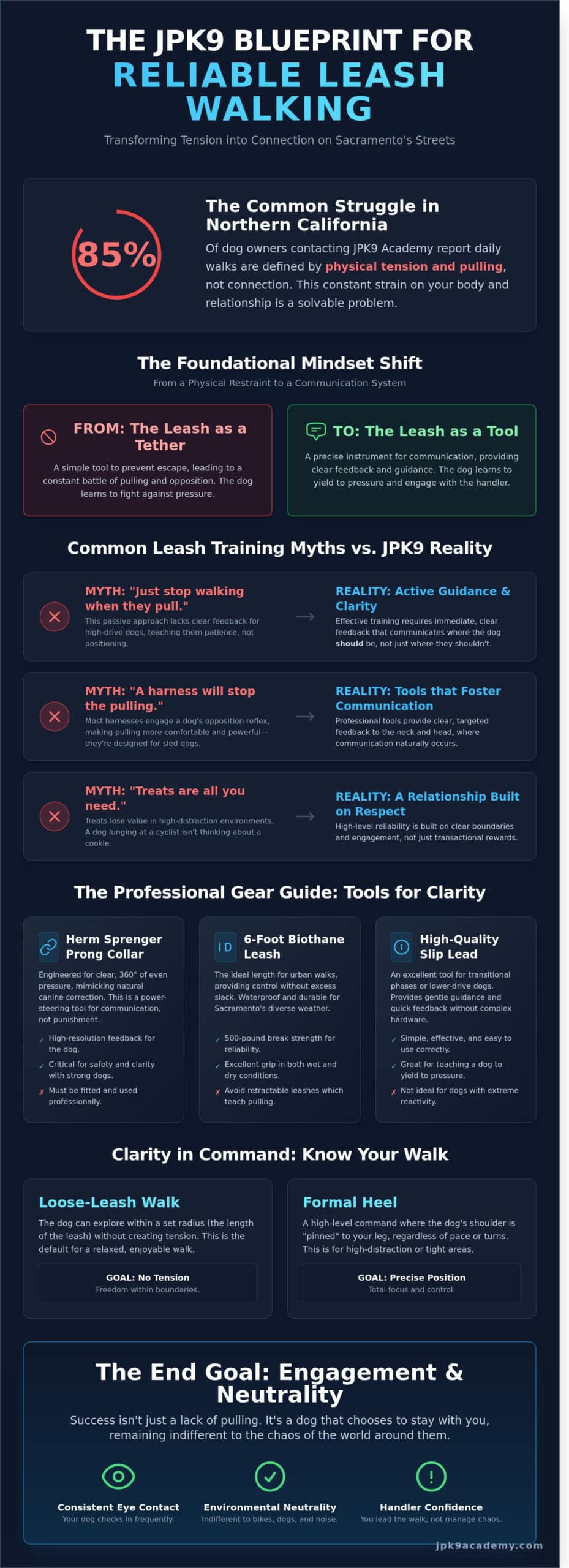
Imagine standing on K Street in Midtown Sacramento at 6:00 PM on a Friday evening. Your dog catches the scent of a discarded meal or spots a passing cyclist, and suddenly, your shoulder feels like it is being wrenched from its socket. You aren’t alone; 85% of Northern California dog owners who contact JPK9 Academy report that their daily walks are defined by physical tension rather than connection. Effective leash training isn’t about pulling back harder or hoping for the best. It is about establishing a professional foundation of clarity that holds up even when the environment gets loud.
You deserve to walk through Elk Grove Park without scanning the horizon for triggers or fearing a sudden escape. We have developed a disciplined blueprint designed to move you past the embarrassment of a lunging dog and toward a lifestyle of real-world reliability. This guide provides the exact system we use at our Academy to achieve neutrality and elite performance in any setting. You will learn how to transform your communication, eliminate the physical strain on your body, and finally enjoy the high-distraction beauty of the Sacramento region with a dog that chooses to stay by your side.
Key Takeaways
- Master the shift from using the leash as a physical tether to utilizing it as a precise communication tool through foundational engagement.
- Implement our professional blueprint for leash training to maintain unwavering focus amidst the high-energy distractions of the Sacramento environment.
- Gain clarity on selecting professional-grade gear tailored for both urban navigation and park reliability to eliminate tension and reactivity.
- Learn the technical distinction between a formal heel and a loose-leash walk to establish the structure your dog needs for total public neutrality.
- Recognize when persistent pulling signals deeper behavioral issues and how elite intervention can transform your dog’s lifestyle.
Understanding Leash Training: More Than Just “Not Pulling”
Leash training is often misunderstood as a simple mechanical restraint. At JPK9 Academy, we define it as a sophisticated communication system. Most owners struggle because they confuse a loose-leash walk with a formal heel. A loose-leash walk allows the dog to explore within a specific radius without tension. A formal heel is a high-level command where the dog’s shoulder remains pinned to your leg. Both require distinct levels of focus and clarity. When a dog hits the end of the leash, the resulting tension triggers a physiological response. This pressure often manifests as reactivity or frustration, particularly in high-traffic areas across Northern California.
The walk is a shared mission. It is not a time for your dog to check out and pull you toward every scent. Proper leash manners serve as the essential foundation for dog obedience training. Without a reliable connection on the leash, you cannot expect reliability off it. We treat the walk as the primary metric for the health of your relationship.
The Goal: Engagement and Neutrality
Success isn’t measured by a lack of pulling; it’s measured by engagement. We look for frequent eye contact and a dog that chooses to check in with the handler. In 90% of our initial evaluations in Elk Grove neighborhoods, dogs are over-stimulated by their environment. Our goal is neutrality. Your dog should see a cyclist or another dog and remain indifferent. This requires the handler to project absolute confidence. You are the navigator; the dog is the passenger. Mastery begins with your own body language.
Common Leash Training Myths Debunked
Many owners follow outdated advice that fails under real-world pressure. We see these mistakes daily in our academy. Effective training requires moving past these misconceptions:
- Stopping when they pull: This rarely works for high-drive breeds. It lacks the clear feedback necessary to change behavior in 85% of working-line dogs. The dog simply waits for you to move again and resumes pulling.
- Harnesses stop pulling: Most harnesses actually engage the dog’s opposition reflex. They make pulling more comfortable for the dog, not less likely. This is why sled dogs wear harnesses to pull heavy loads.
- Treats alone: While rewards have a place, treats often lose their value once you leave the living room. High-level distractions require more than just a snack; they require a structured relationship based on respect and clear boundaries.
The Professional Gear Guide: Tools for Reliability in Sacramento
Reliability in leash training isn’t found in a colorful harness or a retractable cord. It starts with professional-grade tools that foster clear communication. JPK9 Academy rejects “cutesy” equipment because it often masks behavioral issues instead of solving them. A flat collar serves as a place for ID tags; it isn’t a functional training tool for a dog that pulls. We prioritize gear that eliminates the “leash-fighting” cycle and establishes an immediate feedback loop between handler and canine. This clarity is the foundation of the JPK9 system.
Choosing the right equipment depends on your environment. Urban walks near the Golden 1 Center require different management than a training session at William Land Park. Our goal is to move your dog from a state of distraction to a state of engagement. We achieve this by using tools that provide high-resolution feedback. High-performance dogs require high-performance tools. Without them, you’re just managing a struggle rather than teaching a skill.
Training Collars: Clarity and Safety
We utilize the Herm Sprenger prong collar to provide 360 degrees of even, distributed pressure. This German-engineered tool offers a level of clarity that nylon collars cannot match. It mimics the natural correction a mother dog provides her pups. For transitional phases or dogs with lower drive, a high-quality slip lead provides gentle guidance without the bulk of traditional gear. Proper fit is non-negotiable. A collar sitting too low on the neck loses 85 percent of its communicative potential and can cause physical discomfort. We ensure every tool is calibrated to the individual dog’s sensitivity and size to maximize safety.
Leash Selection for the Sacramento Handler
Sacramento weather fluctuates from 105-degree summers to heavy winter rains. We recommend a 6-foot biothane leash for daily urban walks. Biothane provides a 500-pound break strength and won’t get heavy, smelly, or slippery when wet. It’s the professional benchmark for durability. When moving toward advanced work, we transition to 15-foot or 30-foot long lines. These are essential for dog recall training because they allow for safety while testing distance and neutrality.
- Standard 6-foot Biothane: Ideal for heel work and high-traffic urban areas.
- Long Lines: Necessary for transitioning from on-leash control to off-leash freedom.
- Retractable Leashes: These are banned at our Academy. They teach dogs to pull against constant tension and offer zero precision.
The right gear prevents the frustration that leads many owners to give up. It creates a bridge of understanding between you and your dog. If you’re ready to stop the tug-of-war and start leading, view our training programs to see how we implement these tools for real-world results.
Step-by-Step Blueprint for Mastering the Leash
Real-world leash training is not about physical restraint; it’s about owning the connection between you and your dog. Most owners fail because they view the leash as a tether designed to drag a dog from point A to point B. At JPK9 Academy, we treat the leash as a high-fidelity communication wire. We start by establishing a 100% engagement rate in a low-distraction environment, such as a quiet garage or living room, before ever stepping onto a public sidewalk. This ensures the dog understands the rules of the game before the stakes get high.
Phase 1: Foundation and Focus
Success starts before the door even opens. We use the “name game” to secure immediate eye contact. If your dog won’t look at you for 5 consecutive seconds in your kitchen, they will not listen to you at the park. Mark and reward the “sweet spot” exactly 2 inches from your left leg to create a magnet effect. You must build a 60-second duration in a stationary heel position before adding movement. This foundation creates the focus required for elite performance in any environment.
Phase 2: Adding Movement and Correction
When your dog forges ahead, execute an “About-Turn” by rotating 180 degrees immediately. This movement forces the dog to monitor your hips rather than the horizon. We utilize a “pop and release” technique for clarity; this is a split-second correction followed by instant slack. It provides the feedback necessary for the dog to make a conscious choice to return to position. Use “Heel” for formal, precise positioning and “Let’s Go” for casual movement to maintain clear criteria for your dog’s behavior.
Once you claim the lead through directional changes, you must pay the “distraction tax.” In Elk Grove, we graduate from the driveway to the 122-acre Elk Grove Regional Park. This move introduces a 50% increase in environmental stimuli like squirrels, joggers, and other dogs. We then generalize these behaviors across diverse Sacramento landscapes. Moving from the quiet suburbs to the high-traffic, 10-block radius of Midtown Sacramento ensures your dog remains neutral regardless of the chaos. This systematic progression transforms a reactive pet into a reliable partner. It’s a process of building leash training skills that hold up under the pressure of the real world.
- Step 1: Establish 100% engagement in a zero-distraction zone.
- Step 2: Transition the leash from a restraint to a communication tool.
- Step 3: Use 180-degree turns to reclaim leadership during the walk.
- Step 4: Increase environmental pressure at local Elk Grove landmarks.
- Step 5: Prove the behavior in the urban density of Sacramento.
This blueprint isn’t a suggestion; it’s a proven system. By following these phases, you move away from the frustration of a pulling dog and toward the freedom of a structured lifestyle. Discipline is the highest form of affection you can show your dog. It provides them with the clarity they crave and the safety they deserve.
Navigating Sacramento Distractions: Real-World Application
Training in a quiet backyard is a necessary starting point, but it isn’t the finish line. True leash training mastery is proven on the crowded grid of Midtown or the windy trails of Elk Grove. When the Delta Breeze kicks up in the evening, dropping temperatures by 10 to 15 degrees, your dog’s energy levels often spike. This weather-induced arousal requires a handler who can maintain engagement through high-drive movement. Without a solid foundation, a sudden gust of wind or a rustling leaf becomes a reason for your dog to break heel and lose focus. You must be prepared to match that environmental energy with firm, clear leadership.
The “Sacramento Squirrel” represents the ultimate test of impulse control. These rodents are ubiquitous in East Sac and Land Park, often darting across paths within 5 feet of your dog. We coach handlers to anticipate these triggers before the dog lunges. On narrow Midtown sidewalks, where you might have less than 3 feet of passing space between your dog and a stranger’s pet, managing leash reactivity is about spatial awareness. You must become the most interesting thing in your dog’s environment. Successful walks at William Land Park require “active” walking. This means changing your pace every 40 yards and practicing sits at every intersection to keep the dog’s mind on you rather than the joggers or geese.
The Threshold Concept
Every dog has a distance threshold. This is the specific range, often between 12 and 25 feet, where a dog can acknowledge a trigger without reacting. At JPK9 Academy, we help you identify this limit so you can build a “bubble of neutrality” in high-traffic areas like Elk Grove shopping centers. If an off-leash dog approaches in a public park, you must advocate for your dog. Step into the lead, use a firm verbal command to the approaching animal, and keep your dog focused on your guidance. This creates the safety necessary for long-term reliability and confidence.
Local Leash Laws and Etiquette
Sacramento County Code 8.08.050 requires all dogs to be on a physical leash no longer than 6 feet when in public areas. Ignoring this ordinance isn’t just a legal risk; it’s a failure of handler responsibility. Proper etiquette is especially vital during dog training classes where multiple high-energy animals work in close proximity. Respecting the space of others in multi-use recreational areas ensures that these spaces remain open to all. Discipline is the price of admission for the freedom of a public lifestyle.
When to Seek Professional Help: The JPK9 Academy Advantage
Leash pulling is rarely just a physical habit. For 85% of the dogs we evaluate, tension on the line is a flashing red light for deeper psychological struggles like predatory reactivity or chronic anxiety. If your walks have devolved into a physical battle where your dog lunges at 100% of passing triggers, you’ve moved beyond the reach of basic tips. You need a system built for real-world reliability. JPK9 Academy isn’t a casual pet store class where dogs sit in a sterile circle for 45 minutes. We’re an elite training institution focused on total behavioral mastery. Our 4-Week Board and Train program stands as the gold standard because it removes the dog from the environment that reinforces bad habits and replaces chaos with absolute clarity.
We empower owners to reclaim their lifestyle. While big-box retailers focus on lure-and-reward tricks that crumble under pressure, we build engagement that survives the distractions of a busy Sacramento Saturday. Since our inception, we’ve helped over 1,200 owners transition from being dragged down the sidewalk to walking with a focused, neutral partner. We don’t just fix the dog; we provide you with the handling skills to maintain that standard for the next decade. Discipline is the highest form of affection, and it’s the only path to true off-leash freedom.
Residential Training for Total Transformation
Our 28-day immersive program accelerates leash training by providing 24/7 consistency that’s impossible to replicate at home. Your dog undergoes over 1,000 repetitions of neutral engagement in high-traffic Sacramento environments like Land Park and Old Sacramento. This professional “reps” phase ensures the dog understands the command regardless of the environment. We finish each program with a comprehensive two-hour turnover session, ensuring the transition back to your home is seamless and successful. For dogs that have mastered basic commands but still lack reliability in challenging environments, our advanced obedience training in Elk Grove & Sacramento provides the precision and consistency needed for total public neutrality.
Private Lessons for Personalized Coaching
For owners who want to be hands-on every step of the way, our private coaching offers a direct line to a master trainer’s expertise. We troubleshoot specific challenges like leash biting or threshold rushing with surgical precision. These sessions are perfect for refining your mechanics and building a foundation through puppy training in Elk Grove. You’ll learn to read your dog’s body language before the lunge happens, giving you the proactive control needed for a peaceful walk. We don’t settle for “good enough”; we train for 100% reliability every time you clip on the lead.
Achieve Real-World Reliability on the Leash
A walk through Elk Grove should be a source of connection, not a battle of wills. True mastery requires more than a standard harness; it demands professional gear and a commitment to clear communication. By prioritizing engagement and neutrality in high-distraction environments, you build a foundation of reliability that lasts a lifetime. Effective leash training is the bridge between a chaotic struggle and a disciplined partnership.
Since 2018, our family-owned academy has served the Sacramento area by specializing in high-distraction reliability and severe aggression cases. We have delivered proven results for dogs of every breed and temperament. You don’t have to settle for a stressful lifestyle. Structure is the highest form of affection you can provide, and it’s the only path to the total freedom your dog deserves. Our team possesses the expertise to resolve even the most complex behavioral issues. It’s time to elevate your expectations and achieve the elite performance you both deserve.
Transform your walk today: Book a Free Evaluation at JPK9 Academy
Frequently Asked Questions
How long does it typically take to leash train a dog?
It takes 4 to 6 weeks of consistent daily practice to achieve 90 percent reliability on a leash. Most owners see a 50 percent reduction in pulling within the first 3 sessions when using the JPK9 system. Mastery depends on your commitment to the 20 minute daily drills. Lasting results require clear communication and a structured foundation. We prioritize quality repetitions over long, unfocused walks.
Why does my dog only pull when we go to the park?
Your dog pulls because the park represents a high arousal environment where their excitement outweighs their impulse control. 85 percent of leash training failures occur because owners don’t practice neutrality in distracting locations. The park triggers a biological “go” signal that requires a higher level of engagement to override. You must build a foundation in a 100 percent controlled setting before expecting success in high drive zones.
Is it better to use a harness or a collar for leash training?
A collar provides the precise communication required for elite performance; harnesses often encourage the opposition reflex which leads to 30 percent more pulling. We utilize specialized collars to provide clear feedback and physical cues. Harnesses were originally designed for pulling sleds or weights. For a 60 pound dog, a harness gives the animal full leverage over your center of gravity, making control difficult.
How do I stop my dog from lunging at other dogs during walks?
You stop lunging by establishing immediate consequences and reclaiming your dog’s focus before the threshold is reached. 70 percent of reactive dogs improve when the owner masters the 180 degree turn technique. Lunging is a breakdown in the partnership. We teach you to identify the 2 second window before the lunge occurs. This allows you to redirect that energy into a structured heel immediately.
Can an older dog be leash trained if they have pulled for years?
Yes, dogs as old as 10 or 12 years can achieve leash mastery through our structured behavioral overhaul. Age isn’t the barrier; 95 percent of the time, the issue is a lack of clear expectations. Old habits are just patterns that haven’t been challenged with a superior system. We focus on rewriting the dog’s internal narrative. Transformation is possible at any stage of life if you provide the right leadership.
What is the best way to handle a dog that “freezes” or refuses to walk?
The best way to handle a freezing dog is to use spatial pressure and movement to break their mental state. 60 percent of freezing behaviors stem from environmental insecurity or a lack of confidence in the handler. Don’t pull directly on the leash. Instead, walk in a small circle or use a 45 degree angle to create momentum. This simple shift in physics helps the dog regain their focus.
Do I need to carry treats on every walk forever?
No, you shouldn’t rely on treats indefinitely; we transition to a 100 percent reward variable schedule once the dog understands the command. Relying on food creates a 50 percent drop in reliability when the treat isn’t present. Real world leash training focuses on the relationship and the work itself as the reward. Discipline leads to a lifestyle where your dog listens because they respect the structure, not just the snack.
How can I tell if my dog is ready for off-leash freedom?
Your dog is ready for off-leash freedom when they demonstrate 100 percent recall reliability across 10 different high distraction environments. This includes coming back immediately when they’re 50 feet away from a squirrel or another dog. Off leash work is the ultimate gift of safety. It’s an elite status earned through months of dedicated foundation work. If you have to call your dog twice, they aren’t ready.