That $149 digital service dog certification you purchased is legally irrelevant under the 2026 Department of Justice standards. It’s a harsh reality for many Sacramento handlers, but no government agency recognizes a paid registry as a substitute for high-performance training. You’ve likely felt the tension of walking through the Old Sacramento Waterfront, wondering if your dog will hold a stay or if a business owner will demand papers you don’t actually need. We understand the frustration of staring at conflicting legal codes while fearing a public confrontation at an Elk Grove park. It’s exhausting to feel like you’re one bark away from being asked to leave.
This guide will dismantle the myths surrounding “official” documentation and reveal the exact legal requirements for public access in California. You’ll gain a clear understanding of the ADA standards and the specific tasks your dog must master to be legally recognized. We are going to outline a definitive plan for building the elite environmental neutrality and reliability required to move through your life with total confidence. True freedom doesn’t come from a printed certificate; it comes from the discipline of a dog that is prepared for any environment.
Key Takeaways
- Recognize that paid registries are a trap; neither the ADA nor California law requires an “official” certificate for public access.
- Discover why a legitimate service dog certification is earned through rigorous task training and total behavioral control rather than a digital ID card.
- Navigate the specific legal protections for service dogs in training within Sacramento and Elk Grove to ensure your prospect is protected from day one.
- Build a foundation of elite obedience and off-leash reliability to transform your dog from a pet into a focused, high-performance service partner.
- Learn the precise standards of public access mastery required to ensure your dog remains a welcome, unobtrusive asset in any professional environment.
The Truth About Service Dog Certification in Elk Grove & Sacramento
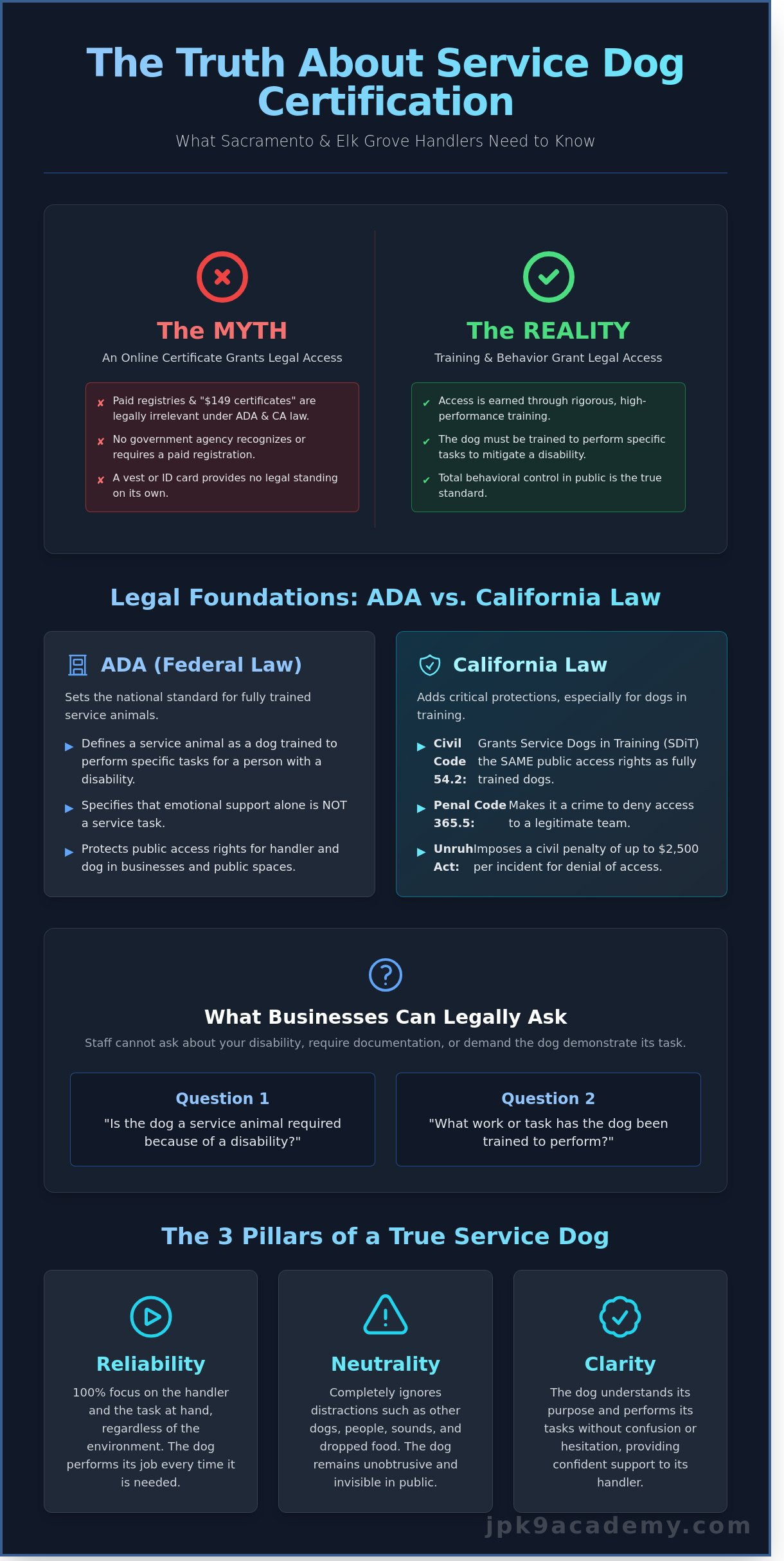
Most Sacramento dog owners are misled by aggressive digital marketing. They believe a PDF certificate or a shiny badge grants them legal access to public spaces. It doesn’t. Under the Americans with Disabilities Act (ADA) and California’s Unruh Civil Rights Act, no official government service dog certification or central registry exists. You cannot buy legal status for $79.99 on a website. Real access is earned through rigorous training and the dog’s ability to perform specific work that mitigates a disability.
At JPK9 Academy, we see the fallout of this misinformation daily. Owners arrive with “registered” dogs that lack basic neutrality and fail under pressure. We prioritize elite reliability over meaningless paperwork. A dog that lunges or barks in a crowded Elk Grove cafe is not a service animal, regardless of what its vest says. True freedom for the handler comes from a dog that has achieved total behavioral mastery.
The Legal Definition of a Service Animal
A Service animal is defined by the ADA as a dog that is individually trained to do work or perform tasks for the benefit of an individual with a disability. This definition hinges on “trained tasks.” Mere presence is not a task. If a dog provides comfort just by being there, it’s an Emotional Support Animal (ESA), which has no public access rights in California. Psychiatric Service Dogs (PSDs) are different; they are trained to detect and stop panic attacks or remind a handler to take medication. In places like the Golden 1 Center, staff can legally ask you only two questions: Is the dog a service animal required because of a disability? What work or task has the dog been trained to perform?
Why “Online Registries” are a Red Flag
The service dog certification industry is a machine built on misinformation. These websites are private businesses with zero legal standing in the United States. They offer no oversight and require no proof of training. In 2025, the surge of poorly behaved “certified” dogs in Sacramento led to increased skepticism from local business owners. This harms the legitimate service dog community. A vest is just fabric; it does not grant access. Only a dog that remains neutral in high-distraction environments and performs its life-saving tasks has the legal right to be in a grocery store or restaurant. We focus on building that foundation of discipline so the dog can actually do its job when it matters most.
- Reliability: 100% focus on the handler in any environment.
- Neutrality: Ignoring other dogs, people, and food dropped on the floor.
- Clarity: The dog understands exactly what its job is at all times.
ADA vs. California Law: What Sacramento Owners Need to Know
Federal law provides the foundation. California law adds the teeth. Understanding the interplay between the ADA and state statutes is the first step toward true public access mastery. While the ADA focuses on the finished product, California recognizes the process. This means your dog in training has legal standing in Sacramento that it might lack in other states. Under California Civil Code 54.2, your service dog in training (SDiT) has the same right of access as a fully trained animal, provided they are under your control and on a leash.
Many owners search for service dog certification thinking a piece of paper grants them entry. It doesn’t. Real authority comes from behavior and legal knowledge. Disability Rights California clarifies that no business can demand “papers” or “proof” as a condition for entry. In Sacramento, your dog is judged by its neutrality and performance, not by a vest you bought online. If your dog isn’t ready for the pressure of a crowded environment, no amount of paperwork will save your reputation.
California Penal Code 365.5 Explained
California Penal Code 365.5 ensures individuals with physical or mental disabilities can bring their dogs into any place of public accommodation. This includes hotels, theaters, and retail stores. If a business owner denies you access, they face a civil penalty of $2,500 per incident under the Unruh Civil Rights Act. California also protects your dog from others. Penal Code 600.2 makes it a crime to allow another dog to injure or kill a working service animal. High standards in training prevent these conflicts before they start.
Public Access Rights in Northern California
Navigating the Arden Fair Mall or catching a Kings game at the Golden 1 Center requires a dog with total neutrality. Sacramento Regional Transit (SacRT) allows service dogs on all buses and light rail trains without extra fees. You must maintain control at all times. Sacramento follows the California Retail Food Code, which allows service dogs in indoor dining areas, unlike pets which are restricted to patios. Achieving this level of reliability requires a structured training foundation that prepares the dog for the sensory overload of downtown Sacramento.
Fraudulent claims undermine the entire community. California Penal Code 365.7 states that any person who knowingly and fraudulently represents themselves as the owner of a service dog is guilty of a misdemeanor. This carries a penalty of up to 6 months in county jail and a $1,000 fine. Integrity is the only way forward. If you are pursuing service dog certification for the right reasons, you understand that the work starts with discipline long before you step into a public space.
The Registry Trap: Why Certificates Don’t Grant Public Access
Many handlers walk into a Sacramento grocery store or an Elk Grove restaurant clutching a laminated card, believing it’s a legal shield. It isn’t. Online registries promise that a $50 service dog certification grants instant access to any business. This is a predatory lie. Under the Americans with Disabilities Act (ADA), these documents carry zero legal weight. Business owners are increasingly aware that a piece of paper doesn’t equal a trained animal. Real access is earned through thousands of hours of repetition and proofing, not a digital download. Organizations like Assistance Dogs International set the global benchmark for what a working dog should be, emphasizing rigorous standards over hollow paperwork. At JPK9 Academy, we replace the “pay-for-paper” model with a “work-for-results” methodology. We focus on Public Access Reliability, which is the only true barrier to entry for a professional team.
When a Service Dog Can Be Legally Excluded
Legality stops where poor behavior begins. A dog can be legally removed from any public space if it is out of control or not housebroken. Barking, jumping on patrons, or wandering away from the handler are immediate grounds for exclusion. In 2024, reports of “fake” service dogs increased by 22 percent in California, leading business staff to be more diligent in identifying behavioral red flags. Handlers must maintain constant tethered or voice control at all times. We eliminate these risks through dog engagement training. We build a foundation where the dog ignores the environment and focuses entirely on the handler, ensuring they remain an asset rather than a liability.
The Myth of the Mandatory Vest
Vests are not required by law. They are tactical tools, not legal requirements. Many handlers use them to signal “do not pet” or to hold medical supplies, but a vest without training is just a costume. Relying on a piece of fabric to bypass scrutiny often leads to public confrontations and unnecessary stress. True service dog certification is reflected in the dog’s ability to remain neutral in a chaotic environment. We train for total neutrality. A dog should be a silent, invisible partner, whether they are tucked under a table at a busy cafe or navigating the crowds at a local event. Mastery of the environment is the ultimate gift of freedom for both the handler and the dog.
The Real Requirements: Task Training and Public Access Mastery
A legitimate service dog is the result of thousands of hours of intentional labor, not a purchased document. While many owners look for a quick service dog certification, the industry reality is far more demanding. Transforming a pet into a reliable prospect requires a shift from casual companionship to high-performance partnership. Statistics from top training programs show that up to 70 percent of candidates fail to meet the rigorous standards required for public work. Success depends on three non-negotiable pillars: obedience, tasking, and total neutrality.
Step 1: Establishing Elite Obedience
Foundation work is the infrastructure of a service dog’s life. Without absolute control, a dog cannot safely navigate public spaces. We demand a level of precision where the dog remains “tucked under the table” at a crowded Elk Grove cafe for 60 minutes without breaking focus. This level of discipline is the focus of our dog obedience training in Elk Grove. We build the clarity needed so the dog understands that its environment is secondary to its handler’s commands. Discipline is the highest form of affection because it grants the dog the ability to accompany you everywhere.
Step 2: Specialized Task Training
Under the ADA, a service dog must be trained to perform specific tasks that mitigate a disability. A natural behavior, like a dog licking a hand, isn’t a task until it’s a reliable, trained response to a specific trigger. Common examples include:
- Medical Alert: Detecting blood sugar fluctuations or oncoming seizures.
- Mobility Assistance: Opening doors or providing physical bracing for balance.
- Deep Pressure Therapy (DPT): Applying weight to specific pressure points to regulate the nervous system.
For a service dog certification to hold any weight in the real world, these tasks must be performed with a 95 percent success rate regardless of the environment. Reliability is the only metric that matters.
Step 3: Proofing in High-Distraction Environments
The final phase is the Public Access Test (PAT). This is the gold standard for behavior. We move training from the controlled facility to the chaos of Old Sacramento or the State Capitol. A service dog must maintain total neutrality while passing aggressive “pet” dogs or navigating the dense crowds of the Elk Grove Commons. The dog’s job is to be invisible until needed. True mastery means the dog remains calm when a child runs past or a tray of food drops nearby. This level of reliability provides the handler with the freedom to live without fear of a behavioral breakdown.
Building the Foundation: How JPK9 Academy Supports Service Prospects
True mastery in service work starts where basic obedience ends. While a piece of paper for service dog certification might satisfy a legal curiosity, it does nothing for the handler when a dog reacts to a distraction in a crowded Sacramento storefront. At JPK9 Academy, we specialize in the elite obedience and environmental neutrality required for life-saving work. We don’t just train behaviors; we forge disciplined partners capable of operating in high-pressure environments. Our system is built on the philosophy that structure is the highest form of affection, providing dogs with the clarity they need to succeed.
The JPK9 Board and Train Advantage
Our residential Board and Train programs are designed for results. We take dogs into our facility for 21 to 28 days to establish a foundation of total engagement. This immersion allows us to proof commands against the 2026 reality of urban distractions. Whether it’s the noise of the Sacramento Light Rail or the bustle of a crowded shopping center, your dog must remain neutral. We achieve off-leash reliability by providing the dog with absolute clarity. This disciplined approach ensures the dog remains a focused partner, not a liability, in any social setting.
Is Your Dog a Candidate for Elite Training?
Success in service work is 70% temperament and 30% training. A dog with genetic nerve issues or high environmental sensitivity will struggle, regardless of the trainer’s skill. We look for dogs that possess a stable “off-switch” and a natural desire to work with their handler. If your dog doesn’t have the right foundation, forcing them into a service role is unfair to the animal and dangerous for the handler. Statistics from professional organizations show that nearly 50% of dogs fail out of service programs due to temperament issues. Before you invest in a path toward service dog certification, you need an honest assessment of your dog’s potential. Schedule a consultation at our Elk Grove facility to evaluate your dog’s temperament and see if they are ready for the rigors of elite training.
We provide the roadmap to freedom through discipline. For Sacramento handlers who demand excellence, JPK9 Academy is the expert partner that turns potential into performance. Our results-oriented methodology ensures your dog is prepared for the serious craft of service work. Don’t leave your safety to chance; build a foundation that lasts a lifetime.
Master the Standard for Sacramento Service Dogs
Legitimacy in the service dog world isn’t bought through a website; it’s earned through hundreds of hours of dedicated training. Online registries offering service dog certification are often nothing more than predatory scams that fail to meet the strict requirements of ADA Title II and Title III regulations. In Sacramento and Elk Grove, your dog’s right to public access depends entirely on their ability to perform specific tasks and maintain elite behavioral neutrality in crowded spaces like the Golden 1 Center. JPK9 Academy’s family-owned facility specializes in the balanced training methodology required to bridge the gap between a pet and a professional partner for the Sacramento region’s 1.5 million residents.
Our team focuses on high-level behavioral modification to ensure your dog remains reliable under pressure. We don’t rely on treats or gimmicks. We build engagement and clarity through a disciplined system that serves the most committed owners. It’s time to stop looking for shortcuts and start building a foundation of true off-leash mastery. Your dog’s potential is waiting to be unlocked through structure and professional guidance.
Transform your dog into an elite partner, Apply for an Evaluation today.
Frequently Asked Questions
Is service dog certification required in California?
No, service dog certification is not legally required in California under the Americans with Disabilities Act or the Unruh Civil Rights Act. Many online registries sell certificates, but these documents hold zero legal weight for public access. True reliability comes from 120 hours of training over six months, ensuring the dog performs specific tasks for a disability. We focus on the work, not a piece of paper.
How do I register my dog as a service animal in Sacramento?
You aren’t required to register your dog in a central database, but Sacramento County offers a voluntary identification tag program through Animal Care Services. This process requires an affidavit stating your dog is trained for a specific task. While this tag identifies the animal, it doesn’t replace the need for rigorous behavioral standards and elite neutrality in high-traffic areas like the Golden 1 Center.
Can a business in Elk Grove ask for proof of my dog’s certification?
Business owners in Elk Grove cannot legally demand to see a service dog certification or any medical documentation. Federal law limits their inquiry to two specific questions: is the dog a service animal required because of a disability, and what work or task has the dog been trained to perform? if your dog isn’t under control, the business can ask you to remove the animal regardless of its status.
What is the difference between a service dog and an emotional support animal?
A service dog is trained to perform specific tasks that mitigate a disability, whereas an emotional support animal (ESA) provides comfort just by being present. Service dogs have public access rights under the ADA; ESAs do not. At JPK9 Academy, we focus on the 2,000 repetitions required to master a task, distinguishing a professional working dog from a pet that simply offers emotional warmth.
Does a service dog have to wear a vest in public?
No legal mandate requires a service dog to wear a vest, harness, or specific collar in public. Many handlers use them to signal to the public that the dog is working, but the law prioritizes the dog’s behavior and task-training over its attire. A dog in a vest that barks or lunges fails the standard of a true service animal. Behavior is the only true indicator of a working dog.
Can I train my own service dog in California?
Yes, California law allows you to train your own service dog without hiring a professional organization. This path demands extreme discipline and a structured curriculum to reach the 95 percent reliability rate expected of working animals. Most owner-trainers spend 18 to 24 months refining obedience and task work to ensure their dog can handle the environmental stressors found in urban Sacramento or busy Elk Grove shopping centers.
What happens if my service dog misbehaves in a store?
If a service dog barks excessively, shows aggression, or isn’t housebroken, the business manager has the right to exclude the animal from the premises. The ADA requires the dog to be under the handler’s control at all times via a leash, tether, or voice commands. One mistake can lead to a 100 percent loss of public access privileges for that visit, emphasizing the need for total behavioral clarity.
How much does it cost to train a service dog in Sacramento?
Professional service dog training in Sacramento typically ranges from $15,000 to $50,000 when working with specialized academies from puppyhood to placement. This investment covers the 600 plus hours of specialized instruction needed for elite performance. For owners pursuing a hybrid model, costs vary based on the dog’s starting foundation, but expect to invest significantly in professional guidance to ensure the dog meets the 2026 public access standards.