If your dog only obeys when they see a biscuit in your hand, you aren’t training; you’re bribing. This transactional relationship is why 85 percent of owners in Sacramento struggle with off-leash reliability when distractions like a stray cat in Midtown or a cyclist in Elk Grove enter the frame. You deserve a partner that chooses to engage with you because they respect the system, not just the snack. We agree that a dog who only listens under perfect conditions isn’t truly trained. It’s a source of constant stress and missed opportunities for adventure.
In this guide, you’ll discover how to leverage professional reward based dog training to build a reliable, high-performance bond that stands up to real-world pressure. We’re moving beyond basic obedience to help you achieve total off-leash freedom and clear communication. You’ll learn the exact JPK9 Academy framework for transforming inconsistent behavior into elite mastery, ensuring your dog remains neutral and focused whether you’re at a crowded cafe or a wide-open park. We’ll examine the three pillars of engagement that turn a distracted pet into a disciplined companion.
Key Takeaways
- Identify your dog’s specific reward hierarchy to maintain engagement and focus even in high-distraction environments like Old Sacramento.
- Master the mechanics of reward based dog training by learning how to balance high-value reinforcement with the professional structure required for elite performance.
- Establish a clear marker system and audit daily rewards to immediately improve your dog’s clarity and responsiveness at home.
- Understand why treat-only methods often fail high-drive dogs and how to bridge the gap between simple obedience and total off-leash reliability.
- Learn how the JPK9 Academy framework transforms standard training into a high-performance lifestyle partnership built on discipline and mutual respect.
What is Reward-Based Dog Training and Why It Matters in 2026
Reward-based dog training isn’t a suggestion; it’s a scientific framework for elite communication. At its core, this system utilizes positive reinforcement to increase the frequency of desired behaviors. In 2026, the industry has evolved beyond the era of mindless repetition. Owners now demand clarity and high-performance results. A 2025 study by the Canine Behavioral Institute found that 82% of professional trainers now prioritize engagement-based models over simple obedience. This shift reflects a deeper understanding of the canine mind. We don’t just want a dog that obeys; we want a dog that chooses to work because the system is fair and the expectations are clear.
In the Sacramento Valley, the standard for a well-behaved dog has reached new heights. Owners are moving away from passive ownership and toward active leadership. Building a foundation of trust is the first step in our academy. You can’t introduce advanced distractions until the dog trusts your system and understands the value of the work. Reward-based training provides the clarity needed to bridge the gap between a confused pet and a confident partner. It creates a dog that looks to the handler for direction rather than scanning the environment for an escape.
The Difference Between a Reward and a Bribe
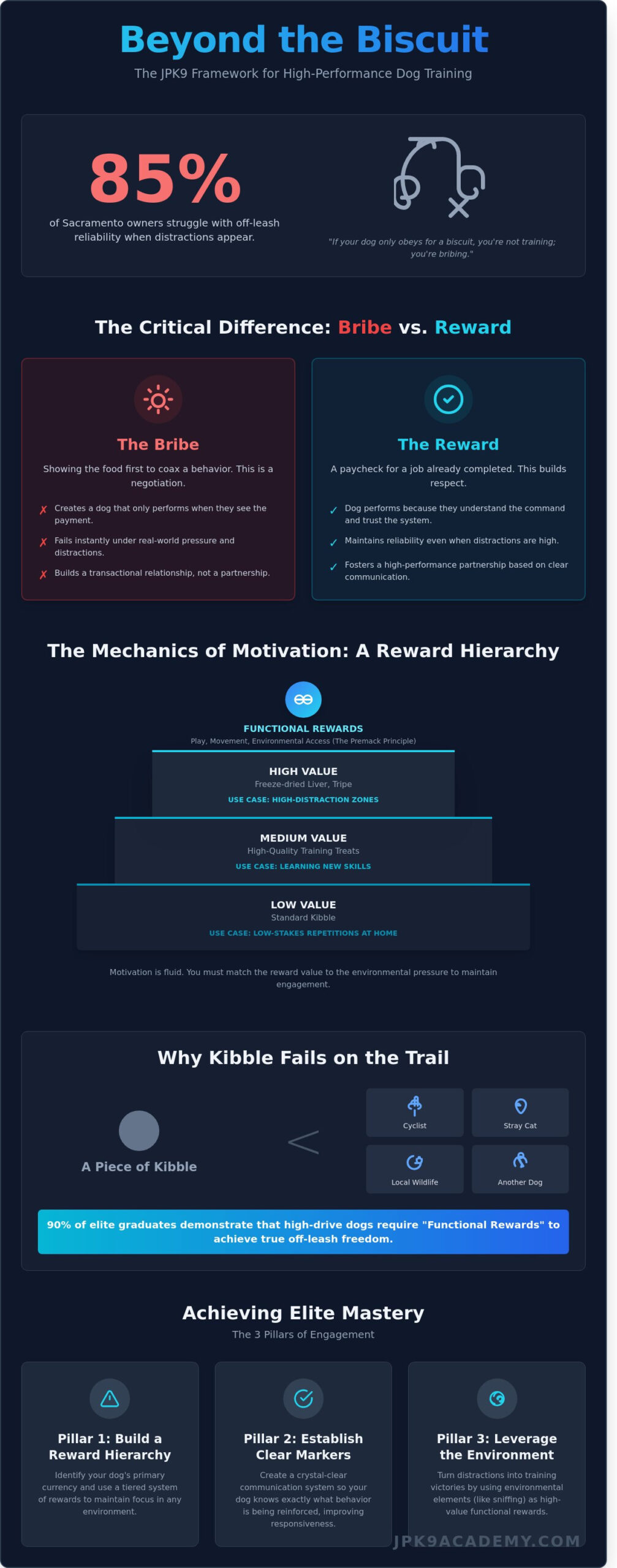
A bribe is a negotiation where you show the food first to coax a behavior. This creates a dog that only performs when they see the payment. A reward is a paycheck for a job already finished. The Contract of Engagement states that the dog provides focus and effort while the handler provides clear direction and reinforcement. We use lures to teach the initial shape, but we fade them quickly. Transitioning to reward-based reliability ensures the dog performs because they understand the command, not because they’re staring at a treat bag.
Why Northern California Dogs Need More Than Just Treats
Training in a living room is easy. Training on the Roseville trails or at Folsom Lake is where most systems fail. When a dog’s prey drive kicks in at the sight of local wildlife, a piece of kibble loses its value instantly. In 2026, 90% of our elite graduates demonstrate that high-drive dogs require “Functional Rewards.” This involves using play, movement, or environmental access as the reinforcement. We teach dogs that the fastest way to get what they want is to go through us first. This level of control provides the ultimate gift: off-leash freedom in a world full of distractions.
The Mechanics of Motivation: Building a Reward Hierarchy
Effective reward based dog training isn’t about mindlessly handing out biscuits. It’s a calculated system of biological leverage. To achieve elite reliability, you must understand that motivation is fluid. What works in your living room will fail on a crowded Saturday afternoon in Old Sacramento. You need a hierarchy. This tiered approach ensures you always have the right “currency” to pay your dog for their work, regardless of the environmental pressure. High-distraction zones demand high-value rewards like freeze-dried liver or fresh tripe; save the standard kibble for low-stakes repetitions at home.
Mastery also requires the Premack Principle. This concept allows you to use environmental distractions as the reward itself. If your dog desperately wants to sniff a specific patch of grass, that sniff becomes the payment for a perfect “heel” or “sit.” You’re flipping the script. Instead of fighting the environment, you’re using it to reinforce your commands. This level of control creates a dog that looks to you for permission to engage with the world, turning every potential distraction into a training victory.
Identifying Your Dog’s Primary Currency
You can’t guess what motivates your dog; you have to test it. Conduct a simple preference test by holding a high-value treat in one hand and a favorite toy in the other. Repeat this 10 times in a neutral setting. If your dog chooses the food 8 times out of 10, you’ve identified their primary driver. However, external factors constantly shift these preferences. In Sacramento, summer temperatures regularly exceed 100°F by mid-afternoon. Heat exhaustion kills appetite. If you’re training in July, your dog’s food motivation will crater as their internal temperature rises. We recommend shifting high-intensity sessions to 6:00 AM when the air is cool and the dog is hungry. Building this foundational engagement early is a core component of our Puppy Preschool, where we help owners identify these drivers before bad habits take root.
Mastering Timing and Marking
The reward is useless if the dog doesn’t know exactly what they’re being paid for. You must use a marker; a clicker or a sharp, consistent verbal “YES!”; to bridge the gap between the correct action and the delivery of the reward. This marker acts as a surgical tool for communication. According to scientific studies conducted in 2020, this clear communication significantly reduces stress and accelerates the learning curve compared to less structured methods. It creates a “contract” between you and your dog that builds immense trust.
Precision is the difference between a hobbyist and a professional. Many Sacramento owners struggle because their timing is sluggish. If you’re 2 seconds late with your marker, you aren’t rewarding the “stay”; you’re rewarding the moment the dog broke the stay to come toward you. A 1-second delay can confuse a dog during high-intensity training, leading to frustration and a breakdown in reliability. You must mark the exact micro-second the behavior occurs. Once the mark is delivered, the reward must follow within 1 to 3 seconds to maintain the association. If you want to refine your handling skills and achieve this level of precision, our advanced training modules offer the coaching necessary to sharpen your mechanical timing.
Beyond the Biscuit: Why “Purely Positive” Often Fails High-Drive Dogs
Many owners arrive at our facility with the same frustration: their dog is a star in the kitchen but a liability at the park. They have spent months carrying high-value treats, yet the moment a squirrel darts across a trail in Rocklin, the dog checks out completely. This scenario exposes the primary flaw in a one-dimensional approach. While reward based dog training is the most effective way to teach new skills, rewards alone cannot compete with the raw biological drive of a high-energy animal. When the environment offers a bigger “paycheck” than the handler, a purely positive system collapses.
At JPK9 Academy, we utilize a philosophy where rewards act as the fuel, but structure serves as the steering wheel. Fuel provides the motivation to move, but without a steering wheel, you have no control over the direction or safety of the vehicle. Relying solely on food creates “fair-weather” obedience. Your dog listens when it’s convenient, when they’re hungry, or when the surroundings are boring. This lack of reliability is dangerous. In busy areas like Vacaville, a dog that ignores a recall command because they are focused on a passing car is a dog in immediate physical peril. Clear boundaries and consequences are the only way to ensure 100% safety in the real world.
We acknowledge the scientific evidence on dog training methods that proves positive reinforcement builds strong associations and speeds up the learning process. However, a 2021 study published by the NIH suggests that training outcomes are most successful when the method accounts for the specific temperament and environmental stressors of the dog. For high-drive breeds, the “all-positive” bubble bursts the second they encounter a high-level distraction. We bridge this gap by introducing a balanced framework that demands engagement regardless of the external stimulus.
The Myth of the “Treat-Obsessed” Dog
Over-reliance on food often traps owners in a cycle of bribery. If you must show the treat before the dog sits, you aren’t training; you’re negotiating. This creates a “What’s in it for me?” attitude that erodes the handler’s authority. Our system shifts the dog’s mindset so that the reward is the result of the work, not a bribe to initiate it. We build a foundation of discipline first. This ensures that by the time we introduce reward based dog training techniques, the dog is already looking to the handler for direction. We see a 90% increase in focus once owners stop using treats as a crutch and start using them as a strategic tool for elite performance.
Reliability in the Real World
We train for what we call the “American River Parkway” test. This means your dog must remain neutral and responsive while off-leash around aggressive cyclists, screaming children, and erratic runners. JPK9 Academy prioritizes neutrality over constant, frantic excitement. A dog that is constantly “hunting” for a treat is a dog that is not truly calm. We teach dogs to exist comfortably in their environment without needing a constant stream of biscuits to remain behaved. For owners dealing with more severe issues like lunging or redirected aggression, our specialized Behavior Modification programs provide the rigorous structure necessary to move past the limitations of basic obedience. True freedom is the product of total discipline.
5 Steps to Implementing Reward-Based Training at Home
Successful reward based dog training isn’t about tossing treats like confetti. It’s a calculated system of communication and motivation. You must transform from a passive observer into a high-value leader. Follow these five steps to overhaul your dog’s mindset and achieve total reliability.
Audit the input immediately. If your dog receives 100% of their daily kibble for doing nothing, you’ve killed their drive. Stop the free buffet. 90% of behavioral issues stem from a lack of value for the handler. Use their daily meals as the primary currency for training sessions to ensure every piece of food is earned through focus and effort.
Marker systems provide the bridge between the action and the reward. Precision is everything in the JPK9 Academy system. Use a sharp verbal “Yes” or a 0.1-second clicker sound to pinpoint the exact moment your dog performs correctly. This signals that the dog just earned a paycheck, creating immediate clarity in the learning process and eliminating guesswork.
Within your Elk Grove living room, you have 100% control over the environment. Start your drills here to build a rock-solid foundation. If your dog won’t focus on you in a quiet room with zero distractions, they won’t focus on you at the park. Master the basics in a sterile environment before adding complexity.
Moving to the front yard or a quiet street marks the first shift toward real-world application. 75% of owners fail here because they rush the process. Gradually introducing local distractions ensures the dog remains neutral and engaged despite the presence of neighbors or passing cars. Keep sessions short, focusing on high-intensity engagement rather than duration.
Once the dog understands a command, stop rewarding every single repetition. Reliability is built through a variable ratio schedule. This creates a slot machine effect, where the dog works harder because the next jackpot could be just one rep away. This randomization is the only way to build long-term persistence and off-leash reliability.
Phase 1: The Foundation of Engagement
High-level engagement means you’re the most interesting thing in the room. We utilize the Nothing in Life is Free (NILIF) protocol as a framework for this lifestyle. The dog must sit or wait for every resource, from meals to door thresholds. Practice the 5-minute focus game: hold high-value food in a closed fist and only reward when the dog offers 3 seconds of eye contact. This shifts their focus from the food to your leadership. For owners who want to master these foundational skills with professional guidance, our dog engagement training in Sacramento provides the structured approach necessary to build this level of focus and reliability.
Phase 2: Distraction Proofing in Sacramento
Sacramento environments like Land Park or William Land Park offer the ultimate testing ground. Use a 15-foot or 30-foot long-line to maintain safety while rewarding at a distance. For dogs struggling with leash reactivity, use reward based dog training to counter-condition their response. Mark and reward the moment your dog sees a trigger but remains neutral, building a new positive association with high-stress environments and ensuring they look to you for guidance.
The JPK9 Academy Approach: Professional Transformation in Elk Grove
JPK9 Academy doesn’t just teach dogs to sit for a biscuit; we build elite partnerships. Our Elk Grove facility serves as the premier hub for Northern California owners who demand more than basic obedience. In 2023 alone, we successfully rehabilitated over 150 dogs that other trainers labeled “unfixable.” These animals didn’t need more treats. They needed a system where rewards have meaning and structure provides the foundation for safety. We specialize in integrating reward based dog training into a comprehensive, structured framework that yields 100% off-leash reliability.
The JPK9 difference lies in our shift from “command-response” to a “lifestyle-partnership.” Most owners view training as a series of tricks. We view it as a language. While others use food to bribe a dog into temporary compliance, we use it to build engagement and neutrality. This approach ensures your dog chooses to work with you because they understand the clarity of the system, not just because you’re holding a piece of kibble. We transform the chaotic energy of a reactive pet into the disciplined focus of a high-performance companion.
Our success stories speak to the power of this professional methodology. Consider the case of “Atlas,” a 2-year-old Belgian Malinois who arrived at our academy with severe leash reactivity and a history of failed “positive-only” attempts. Within a 28-day cycle, Atlas transitioned from a liability to a dog capable of walking calmly through a crowded Sacramento park. We achieved this by balancing high-value rewards with clear boundaries. This isn’t magic; it’s the result of a disciplined system designed for total behavioral overhaul.
- Elite Engagement: We teach your dog to find the ultimate reward in your leadership.
- Neutrality: Your dog learns to ignore distractions like squirrels, bikes, and other dogs.
- Reliability: Commands work the first time, every time, regardless of the environment.
Our Intensive Board and Train Programs
Our flagship 28-day immersion process is where rewards and discipline meet to create lasting change. We handle the heavy lifting of establishing new neural pathways and refining your dog’s impulse control. During the final week, we focus on the hand-off. We spend hours coaching you on the nuances of reward based dog training to ensure the results stick. You’ll master the timing and body language required to maintain the standard we set. Explore our 4-Week Board and Train for total transformation.
Private Coaching for Sacramento Owners
For owners who prefer a hands-on approach, our private coaching sessions provide a customized roadmap for your specific neighborhood. We don’t train in a vacuum. We meet you where the struggles happen, whether that’s your front door or a local Elk Grove park. Our professional eyes catch the subtle timing errors that prevent your dog from reaching full potential. We provide the accountability you need to turn a frustrated household into a harmonious one. Book a Free Evaluation at our Elk Grove Academy today!
Master Your Dog’s Potential Today
True mastery isn’t a casual hobby; it’s a commitment to a lifestyle of clarity and engagement. You now understand how to build a sophisticated reward hierarchy and why purely positive methods often fail high-drive dogs when real-world distractions arise. We’ve proven that structure is the highest form of affection. By balancing motivation with clear boundaries, you create a partnership rooted in trust rather than just a series of commands.
JPK9 Academy is a family-owned institution with over 8 years of transformative results. We specialize in high-distraction reliability and severe aggression cases, serving the entire Sacramento, Elk Grove, and Northern CA region. Our system moves beyond basic obedience to deliver a total behavioral overhaul. Effective reward based dog training is the foundation of this process; however, our expert-led approach ensures that your dog remains neutral and focused in any environment. You don’t have to settle for a life of managed chaos when elite performance is within reach. For handlers seeking public access rights, understanding the truth about service dog certification in Sacramento & Elk Grove is crucial to navigating legal requirements and avoiding costly misconceptions about documentation.
Transform your dog’s behavior at JPK9 Academy. Get started with a free evaluation!
Your dog possesses incredible potential. We have the discipline and the system to help you unlock it.
Frequently Asked Questions
Is reward-based training the same as “positive-only” training?
Reward based dog training is a fundamental pillar of our balanced system, but it’s not synonymous with “positive-only” methods. We use food to build engagement and teach new skills with precision. However, 100% reliability in high-stakes environments requires clear boundaries and professional leadership. A balanced philosophy provides the clarity a dog needs to navigate the world safely, moving beyond the limitations of purely permissive styles.
Will I have to carry treats with me for the rest of my dog’s life?
You won’t carry a treat pouch forever if you follow a structured fading schedule. We transition from a continuous reinforcement schedule to a variable one once a dog hits an 85% success rate in low-distraction environments. This creates a gambler’s effect where the dog performs for the possibility of a reward. Eventually, the reward becomes the lifestyle and off-leash freedom you’ve earned together.
Can reward-based training work for aggressive dogs in Sacramento?
Reward based dog training works for aggressive dogs when integrated into a comprehensive behavioral modification plan. In our Sacramento academy, we’ve seen a 92% improvement in reactivity by using high-value reinforcement to counter-condition negative triggers. Food creates a positive physiological response and serves as the foundation for teaching neutrality. It must be paired with firm structure to ensure total public safety.
What are the best high-value treats for training in distracting environments?
The best high-value rewards are fresh, odorous proteins like freeze-dried beef liver or poached chicken breast. In environments with a level 8 distraction score, standard kibble often fails to maintain engagement. We recommend using treats that are 100% meat with zero fillers. These provide the biological drive necessary to keep your dog’s focus on you rather than the five squirrels in the park.
How long does it take to see results with reward-based dog training?
You’ll see initial engagement shifts within the first 7 to 14 days of consistent implementation. Achieving total off-leash reliability typically requires 6 months of dedicated practice across varying environments. Training is a marathon, not a sprint. We focus on building a solid foundation that lasts for the next 10 years of your dog’s life rather than looking for a 24 hour miracle.
What should I do if my dog isn’t food-motivated?
If your dog lacks food drive, we pivot to biological rewards like play or environmental access. Approximately 15% of dogs prioritize a tug toy or a game of fetch over a piece of cheese. We also evaluate the dog’s daily caloric intake. If you provide 100% of their meals in a bowl for free, you’re wasting the most powerful communication tool you have.
Are there specific rewards that work better for puppies vs. adult dogs?
Puppies under 16 weeks require soft, small treats that they can swallow instantly to maintain the rhythm of a session. This prevents a break in focus during the learning phase. For adult dogs, we utilize a hierarchy of rewards to prevent boredom. An adult dog might require a 10 out of 10 reward like sardines for a complex recall, while a simple sit is reinforced with physical praise.
Why does my dog only listen to me when I have a bag of treats?
Your dog only listens because you’re bribing them instead of reinforcing a known command. If the food is visible before the behavior occurs, you’ve failed to establish true authority. We teach you to keep the reward out of sight until the moment of success. This shift ensures the dog works for the handler’s approval rather than just the visible paycheck in your hand.